
The two most prominent families to arrive …
Years: 1030 - 1030
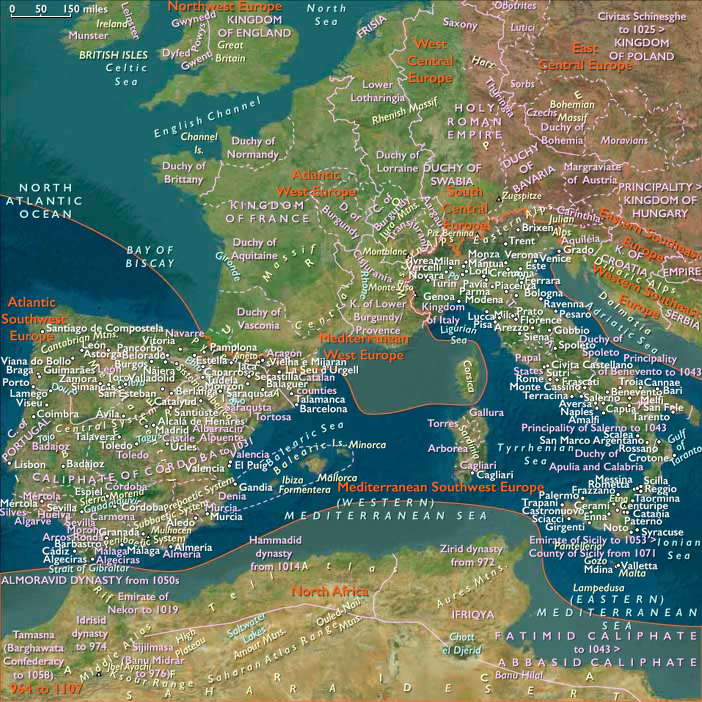
The two most prominent families to arrive in the Mediterranean are descendants of Tancred of Hauteville and of the Drengots, of whom Rainulf Drengot receives the county of Aversa, the first Norman toehold in the south, from Duke Sergius IV of Naples in 1030.
The Hautevilles achieve princely rank by proclaiming Prince Guaimar IV of Salerno "Duke of Apulia and Calabria".
He promptly awards their elected leader, William Iron Arm, with the title of count with his capital of Melfi.
Locations
People
Groups
- Christianity, Chalcedonian
- Greeks, Medieval (Byzantines)
- Sorrento, Duchy of
- Naples, Duchy of
- Papal States (Republic of St. Peter)
- Salerno, Lombard Principality of
- Roman Empire, Eastern: Macedonian dynasty
- Normans
- Amalfi, Duchy of
- German, or Ottonian (Roman) Empire
- Italy, Catepanate of
- Capua, Lombard Principality of
- Benevento, Lombard Duchy of
Topics
Commodoties
Subjects
Regions
Subregions
Related Events
Filter results
Showing 10 events out of 51548 total
The successors of Sviatoslav I of Kiev had succeeded in crushing Khazar power by 1010.
Although the Khazars continue to be mentioned in historical documents as late as the twelfth century, by 1030 their political role in the lands north of the Black Sea has greatly diminished.
(Despite the relatively high level of Khazar civilization and the wealth of data about the Khazars that is preserved in Eastern Roman and Arab sources, not a single line of the Khazar language has survived.
References to the Judaized Turkic Khazars become much more sparse after the fall of Khazaria.
Their ultimate fate as a people remains a mystery, although some clues point to their continuance among various Jewish, Muslim and Christian communities.
Some have speculated that the Mountain Jews of the eastern Caucasus are descended in part from the Khazars.
Various Turkic groups living in the North Caucasus today may be descended from Khazars who adopted Islam.
Abba Eban, Israel's foreign minister from 1966 to 1974, argued in his 1968 book My People that it is likely that “...Khazar progeny reached the various Slavic lands where they helped to build the great Jewish centers of Eastern Europe.”
Yaroslav, resuming his father’s advance in the west at the expense of the Lithuanians, Poles and Finns, establishes the town of Yurev (Dorpat), using it as a base to secure Novgorodian control over the southern littoral of the Gulf of Finland.
A settlement had been established on the site of the current Kaunas old town at the confluence of two large rivers, at least by the tenth century CE.
It is believed the town was founded in 1030, but it is first mentioned in written sources in 1361.
Kaunas is today the second-largest city in Lithuania.
Olaf, returning with an army in a bid to regain his Norwegian throne, is killed on July 29, 1030, at the Battle of Stiklestad, his forces defeated by a "Peasant Army" of rival nobles, wealthy farmers and others loyal to Cnut the Great.
Bezprym is the only child of Boleslaw I the Brave born from his second marriage with an unknown Hungarian princess, who, in older literature, was identified as Judith, daughter of Géza, Grand Duke of Hungary.
Though opinions vary about the identity of Boleslaw’s second wife, there is a number of researchers still support the hypothesis of her being the daughter of Géza.
The marriage of Bezprym’s parents had ended soon after his birth, probably because of the deterioration in political relations between Poland and Hungary.
Bezprym's mother had been repudiated and sent away, although probably she remained in Poland and died soon afterwards.
Shortly after Boleslaw’s divorce, he had remarried with Emnilda, who has borne him five children.
The eldest son of this union, the future Mieszko II Lambert, was born in 990.
Almost nothing is known about Bezprym's first years of life in contrast with his half-brother Mieszko II, whose youth is fully described in several contemporary sources.
This probably shows that his father disliked him and considered Mieszko II as his successor since his birth, which was already confirmed by Boleslaw’s later political activity.
Bezprym was destined to a Church career, a fact demonstrated in the Vita of St. Saint Romuald, a hermit from Ravenna.
There it is stated that in one of the hermitages resided a son of a Polish Duke, who in 1001 gave him a horse.
According to modern historians, this Polish prince could only be Bezprym.
In earlier historiography, it was theorized that the Polish prince who lived in the hermitage of Ravenna was Lambert, son of Mieszko I or an unknown son of Boleslaw from his first marriage with the daughter of Rikdag, Margrave of Meissen.
It is possible that he was in Hungary and there he was appointed head of Veszprém and Zala county.
In this case the name "Veszprém" originated from his name.
This hypothesis proposed by a Hungarian researcher, is not accepted by Polish historians.
It is also probable that Bezprym was present at the coronation of his father as King of Poland in Gniezno Cathedral on April 25, 1025.
Probably after Mieszko II took control over the government of Poland, both Bezprym and his youngest half-brother Otto resided in Poland for a short time.
However, Mieszko had soon expelled Bezprym from the country.
He probably does the same with Otto in 1030, when he discovers that they are conspiring against him with the help of Emperor Conrad II.
Aleppo had been an imperial vassal since the days of Nikephoros II Phokas (r. 963–969), but already in the years before the death of Basil II (r. 976–1025), its emirs had begun to acknowledge the suzerainty of the Fatimid caliphs of Egypt.
After the overthrow of the Hamdanids in 1004, Aleppo had been ruled by several princes nominally subordinate to the Fatimids.
It was from these individuals that Salih ibn Mirdas had taken the town in 1024, by which time Constantinople’s influence over Aleppo and northern Syria in general had declined considerably.
When he died fighting the Fatimid governor of Damascus, al-Duzbari, five years later, his two sons Shibl al-Daula Nasr and Mu'izz al-Daula Thimal had succeeded him.
During an absence from the town, however, Thimal had been removed from power by his brother.
Nasr is hereafter the sole ruler of the Mirdasid territories.
Romanos III, despite his complete lack of military experience, is eager to emulate Basil's military successes, and in March 1030 he departs Constantinople, leading in person a campaign against Aleppo.
His army, some twenty thousand strong, contains many foreign mercenaries.
According to the Byzantine chroniclers, so confident was Romanos of his success that he prepared special crowns for his triumph to come, and staged a grandiose entry into Antioch.
Shibl al-Dawla Nasr, learning of the imperial army’ approach, sends envoys and offers to recognize imperial suzerainty and to restart the payment of tribute.
Romanos's generals counsel him to accept so as to avoid the hazards of campaigning in the arid Syrian desert in summer, especially as their troops are unaccustomed to such conditions and are encumbered by their heavy armor, but Romanos rejects their advice and leads his army towards Azaz.
The imperial troops set up a fortified camp near Azaz, and the Emperor dispatches the Excubitors, under their commander, the patrikios Leo Choirosphaktes, to reconnoiter the area.
Choirosphaktes is ambushed, however, and taken captive, while his men disperse.
This success encourages the Arabs, who begin to harass the imperial camp and prohibit the imperial troops from foraging.
As a result, the invading army begins to suffer from hunger and especially from thirst.
The patrikios Constantine Dalassenos now leads an attack against the Arabs, but is defeated, and flees back to the camp.
The invaders become demoralized, and an imperial council resolves to abandon the campaign and return to imperial territory.
Thus, in the next morning, August 10, 1030, the army departs its camp and makes for Antioch.
The besieging Arabs attack the retreating imperial army.
As most of the troops are too worn out from thirst and dysentery to fight, the imperial army breaks and flees.
Only the imperial bodyguard, the Hetaireia, holds firm, and their brave stand allows Romanos, who is nearly captured himself, to escape.
According to the report of Yahya of Antioch, however, the imperial army suffered remarkably little casualties.
The Arabs take great booty, including the entire imperial army's baggage train, which the army had abandoned in their hasty flight.
Among the spoils is the sumptuous imperial tent with its treasures, which allegedly had to be carried off on seventy camels.
Only the holy icon of the Theotokos, which the emperors habitually carry along on campaigns, has been saved.
The Ghaznavid Empire extends by 1030 from Ray in the west to Samarkand in the northeast, and from the Caspian Sea to the Yamuna.
Although his raids have carried his forces across the South Asia, only a portion of Punjab and Sindh in modern-day Pakistan come under his semi-permanent rule; Kashmir, the Doab, Rajasthan and Gujarat remain under the control of the local Rajput dynasties.
The booty brought back to Ghazni is enormous, and contemporary historians (e.g.
Abolfazl Beyhaghi, Ferdowsi) give descriptions of the magnificence of the capital, as well as of the conqueror's munificent support of literature.
He has transformed Ghazni, the first center of Persian literature, into one of the leading cities of Central Asia, patronizing scholars, establishing colleges, laying out gardens, and building mosques, palaces, and caravansaries.
He has patronized Ferdowsi to write the Shahnameh; and, after his expedition across the Gangetic plains in 1017, of Al-Biruni to compose his Tarikh Al-Hind in order to understand the Indians and their beliefs.
During his rule, universities have been founded to study various subjects such as mathematics, religion, the humanities, and medicine.
Islam is the main religion of his kingdom.
Persian, spoken in the empire, is made to the official language.
Sultan Mahmud, who had contracted malaria during his last invasion, dies in Ghazni at the age of fifty-nine on April 30, 1030.
The medical complication from malaria had caused lethal tuberculosis.
The Ghaznavid Empire will be ruled by his successors for one hundred and fifty-seven years.
Mohammad Ghaznavi, the younger of a set of twins, ascends the throne upon the death of his father Mahmud in 1030.
His uncle Yusuf Sebüktigin initially supported his coronation but later forms a confederacy supporting Mas'ud, the elder twin.
Mas'ud had proved himself a capable general during his father's time, annexing the provinces of Joorjistan, Tuburistan and the Persian portion for his father.
He had been appointed governor of Rayy, Isfahan, Balkh and Herat.
Upon his father's death, he gathers his supporters at Nishapur, where his captured brother is delivered to him, after which he is blinded and imprisoned.
“Ruodlieb,” a tale of the adventures of a young hero, exemplifies the transitional phase between Old High German and Middle High German.
A fragmentary romance in Latin verse written by an unknown southern German poet who flourished about 1030, its author is almost certainly a monk of the Bavarian abbey of Tegernsee.
The poem is one of the earliest German romances of knightly adventure, and its vivid picture of feudal manners gives it a certain value as a historical document.
The poet was probably an eyewitness of the episode (II.4231-5221) which represents the meeting of the Emperor Henry II (d. 1024) with Robert II of France (d. 1031) on the banks of the Meuse River in 1023.
Ruodlieb is left unfinished, and furthermore the manuscript is cut up and used for binding books, so that the fragments will be only gradually discovered (from 1807 onward) and pieced together.
Conrad II had in 1024 commissioned the construction of the Christian Western world's largest church, which is also meant to be his final resting place.
Construction begins in 1030 on the site of a former basilica which stood on an elevated plateau right by the Rhine but safe from high water.
Along with Santiago de Compostela (begun 1075), Cluny Abbey (Cluny III, begun 1085), and Durham Cathedral (begun 1093), it was the most ambitious project of the age.
The red sandstone for the building comes from the mountains of the Palatine Forest and is thought to have been shipped down the channeled Speyerbach, a stream running from the mountains into the Rhine at Speyer.
As with the earlier imperial cathedral at Mainz, the arcaded wall elevations and the articulated spaces introduced in the abbey churches will achieve the enormous scale characteristic of the Rhenish early Romanesque churches.
Multiple towers will make an appearance on the Speyer cathedral.
Years: 1030 - 1030
Locations
People
Groups
- Christianity, Chalcedonian
- Greeks, Medieval (Byzantines)
- Sorrento, Duchy of
- Naples, Duchy of
- Papal States (Republic of St. Peter)
- Salerno, Lombard Principality of
- Roman Empire, Eastern: Macedonian dynasty
- Normans
- Amalfi, Duchy of
- German, or Ottonian (Roman) Empire
- Italy, Catepanate of
- Capua, Lombard Principality of
- Benevento, Lombard Duchy of
