
The two groups of German "crusaders” that …
Years: 1230 - 1230
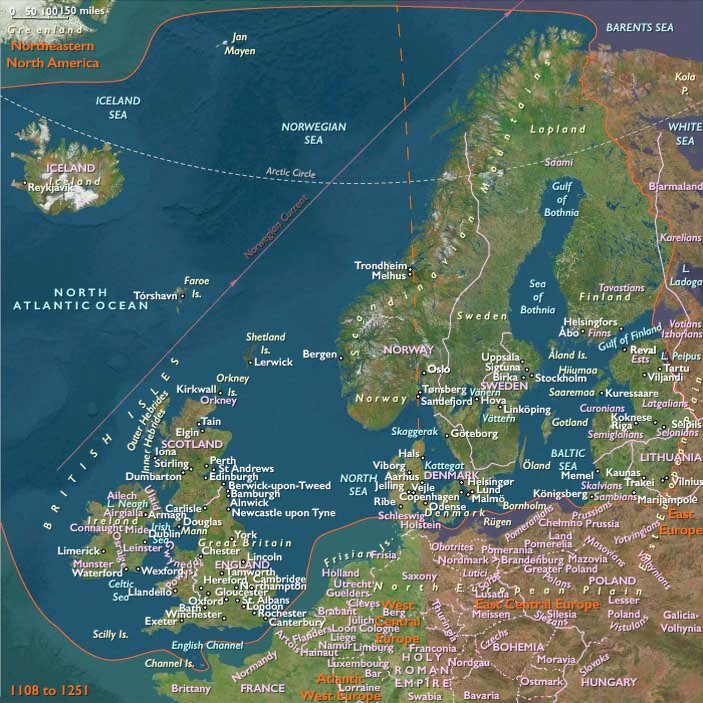
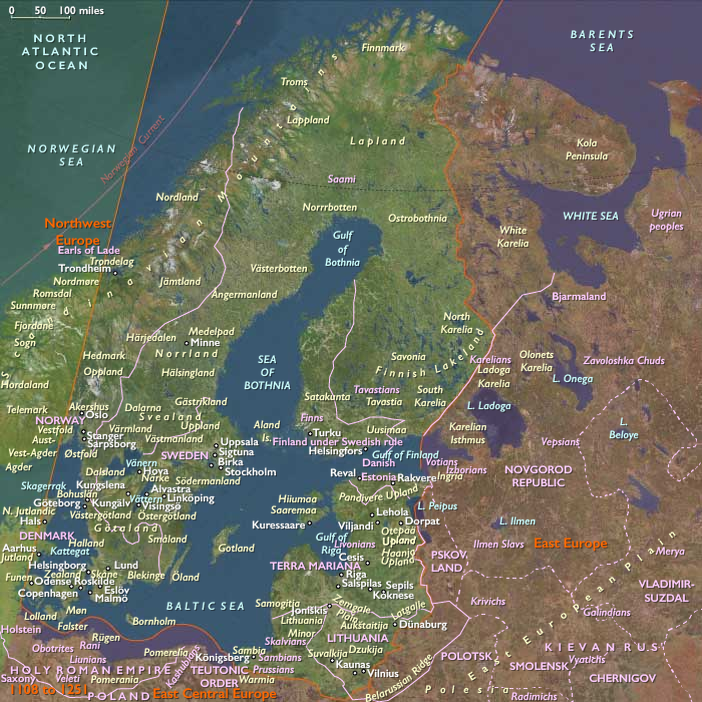
The two groups of German "crusaders” that set forth, under papal approval, to Christianize the pagan Balts (very often by sending them to their deaths), have largely succeeded by 1230.
The Teutonic Knights now fully occupy the valley of the lower Vistula, courtesy of the Polish princes.
The Knights of the Sword occupy the valley of the lower Dvina River.
Locations
People
Groups
- Polytheism (“paganism”)
- Prussians, Old, or Baltic (Western Balts)
- Papal States (Republic of St. Peter)
- Holy Roman Empire
- Christians, Roman Catholic
- Mazovia, Duchy of
- Poland during the period of fragmentation, Kingdom of
- Teutonic Knights of Acre (House of the Hospitalers of Saint Mary of the Teutons in Jerusalem)
Topics
- Crusades, The
- Ostsiedlung (German: Settlement in the East), a.k.a. German eastward expansion
- Northern Crusades, or Baltic Crusades
Commodoties
Subjects
Regions
Subregions
Related Events
Filter results
Showing 10 events out of 47040 total
The Sword Brethren had conquered the last indigenous stronghold on the Estonian island of Saaremaa in 1227.
After the conquest, all the remaining local pagans of Estonia are ostensibly Christianized.
An ecclesiastical state, Terra Mariana, has been established.
The conquerors exercises control through a network of strategically located castles.
Jena, a city in east central Germany, on the Saale River, was first mentioned in an 1182 document.
In the eleventh century it had been a possession of the lords of Lobdeburg but, in the following century, it developed into an independent market town with laws and magistrates of its own.
The local economy is based mainly on wine production.
The town receives a charter in 1230.
Wenceslaus had been crowned in February 1228 as co-ruler of the Kingdom of Bohemia with his father, Ottokar I.
On December 15, 1230, Ottokar dies and Wenceslaus succeeds him as the senior King of Bohemia.
One of the first instances of Mughal architecture in India, the minaret known as Qutb Minar, decorated with relief work and standing two hundred and forty feet (seventy-three meters) high, is erected near present New Delhi about 1230 to commemorate the military triumph of Qutb-ud-Din Aybak, founder of the Delhi Sultanate.
Made of fluted red sandstone covered with intricate carvings and verses from the Qur'an, construction was started in 1192 by Qutub-ud-din Aibak and is completed by Iltutmish.
Iltutmish also builds the Hauz-i-Shamsi reservoir in Delhi’s Mehrauli Disrtict.
Ferdinand III, king of Castile from 1217, inherits the neighboring kingdom of León at the death, in 1230, of his father, King Alfonso IX, and unites the two states as the kingdom of Leon and Castile.
A Christian zealot known as “the Saint,” Ferdinand inaugurates a military crusade to destroy the Moors in southern Spain.
The University of Orléans and the Parisian Academic Crisis (1230 CE)
In 1230, a major academic dispute in Paris led to the temporary dispersal of scholars from the University of Paris, with many professors and students seeking refuge in Orléans. This migration is considered the beginning of the University of Orléans, which would later become one of the leading centers for legal studies in medieval Europe.
Background: The 1230 Academic Crisis in Paris
- The University of Paris was the most prestigious center of theology, philosophy, and liberal arts in medieval Europe, but it often faced tensions with both ecclesiastical and secular authorities.
- In 1230, the university was affected by a dispute between the teaching faculty and the Church, possibly related to:
- Conflicts over academic freedoms and privileges.
- Tensions with Pope Gregory IX, who was involved in regulating university affairs.
- Political struggles between the French monarchy and clerical institutions.
- As a result, many Parisian scholars left the city and found refuge in Orléans.
The Birth of the University of Orléans
- The displaced scholars established a new center of learning in Orléans, which gradually developed into a full-fledged university.
- Over time, the University of Orléans specialized in legal studies, particularly in:
- Civil law (Roman law).
- Canon law (Church law).
- It became one of the great centers of medieval jurisprudence, second only to the University of Bologna in Italy.
Legacy and Impact
- The academic crisis of 1230 indirectly led to the diversification of university education in France, spreading learning beyond Paris.
- The University of Orléans flourished, attracting students from across Europe, including many future legal scholars and statesmen.
- The university played a crucial role in the development of medieval and Renaissance legal traditions, influencing French and European legal systems for centuries.
The scattering of Parisian scholars in 1230 ultimately led to the founding of the University of Orléans, shaping the intellectual and legal history of medieval France.
The "Visitation" Sculpture Group at Reims Cathedral (c. 1230): A Masterpiece of Gothic Classicism
The "Visitation" sculpture group, created around 1230 for the west-central portal of Reims Cathedral, marks a mature stage in the development of Gothic classicism. It exemplifies how Gothic sculpture evolved beyond rigid columnar figures, embracing greater grace, movement, and human expression while drawing from classical influences.
The Classicizing Style in Gothic Sculpture
- By the early 13th century, Gothic sculpture had begun to break free from the constraints of the columnar form, allowing for greater naturalism and spatial interaction between figures.
- The Visitation group is a prime example of this maturation, displaying:
- Sinuous and flowing drapery, emphasizing movement and volume.
- Contrapposto poses, inspired by Greco-Roman statuary, creating a sense of lifelike interaction between the figures.
- Expressive faces, conveying the human emotion of the biblical encounter between Mary and her cousin Elizabeth.
Analysis of the Virgin in the "Visitation"
- The Virgin Mary, depicted veiled like a Roman matron, is one of the most classical figures in Gothic sculpture.
- Her pose suggests contrapposto, a feature of ancient Greek and Roman sculpture, where weight shifts naturally onto one leg, enhancing realism.
- However, her gracefully curving sway is distinctly Gothic, departing from the static balance of classical art and instead conveying a sense of spiritual movement.
Impact and Legacy
- The "Visitation" group at Reims represents one of the finest examples of Gothic classicism, demonstrating how sculptors combined classical traditions with Gothic ideals of expressiveness and movement.
- It influenced later High Gothic sculpture, including figural programs at Amiens and Chartres Cathedrals.
- This shift in sculptural style paralleled architectural innovations of the Gothic period, emphasizing openness, fluidity, and interaction with light.
The "Visitation" at Reims Cathedral (c. 1230) is a landmark in medieval sculpture, illustrating the harmonious blend of classical elegance and Gothic dynamism, defining the artistic achievements of the 13th century.
The North Transept Portal Statuary of Chartres Cathedral (c. 1230): A Transition from Romanesque to Gothic
The statuary group for the north transept portal of Chartres Cathedral, completed around 1230, exemplifies the gradual transition from the Romanesque to the Gothic style in medieval sculpture. While the figural composition retains some Romanesque rigidity, the expressive individualism of the faces signals the emerging Gothic aesthetic.
Romanesque Features
- The figures remain largely columnar, maintaining rigid postures characteristic of Romanesque sculptural conventions.
- Their gestures are stiff and formal, lacking the fluidity and movement that would later define fully mature Gothic sculpture.
- The vertical elongation of the figures, while imposing, still conveys a sense of stylization over naturalism.
Gothic Elements: Expressive and Individualized Faces
- The faces of Saint John the Baptist, Saint Peter, Isaiah, Jeremiah, and Simeon show a striking new level of individuality.
- Their expressions are more naturalistic, suggesting introspection, wisdom, or emotional depth.
- This greater attention to psychological realism marks a shift toward humanizing sacred figures, a defining characteristic of Gothic art.
Significance of the North Transept Portal Sculptures
- The portal serves as a transitional moment in medieval sculpture, reflecting the artistic evolution of the early 13th century.
- It mirrors broader Gothic architectural innovations, as cathedrals became more open, luminous, and organic in form.
- The statuary’s fusion of Romanesque structure and Gothic expressiveness influenced later sculptural programs, particularly at Amiens, Reims, and Bourges Cathedrals.
The north transept portal of Chartres Cathedral (c. 1230) represents a pivotal moment in Gothic art, where rigid Romanesque conventions gave way to a newfound Gothic naturalism, foreshadowing the fully developed Gothic sculpture of later cathedrals.
Blanche of Castile Repels the English Invasion of 1230
In 1230, Blanche of Castile, the Queen Mother and regent of France, successfully defended the kingdom against an invasion led by Henry III of England, ensuring the continued strength of the Capetian monarchy.
Background: The English Invasion of 1230
- Since the Treaty of Paris (1229) had brought an end to the Albigensian Crusade, Capetian France had consolidated its control over Languedoc.
- Henry III of England, seeking to recover lost Angevin territories, launched an expedition to Brittany in May 1230.
- With Louis IX still a minor, Henry believed that France under Blanche’s regency would be vulnerable, offering an opportunity to regain Poitou and Normandy.
Blanche’s Strategy and French Resistance
- Blanche of Castile took decisive action, mobilizing the French royal army to counter the English threat.
- Instead of engaging Henry III in open battle, she adopted a defensive strategy, refusing direct confrontation and avoiding unnecessary risks.
- She secured the loyalty of French vassals and cut off English supply lines, making it difficult for Henry to advance into the interior.
- By late 1230, the English failed to gain any significant territory and were forced to retreat, abandoning the campaign.
Consequences of Blanche’s Victory
- Blanche’s leadership solidified Capetian control over western France, preventing any major territorial losses to England.
- Henry III’s failed campaign further weakened English influence on the Continent, leaving England in a weakened position for future conflicts.
- Blanche’s successful defense of the kingdom strengthened her authority, reinforcing her role as a powerful regent for her son, Louis IX (Saint Louis).
Blanche of Castile’s defense against the English invasion of 1230 demonstrated her exceptional political and military leadership, ensuring that France remained strong and united during the minority of Louis IX.
Johannes de Sacrobosco and Tractatus de Sphaera (c. 1230): The Foundational Astronomy Text of the Middle Ages
Around 1230, Johannes de Sacrobosco (John of Holywood), a scholar at the University of Paris, wrote Tractatus de Sphaera (Treatise on the Sphere), a seminal text on elementary astronomy. This work became the standard introduction to astronomy in medieval Europe, widely used in universities for centuries.
Content and Structure of Tractatus de Sphaera
- The treatise focuses on spherical astronomy, which describes the motions of celestial bodies as seen from Earth, within the framework of the Ptolemaic geocentric system.
- It is divided into four main sections, covering:
- The Spherical Nature of the Earth – Sacrobosco argues for a spherical Earth, a concept widely accepted by educated medieval scholars.
- The Celestial Sphere – Explanation of the fixed stars and planetary movements relative to Earth.
- The Rising and Setting of Stars – How different stars and planets are visible from different locations on Earth.
- The Zones of the Earth – A discussion of climatic zones, reinforcing the idea of a structured and ordered universe.
Scientific Framework and Influence
- Sacrobosco's treatise was based on Ptolemaic cosmology, which placed the Earth at the center of the universe, with the heavens moving in perfect spheres around it.
- The text incorporated ancient Greek and Arabic astronomical knowledge, drawing from sources such as Ptolemy’s Almagest and Islamic scholars like Al-Farghani.
- It became the standard astronomical textbook in European universities well into the 16th century, influencing thinkers like Copernicus, Tycho Brahe, and Kepler.
Legacy of Tractatus de Sphaera
- It remained the most widely used introductory astronomy text for over three centuries.
- Despite its geocentric model, it helped prepare scholars for later developments, including the eventual Copernican Revolution.
- The work was widely copied and printed, ensuring its long-lasting impact on medieval and Renaissance astronomy.
Sacrobosco’s Tractatus de Sphaera (c. 1230) represents a milestone in medieval science, blending classical and Islamic astronomical knowledge to shape the European understanding of the cosmos for generations.
Years: 1230 - 1230
Locations
People
Groups
- Polytheism (“paganism”)
- Prussians, Old, or Baltic (Western Balts)
- Papal States (Republic of St. Peter)
- Holy Roman Empire
- Christians, Roman Catholic
- Mazovia, Duchy of
- Poland during the period of fragmentation, Kingdom of
- Teutonic Knights of Acre (House of the Hospitalers of Saint Mary of the Teutons in Jerusalem)
Topics
- Crusades, The
- Ostsiedlung (German: Settlement in the East), a.k.a. German eastward expansion
- Northern Crusades, or Baltic Crusades
