
The two forces meet on November 1 …
Years: 82BCE - 82BCE
November
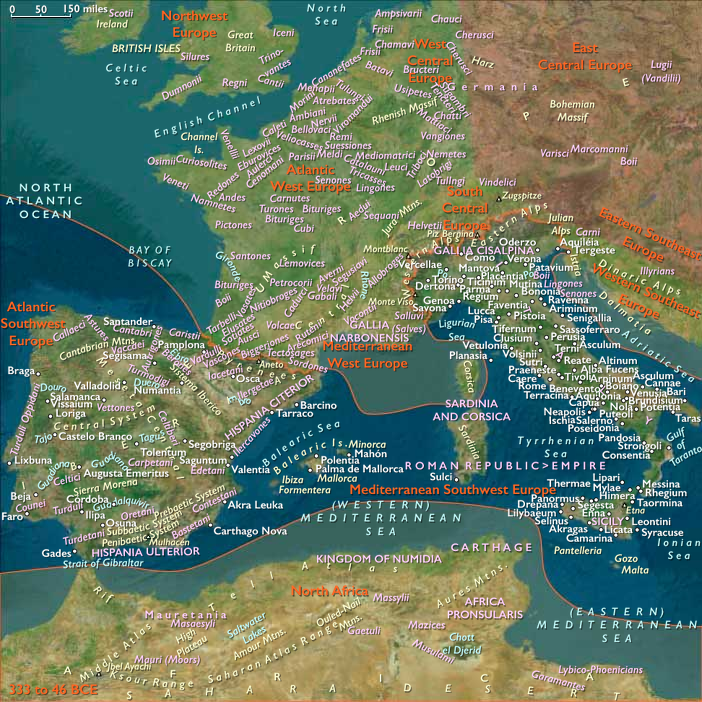
The two forces meet on November 1 of 82 BCE, at the battle of the Colline Gate, just outside of Rome.
The battle is a huge and desperate final struggle with both sides certainly believing their own victory will save Rome.
Sulla is pushed hard on his left flank with the situation so dangerous that he and his men are pushed right up against the city walls.
Crassus' forces, fighting on Sulla's right, however, manage to turn the opposition's flank and drive them back.
The Samnites and the Marian forces fold up and break.
In the end, over fifty thousand combatants lose their lives and Sulla stands alone as the master of Rome.
Having observed the violent results of radical popular reforms, Sulla is naturally conservative.
As such, he seeks to strengthen the aristocracy, and by extension the Senate.
At the end of 82 BCE or the beginning of 81 BCE, the Senate appoints Sulla dictator legibus faciendis et reipublicae constituendae causa ("dictator for the making of laws and for the settling of the constitution").
The decision is subsequently ratified by the "Assembly of the People", with no limit set on his time in office.
Sulla has total control of the city and republic of Rome, except for Hispania (which Marius's general Quintus Sertorius has established as an independent state).
This unusual appointment (used hitherto only in times of extreme danger to the city, such as the Second Punic War, and then only for six-month periods) represents an exception to Rome's policy of not giving total power to a single individual.
Sulla can be seen as setting the precedent for Julius Caesar's dictatorship, and the eventual end of the Republic under Augustus.
Locations
People
- Gaius Marius the Younger
- Gaius Papirius Carbo (tribune 90 BCE)
- Gnaeus Papirius Carbo
- Lucius Cornelius Sulla
- Lucius Domitius Ahenobarbus (consul 94 BCE)
- Marcus Licinius Crassus
- Pompey
- Publius Antistius
- Quintus Caecilius Metellus Pius
- Quintus Mucius Scaevola Pontifex
Groups
Topics
Commodoties
Subjects
Regions
Subregions
Related Events
Showing 10 events out of 62760 total
Years: 82BCE - 82BCE
November
Locations
People
- Gaius Marius the Younger
- Gaius Papirius Carbo (tribune 90 BCE)
- Gnaeus Papirius Carbo
- Lucius Cornelius Sulla
- Lucius Domitius Ahenobarbus (consul 94 BCE)
- Marcus Licinius Crassus
- Pompey
- Publius Antistius
- Quintus Caecilius Metellus Pius
- Quintus Mucius Scaevola Pontifex
Groups
Topics
Commodoties
Subjects
Regions
Subregions