
...the two armies approach each other near …
Years: 1578 - 1578
August
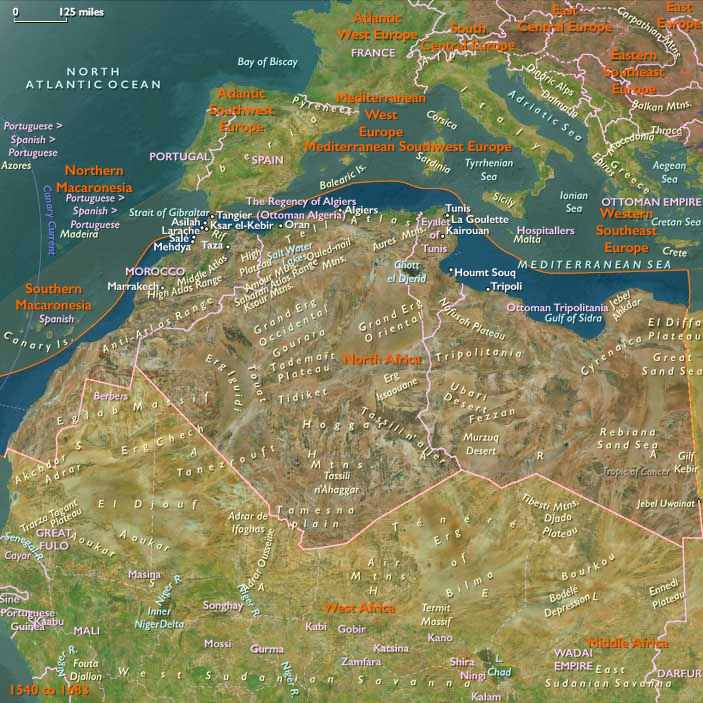
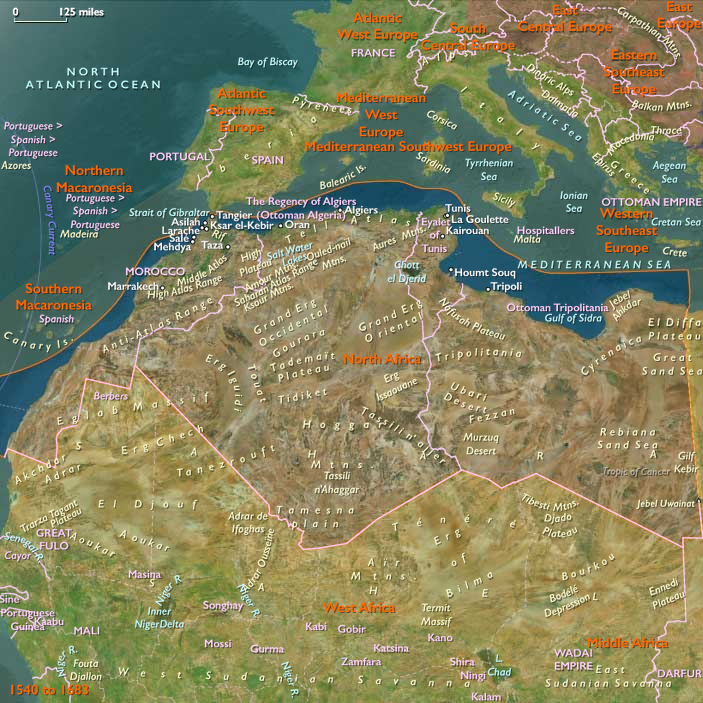
...the two armies approach each other near Alcazarquivir, “The Great Fortress,” camping on opposite sides of the Loukkos, or Lucus, River.
The Emir, although he has obvious superiority in numbers, again attempts to negotiate a peace, but without success.
Sebastian's army is low on provisions and in a poor tactical position as the Moors have occupied all the surrounding high ground, but he will not be persuaded to temporize or withdraw, even by Mulay Mohammed.
The Portuguese troops are drawn up in battle array on August 4, and Sebastian rides around encouraging the ranks.
The Moors advance on a broad front and encircle his army.
The Emir has ten thousand cavalry on the wings, and in the center he has placed Moors who had been driven out of Spain and thus bear a special grudge against Christians.
The Emir leaves his litter despite his illness, and leads his forces on horseback.
The ensuing battle ends in the total defeat of the Portuguese, with eight thousand dead, including the slaughter of almost the whole of the country’s nobility, and fifteen thousand taken prisoner; perhaps a hundred survivors escape to the coast.
Stukley, commanding the Portuguese center, is killed early in the day after a cannonball cuts off his legs.
Tradition asserts that he had been murdered by his Italian soldiers after the Portuguese had been defeated.
The body of King Sebastian, who had led a charge into the midst of the enemy and was then cut off, is never found.
The Emir Abd Al-Malik also dies during the battle, but from natural causes (the effort of riding had been too much for him), and the news is concealed from his troops until total victory has been secured.
Mulay Mohammed attempts to flee but is drowned in the river.
For this reason, the battle is known in Morocco as the Battle of the Three Kings.
Abd Al-Malik is succeeded as Emir by his brother Ahmad al-Mansur, also known as Ahmed Saali, who obtains great wealth for his lands through the ransoms of the Portuguese prisoners.
Locations
People
Groups
Topics
Commodoties
Subjects
Regions
Subregions
Years: 1578 - 1578
August
Locations
People
Groups
Topics
Commodoties
Subjects
Regions
Subregions