
The twelve-year-old Peter II of Russia now …
Years: 1728 - 1728
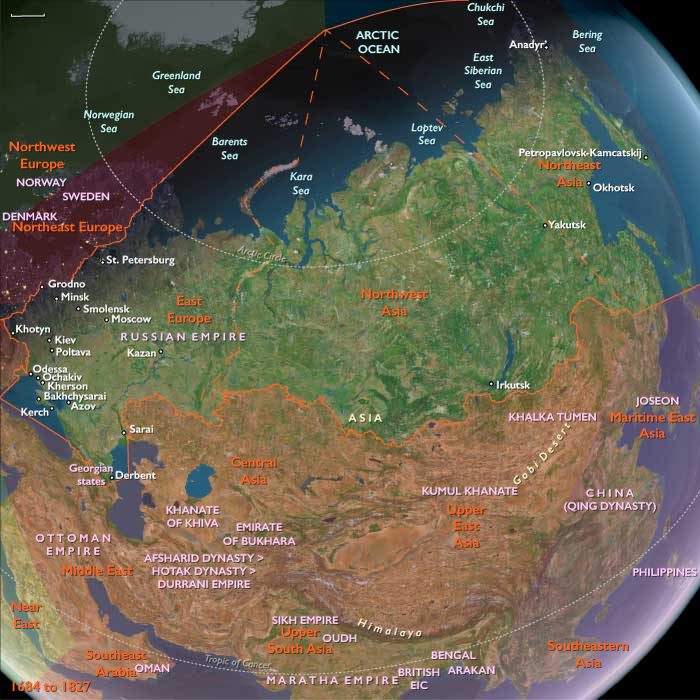
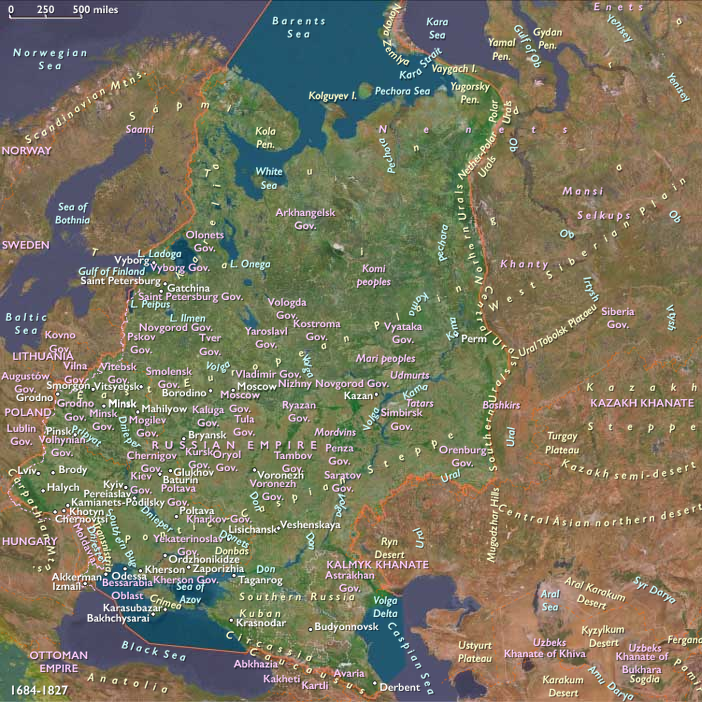
The twelve-year-old Peter II of Russia now falls into the hands of the equally unscrupulous Prince Vasily Lukich Dolgorukov, who carries him away from Petersburg to Moscow, where Peter's coronation is celebrated on February 25, 1728.
As the conservative influences prevail among its members, the Council—although nominally a consultative body—monopolizes supreme power and has the imperial capital moved back to Moscow.
The collegiums (i.e., ministries) and the Senate, instituted by Peter I as supreme governing bodies, are no longer called "governing" and are held accountable before the Council rather than the Emperor.
Locations
People
- Charles VI, Holy Roman Emperor, King of the Romans (King of Germany)
- Dmitry Mikhaylovich Galitzine
- Elizabeth of Russia
- Peter II of Russia
- Vasiliy Lukich Dolgorukov
Groups
Subjects
Regions
Subregions
Related Events
Filter results
Showing 10 events out of 27740 total
The first years of Yongzheng's reign have been spent consolidating his power.
He has imprisoned or executed some of his brothers and their supporters and undermined the power of the others.
Longkedo, for example, is disgraced and executed in 1728 for reasons that remain shrouded in mystery.
Yongzheng's espionage system is so efficient that every action of his ministers is said to have been reported to him.
He even tampers with the imperial records from the last years of his father's reign and the first years of his own, ordering the suppression of any accounts unfavorable to himself or favorable to his opponents.
More significant is his removal of the Imperial princes from control of the Eight Banners, the major Qing military units.
When the Yongzheng emperor had ascended the throne, three of the Eight Banners had been controlled directly by the throne, but the rest had been under the rule of Qing princes.
Fearing that they could use this control for personal advantage—as the Yongzheng emperor had done in his own ascension to the throne—he compels all the princes to attend a special palace school, where they are indoctrinated with the idea of subservience to the throne.
As a result, the Eight Banners will remain loyal throughout the existence of the dynasty.
The largest fire in the history of Copenhagen begins on the evening of October 20, 1728, and continues to burn until the morning of October 23.
It destroys approximately twenty-eight of the Danish capital (measured by counting the number of destroyed lots from the cadastre), leaves twenty percent of the population homeless, and the reconstruction will last until 1737.
No less than forty-seven percent of the old section of the city, which dates back to the Middle Ages, is completely lost (and along with the Copenhagen Fire of 1795, it is the main reason that few traces of medieval Copenhagen can be found in the modern city).
Although the number of dead and wounded is relatively low compared to the extent of the fire, the cultural losses are huge.
In addition to several private book collections, thirty-five thousand texts including a large number of unique works have been lost with the University of Copenhagen library, and at the observatory on top of Rundetårn, instruments and records made by Tycho Brahe and Ole Rømer have been destroyed.
Johann Michael Rottmayr has brought the Italian Renaissance north of the Alps, just as Hans Adam Weissenkircher had brought to the southern Alps and the court of the Princes of Eggenberg in Graz.
Rottmayr has worked from 1689 onward in Salzburg, where he is employed as the general painter of the Prince-Bishop of Salzburg.
Born in Laufen an der Salzach, Salzburg, now Germany, he had received his education from Johann Carl Loth in Venice, along with his Laufen-born contemporary, Weissenkircher.
Maratha King Shahu had appointed Balaji Vishwanath as his Peshwa or Prime Minister in 1713.
Balaji had managed within the ensuing decade, to extract a significant amount of territory and wealth from the fragmenting Mughal Empire.
Baji Rao, the son of the first Bhat family Peshwa, Balaji Vishwanath, was at the age of twenty ppointed by Chhattrapati Shahu as Peshwa upon the death of his father, setting aside all other claimants.
The Mughal Emperor Muhammad Shah in October 1724 had appointed Nizam-ul-Mulk as the Governor of Deccan.
The Nizam had set about strengthening the province by attempting to control the growing influence of the Marathas.
He has utilized a growing polarization in the Maratha Empire due to the claim of the title of King by both Shahu and Sambhaji II of Kolhapur.
The Nizam has begun supporting the Sambhaji faction, thus enraging Shahu, who has been proclaimed as King.
The Nizam further decides to halt the payment of the chauth, twenty-five percent of the revenue being given by many landowners of the Deccan province to the Marathas, as had been agreed by the Sayyid brothers in 1719.
The withdrawal of Baji Rao’s army from the southern reaches of the Maratha empire during May 1727 is followed by Shahu’s breaking off negotiations with the Nizam-ul-Mulk concerning restoration of the chauth.
The Nizam pursues Baji Rao's army around the vicinity of Pune for about six months, where Baji Rao executes a series of thrust and parry moves to finally corner the Nizam at Palkhed.
Defeated, the NIzam signs a peace treaty on March 6, 1728, at the village of Mungi-Paithan.
By the treaty of Munji Shivagaon, the Nizam is forced to recognize Chhatrapati Shahu as the only Maratha ruler, and to recognize Maratha authority to collect from the Deccan chauth and sardeshmukhi—an additional ten per cent levy on top of the chauth, a tribute paid to the king—of the Deccan.
Those revenue collectors driven out are to be reappointed, and the balance of the revenue owed is to be paid to Chhatrapati Shahu.
No more hostilities have taken place between Britain and Spain following the failed siege of Gibraltar.
A truce is declared in February 1728, with a preliminary agreement of issues at the March Convention of El Pardo and ...
Jean Siméon Chardin was born in Paris, the son of a cabinetmaker, and rarely left the city.
He will live on the Left Bank near Saint-Sulpice until 1757, when Louis XV grants him a studio and living quarters in the Louvre.
Chardin had entered into a marriage contract with Marguerite Saintard in 1723, whom he will not marry until 1731.
He serves apprenticeships with the history painters Pierre-Jacques Cazes and Noël-Nicolas Coypel, and in 1724 became a master in the Académie de Saint-Luc.
According to one nineteenth-century writer, at a time when it was hard for unknown painters to come to the attention of the Royal Academy, he first found notice by displaying a painting at the "small Corpus Christi" (held eight days after the regular one) on the Place Dauphine (by the Pont Neuf).
Van Loo, passing by in 1720, bought it and later assisted the young painter. (Édouard Fournier, Histoire du Pont-Neuf, 1862)
Upon presentation of The Ray in 1728, he was admitted to the Académie Royale de Peinture et de Sculpture.
The Ray, hung from a chain and gutted, reads like a Crucifixion.
Jean-Philippe Rameau, a composer in the French Baroque style, has written three books of Pièces de clavecin for the harpsichord.
The first, Premier Livre de Pièces de Clavecin, was published in 1706; the second, Pièces de Clavessin, in 1724; and the third, Nouvelles Suites de Pièces de Clavecin, in 1726 or 1727.
Use of opium as a cure-all is reflected in the formulation of mithridatium, described in Ephraim Chambers’ 1728 Cyclopaedia, or an Universal Dictionary of Arts and Sciences, which includes true opium in the mixture.
Subsequently, laudanum, also known as Tincture of Opium, is to become the basis of many popular patent medicines of the nineteenth century.
Voltaire, during a stay that has lasted more than two years, has succeeded in learning the English language; he writes his notebooks in English and to the end of his life will be able to speak and write it fluently.
He has met such English men of letters as Alexander Pope, Jonathan Swift, and William Congreve, the philosopher George Berkeley, and Samuel Clarke, the theologian.
He has been presented at court, and he has dedicated his Henriade to Queen Caroline.
Though at first he had been patronized by Bolingbroke, who had returned from exile, it appears that he had quarreled with the Tory leader and turned to Sir Robert Walpole and the liberal Whigs.
He admires the liberalism of English institutions, though he is shocked by the partisan violence.
He envies English intrepidity in the discussion of religious and philosophic questions and is particularly interested in the Quakers.
He is convinced that it is because of their personal liberty that the English, notably Sir Isaac Newton and John Locke, were in the forefront of scientific thought.
He believes that this nation of merchants and sailors owed its victories over Louis XIV to its economic advantages.
He concludes that even in literature, France has something to learn from England; his experience of Shakespearean theater is overwhelming, and, however much he is shocked by the “barbarism” of the productions, he is struck by the energy of the characters and the dramatic force of the plots.
Years: 1728 - 1728
Locations
People
- Charles VI, Holy Roman Emperor, King of the Romans (King of Germany)
- Dmitry Mikhaylovich Galitzine
- Elizabeth of Russia
- Peter II of Russia
- Vasiliy Lukich Dolgorukov
