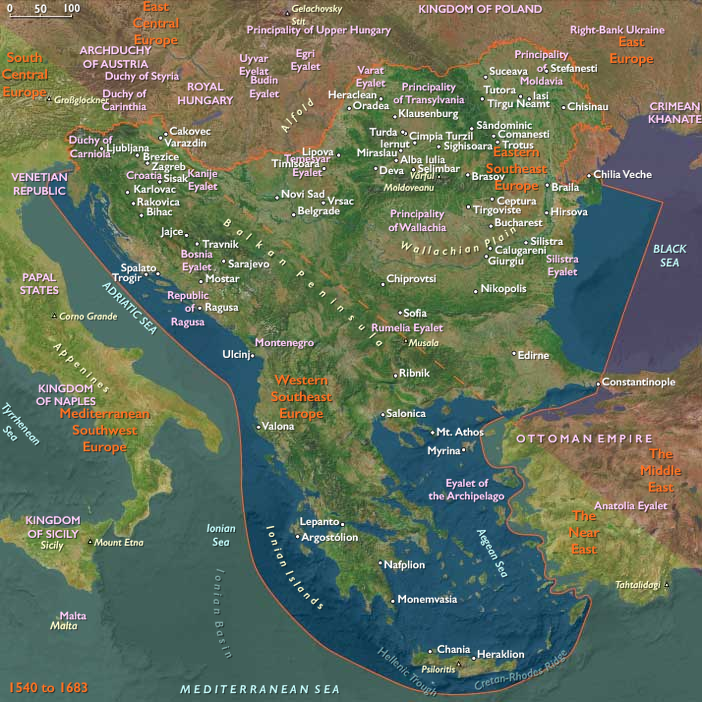
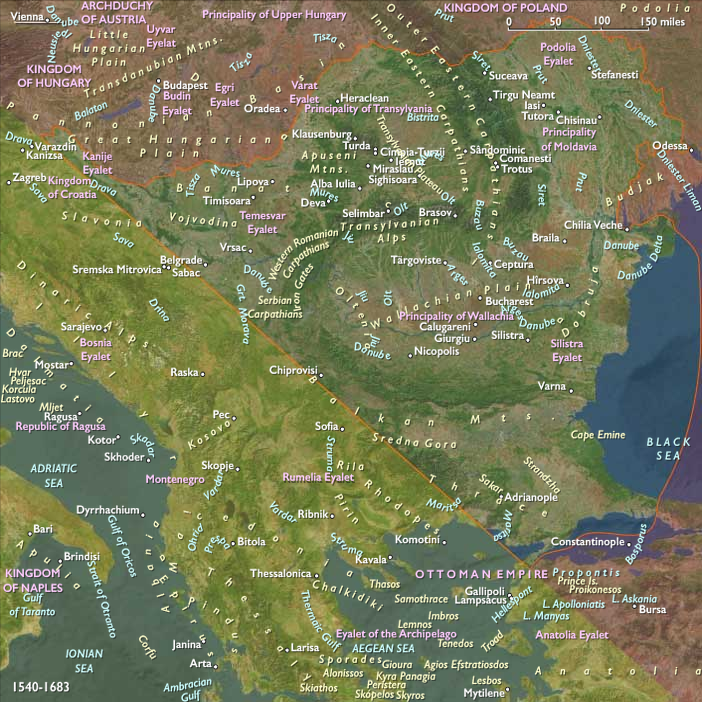
The Turks have arranged for the election …
Years: 1661 - 1661
September
The Turks have arranged for the election of Mihály Apafi as prince.
Kemény, initially supported by Imperial general Raimondo Montecuccoli, returns to Transylvania in early September.
The Austrian army soon deserts him, however.
Locations
People
Groups
- Ottoman Empire
- Hungary, Royal
- Transylvania (Ottoman vassal), Principality of
- Habsburg Monarchy, or Empire
Topics
Commodoties
Subjects
Regions
Subregions
Related Events
Filter results
Showing 10 events out of 31161 total
Johan Palmstruch had in 1657 founded Stockholms Banco, a predecessor of the Bank of Sweden.
Palmstruch's first major innovation in combining the exchange bank and the loans bank was to use the money deposited by account holders to finance the loans rather than requiring capital to be provided by himself or the other bank owners.
This soon became a problem, however, as deposits were usually short-term and the loans long-term, meaning that deposited money was unavailable to be withdrawn by account holders.
This problem had been rendered more acute when the copper content of the coins was lowered seventeen percent in 1660 as account holders demanded the return of the copper daler they had deposited since they were now worth more as metal than as coins.
It was impossible for the bank to fulfill these requests as the money had been paid out as loans.
Palmstruch's second major innovation is the introduction of paper banknotes as a solution to the bank's problems balancing deposits and loans.
To cover the amounts requested by the account holders, in 1661 he begins to make out credit notes (Kreditivsedlar) in round denominations which are freely transferable and backed by the promise of future payment in metal.
These, the first European banknotes, become very popular very quickly simply because they are much easier to carry than the large copper daler, especially for making large payments (a note could be sent in an envelope—previously the large coins had to be transported by horse and cart).
A further reason is that when the amount of copper in the coins was reduced the old coins were taken out of circulation faster than new ones could be minted, meaning that there was a shortage of money which could only be solved by replacing the coins with banknotes.
Afanasy Lavrentyevich Ordyn-Nashchokin, the son of a petty landowner, had received a good education in the relatively cosmopolitan environment of Pskov.
During the reign of Michael (ruled 1613–45), he had participated in the work of ambassadorial commissions that defined the Russo-Swedish borders and gained a reputation as a talented administrator.
He served in 1656–58 has the virtual ruler of all the Livonian lands recently seized by Russia from Poland-Lithuania.
The experience Ordyn-Nashchokin acquired in dealing with Sweden at this time had persuaded him that Russia should seek to become a maritime power with a Baltic seaboard.
Since Russia could not simultaneously contend for Livonia against Sweden and for Ukraine against Poland, he recommended peace with Poland even at the price of losing Ukraine.
Alexis, however, overrules his plan; he concludes the Treaty of Kardis, a peace settlement made in 1661 between the Tsardom of Russia and the Swedish Empire that formally ends the Russo–Swedish War (1656–1658) and restores the prewar territorial distribution.
Russia surrenders to Sweden all captured territories.
Moreover, all vessels constructed at Tsarevich-Dmitriev are destroyed (the vessels had been constructed in a shipyard founded by Ordyn-Nashchokin).
Overall, the Peace of Kardis maintains the territorial accords of the Treaty of Stolbovo.
The Church of Saint Andrew's at the Quirinal (Italian: Sant'Andrea al Quirinale, Latin: S. Andreae in Quirinali), a Roman Catholic titular church in Rome, is built for of the Jesuit seminary on the Quirinal Hill.
The site had previously accommodated a sixteenth century church, Sant'Andrea a Montecavallo.
Commissioned by Cardinal Camillo Francesco Maria Pamphili, with the approval of Pope Alexander VII, Sant'Andrea is the third Jesuit church constructed in Rome, after the Church of the Gesù and Sant'Ignazio.
It is to serve the Jesuit novitiate, which had been founded in 1566.
An important example of Roman Baroque architecture, Sant'Andrea has been designed by Gian Lorenzo Bernini with Giovanni de'Rossi.
Bernini had received the commission in 1658 and the church is constructed by 1661, although the interior decoration will not be finished until 1670.
Bernini considers the church one of his most perfect works; his son, Domenico, will recall that in his later years, Bernini spent hours sitting inside it, appreciating what he had achieved.
The main façade of the church faces onto the Via del Quirinale (formerly the Via Pia), as does Borromini's San Carlo alle Quattro Fontane further down the road.
Unlike San Carlo, Sant’Andrea is set back from the street and the space outside the church is enclosed by low curved quadrant walls.
An oval cylinder encases the dome, and large volutes transfer the lateral thrust.
The main façade to the street has an aedicular pedimented frame at the center of which a semicircular porch with two Ionic columns marks the main entrance.
Above the porch entablature is the heraldic coat of arms of the Pamphili patron.

Vermeer produces transparent colors by applying paint to the canvas in loosely granular layers, a technique called pointillé (not to be confused with pointillism).
View of Delft, painted around 1660-1661, is among his most popular.
Painted at a time when cityscapes are not commonplace, it is one of three known paintings of Delft by Vermeer, along with The Little Street and the lost painting House Standing in Delft.
The use of pointillé in the work suggests it postdates The Little Street.
The customary ration for servants at this time includes meat three times a week.
When a planter named Major Goodwin decided to keep his servants on a diet of cornbread and water, discontent followed.
Leaders of the servants named Isaac Friend and William Cluton determine to petition the king for redress.
Isaac Friend escapes punishment as well.
The court admonishes the masters and magistrates to keep a close watch on their servants.
The Susquehannocks, an Iroquoian-speaking tribe living in the vicinity of the lower Susquehannock River valley near present-day Lancaster, Pennsylvania, had in 1658 used their influence with the Esopus tribe to end the Esopus Wars because the conflict interfered with the important fur trade with the Dutch of New Netherland.
The Susquehannocks have been at war with the Iroquois since 1658.
Maryland's treaty of peace is expanded by 1661, to a full alliance between the Maryland colonists and the Susquehannocks against the Iroquois, the English having grown fearful of the Iroquois and hopeful that an alliance with the Susqehannocks would help block the northern tribes' advance on the English colonies.
Besides goods and arms, fifty Englishmen are assigned to the Susquehannocks to guard their fort.
An attack on Montrèal by two hundred and fifty Iroquois warriors in 1661 yields ten French captives.
Kemény is elected prince by the rebellious Transylvanian Diet on January 1, 1661, after Ákos Barcsai, backed up by the Turks, had been forced to resign.
The disorder in the accounts of the French government has become hopeless under Nicolas Fouquet, whom Cardinal Mazarin had appointed Superintendent of Finances in 1653; fraudulent operations are entered into with impunity, and the financiers are kept in the position of clients by official favors and by generous aid whenever they need it.
Fouquet's fortune now surpasses even Mazarin's, but the latter is too deeply implicated in similar operations to interfere.
Fifty Fifth Monarchists, headed by a wine-cooper named Thomas Venner, make an effort to attain possession of London in the name of "King Jesus" on January 6, 1661.
George Monck's regiment defeats them: most of the fifty are either killed or taken prisoner, and on January 19 and 21, Venner and ten others are hanged, drawn and quartered for high treason.
The failure of Venner's Rising leads to repressive legislation to suppress non-conformist sects.
The bodies of Oliver Cromwell, Henry Ireton and John Bradshaw are subjected on January 30 to the indignity of posthumous decapitations.
Years: 1661 - 1661
September
Locations
People
Groups
- Ottoman Empire
- Hungary, Royal
- Transylvania (Ottoman vassal), Principality of
- Habsburg Monarchy, or Empire