The Fall of …
Years: 923 - 923
The Fall of Charles the Simple and the Rise of Rudolph of Burgundy (923)
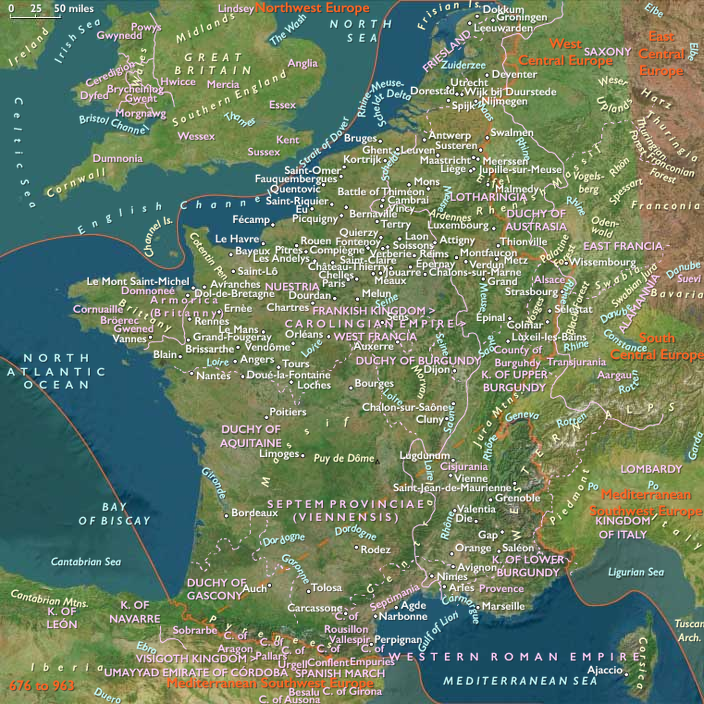
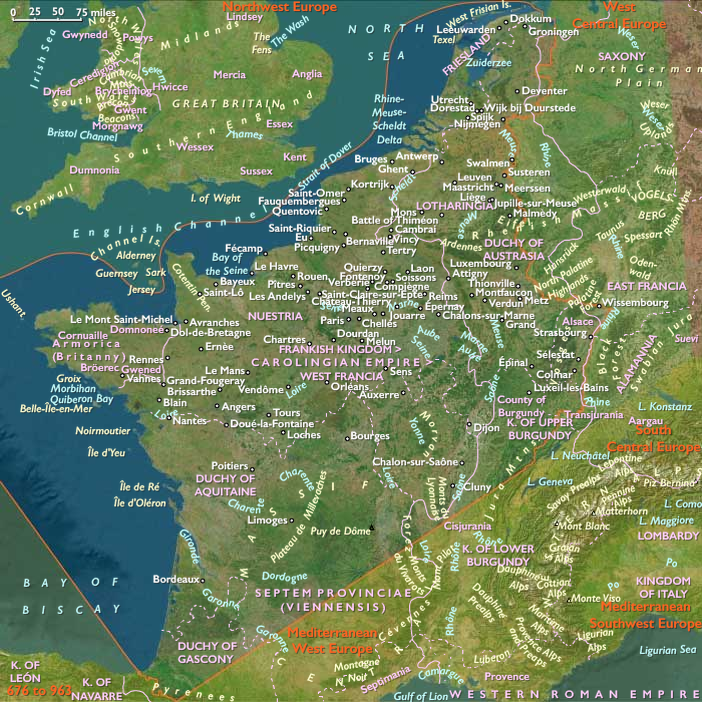
The struggle for control of West Francia reaches a turning point in 923, as Charles the Simple attempts to reclaim his throne from the usurper Robert I, leading to a decisive battle near Soissons. Despite Charles’ military success, the political landscape shifts against him, resulting in his capture and imprisonment, while Rudolph of Burgundy is elected king.
Failed Diplomacy: The Treaty of Bonn and Henry the Fowler’s Role
- The Treaty of Bonn, initially meant to ensure peace between Charles the Simple and Henry the Fowler (King of East Francia), proves ineffective as Henry aligns with Robert I in early 923.
- In an effort to restore relations, Charles sends Henry a holy relic—the gold-encased, gem-studded hand of St. Dionysius the Areopagite—as a symbol of faith and a pledge of perpetual alliance (as described by Widukind of Corvey).
- Charles likely hopes to remind Henry of the Treaty of Bonn and lure him away from supporting Robert, but Henry does not change his allegiance.
Robert I’s Struggles and Rollo’s Loyalty to Charles
- Robert I’s rule is contested not only by Charles but also by the Viking leader Rollo, who had settled in Normandy in 911 under Charles’ authority.
- Unlike other nobles, Rollo remains loyal to Charles, as his land grants and recognition depended on the Carolingian king.
- This further weakens Robert’s position, as his legitimacy is challenged by both Charles and the Normans.
The Battle of Soissons (June 15, 923): The Death of Robert I
- Charles gathers an army and marches against Robert I, seeking to reclaim his throne.
- In a fierce battle near Soissons on June 15, Robert I is killed in combat, but his army wins the battle, forcing Charles to retreat.
- With Robert dead, the nobles quickly rally behind another leader—Rudolph (Raoul) of Burgundy, who is married to Robert’s daughter, Emma of France.
Rudolph of Burgundy Elected King (923)
- Shortly after the battle, the nobles convene and elect Rudolph as King of West Francia to succeed his father-in-law, Robert I.
- He is crowned by Walter, Archbishop of Sens, at the Abbey of Saint-Médard in Soissons on Sunday, July 13, 923.
- Upon assuming the throne, he transfers the Duchy of Burgundy to his younger brother, Hugh the Black, in 925.
The Capture and Imprisonment of Charles the Simple (923–929)
- Charles continues to claim the throne, refusing to accept Rudolph’s rule.
- However, Herbert II of Vermandois, Charles’ distant cousin and former ally, tricks Charles into meeting him, only to take him prisoner.
- Charles is held in captivity for six years, dying in 929.
Eadgifu and the Flight of Louis to England
- Charles’ wife, Eadgifu, the daughter of King Edward the Elder of England, flees with her three-year-old son, Louis, to her father’s court in England.
- This ensures that the Carolingian bloodline survives, as Louis (later Louis IV) will eventually return to reclaim his father’s kingdom.
Conclusion: The Fall of the Carolingians and the Rise of the Robertians
- The events of 923 mark the effective end of Carolingian rule in West Francia, though Charles the Simple remains alive in captivity.
- Rudolph of Burgundy begins his struggle to consolidate power, facing challenges from both Normans and rebellious nobles.
- Herbert II of Vermandois emerges as a key power broker, having imprisoned the last Carolingian king and positioned himself as a kingmaker in the kingdom’s future.
- The young Carolingian heir, Louis IV, survives in English exile, setting the stage for his later return to the Frankish throne in 936.
The Battle of Soissons (923) and its aftermath cement the power of the Robertian faction, shaping the course of West Francia’s transition from the Carolingians to the Capetians in the following century.
Locations
People
- Charles the Simple
- Edward the Elder
- Gilbert
- Henry the Fowler
- Herbert II
- Hugh the Black
- Louis IV, King of Western Francia
- Robert I of France
- Rollo of Normandy
- Rudolph of France
Groups
- Franks
- Anglo-Saxons
- Wessex, English Kingdom of
- Francia Occidentalis (West Francia, or France), Kingdom of
- Francia Orientalis (East Francia), Kingdom of
- Lotharingia, Duchy of
Commodoties
Subjects
Regions
Subregions
Related Events
Filter results
Showing 10 events out of 53264 total
The Later Liang Dynasty controls most of northern China, though much of Shaanxi (controlled by the Qi) as well as Hebei (controlled by the Yan state) and Shanxi (controlled by Shatuo Turks) remains largely outside Later Liang control.
The Later Liang maintains a tense relationship with the Shatuo Turks, due to the rivalry between Zhu Quanzong and Li Keyong, a relationship that had begun back in the time of the Tang Dynasty.
After Li Keyong’s death, his son, Li Cunxu, has continued to expand his State of Jin.
Li is able to destroy the Later Liang in 923 and found the Later Tang Dynasty, which he refers to as the “Restored Tang”.
The Later Liang dynasty moves the capital back to the old Tang eastern seat of Luoyang in 923 as a part of “restoring the Tang.”
Simeon is a gifted military leader whose campaigns have greatly extended Bulgaria's borders, but he has ultimately dissipated the country's strength in his efforts to take Constantinople.
Desperate to conquer the imperial capital, he plans a large campaign in 924.
He sends envoys to the Fatimid caliph Ubayd Allah al-Mahdi Billah, who possesses the powerful navy that Simeon needs.
The caliph agrees and sends his own representatives back with the Bulgarians to arrange the alliance.
However, the envoys are captured by imperial agents at Calabria.
Romanos offers peace to the Arabs, supplementing this offer with generous gifts, and ruins their union with Bulgaria.
The forces of Rudolph, Adalbert, and Berengar of Ivrea meet those of Berengar on July 29, 923, and defeat him in the Battle of Fiorenzuola, near Piacenza.
The battle is decisive and Berengar is de facto dethroned and replaced by Rudolf.
Rudolph of Burgundy’s Campaign Against Henry I of Germany and the Struggle for Lotharingia (923–924)
Upon his election as King of West Francia in 923, Rudolph of Burgundy’s first major act is to confront Henry I of Germany, the newly crowned King of East Francia, over the disputed region of Lotharingia (Lorraine). This reflects the continued struggle between East and West Francia over control of the former Middle Kingdom of Lothair II.
Background: Henry I’s Claim to Lotharingia
- Lotharingia had historically been a contested region, shifting between East and West Francia since the Treaty of Meerssen (870) and the Treaty of Ribemont (880).
- Before the death of Robert I, Henry I had made a compact with King Robert at Jülich in early 923, possibly negotiating peace over Lorraine.
- However, Rudolph, as the new king, does not honor this agreement and instead seeks to reassert West Frankish control over the region.
Rudolph’s Campaign and the Confrontation with Henry I (923–924)
- Rudolph marches into Lotharingia with a sizable army, seeking to annex the duchy into West Francia.
- Henry I, unwilling to let Lotharingia fall into West Frankish hands, gathers his forces to meet Rudolph in battle.
- Both armies face off in what seems to be a significant military engagement, but rather than escalating into war, the two kings negotiate peace again.
Outcome: A Renewed Peace Between West and East Francia
- Rudolph and Henry I reach a diplomatic settlement, though the terms remain unclear.
- Henry maintains control over Lotharingia, preventing its annexation into West Francia.
- The balance of power between the two kingdoms remains tense, as neither king is willing to allow full control of Lotharingia to the other.
Significance of Rudolph’s Failed Attempt to Annex Lorraine
- Continues the long-standing Carolingian-era struggle over Lotharingia, which remains a contested regionfor centuries.
- Prevents an outright war between West and East Francia, preserving a fragile peace in the early years of both kings’ reigns.
- Establishes Henry I as the stronger monarch, as his ability to defend Lotharingia reinforces East Francia’s dominance over the region.
Conclusion: A Diplomatic Defeat for Rudolph
While Rudolph’s attempt to take Lotharingia fails, his early military actions set the tone for his reign—one marked by struggles to consolidate power against both external threats like East Francia and internal challenges from feudal lords and Vikings. Meanwhile, Henry I strengthens East Francia’s position, setting the stage for its evolution into the Holy Roman Empire under his successors.
Gao Jichang, also known as Gao Jixing, had been appointed the regional military governor of Jiangling in 907 by the Later Liang Dynasty, which had taken over northern China in the wake of the Tang Dynasty.
He declares the foundation of the Kingdom of Jingnan (or Nanping) in 924 after the Later Liang Dynasty falls to the Later Tang Dynasty.
Li Maozhen, the sole ruler of the state of Qi, submits in 924 to the Later Tang Dynasty.
After Li Maozhen’s death in this year, his son Li Congyan will continue to govern Fengxiang until 926, when he is removed by the Later Tang's Emperor Zhuangzong, although he will serve two later stints as governor of Fengxiang.
Simeon arrives at Constantinople in the summer of 924 and demands to see the patriarch and the emperor.
He converses with Romanos on the Golden Horn on September 9, 924 and arranges a truce, according to which Constantinople will pay Bulgaria an annual tax, but will be ceded back some cities on the Black Sea coast.
During the interview of the two monarchs, two eagles are said to have met in the skies above and then to have parted, one of them flying over Constantinople and the other heading to Thrace, as a sign of the irreconcilability of the two rulers.
In his description of this meeting, Theophanes Continuatus mentions that "the two emperors... conversed", which may indicate renewed Constantinople’s recognition of Simeon's imperial claims.
Zaharije, who has been persuaded by Constantinople to revolt against Simeon, is supported by many Bulgarians exhausted from Simeon's endless campaigns against the Empire.
The Bulgarian emperor sends a punitive force under Sigrica and Marmais, but they are routed and the two commanders beheaded, which forces Simeon to conclude an armistice with Constantinople in order to concentrate on the suppression of the uprising.
Simeon sends an army led by Časlav Klonimirović in 924 to depose Zaharije.
He is successful, as Zaharije flees to Croatia.
The Serbian zhupans are then summoned to recognize Caslav as the new Prince.
When they come, however, they are all imprisoned and taken to Bulgaria, as is Časlav.
Much of Serbia is ravaged, and many people flee to Croatia, Bulgaria and Constantinople.
Simeon makes Serbia into a Bulgarian province, so that Bulgaria now borders Croatia and Zahumlje.
He then resolves to attack Croatia, because it is an ally of the Empire and had sheltered the Serbian prince.

Yusuf had been released in 922 and the caliph had invested him with the governorship of Azerbaijan and the provinces that he had conquered from the Samanids.
Returning to Azerbaijan, he found that Subuk had died.
In 924, he conquers Rey from its governor, who had rebelled against the Samanids.
After Yusuf leaves the area and occupies Hamadan, the people of Rey expel his officials.
In 925, the Sajid will briefly return to Ray.
Years: 923 - 923
Locations
People
- Charles the Simple
- Edward the Elder
- Gilbert
- Henry the Fowler
- Herbert II
- Hugh the Black
- Louis IV, King of Western Francia
- Robert I of France
- Rollo of Normandy
- Rudolph of France
Groups
- Franks
- Anglo-Saxons
- Wessex, English Kingdom of
- Francia Occidentalis (West Francia, or France), Kingdom of
- Francia Orientalis (East Francia), Kingdom of
- Lotharingia, Duchy of