
Atlantic Southwest Europe: Unification, Exploration, and Cultural …
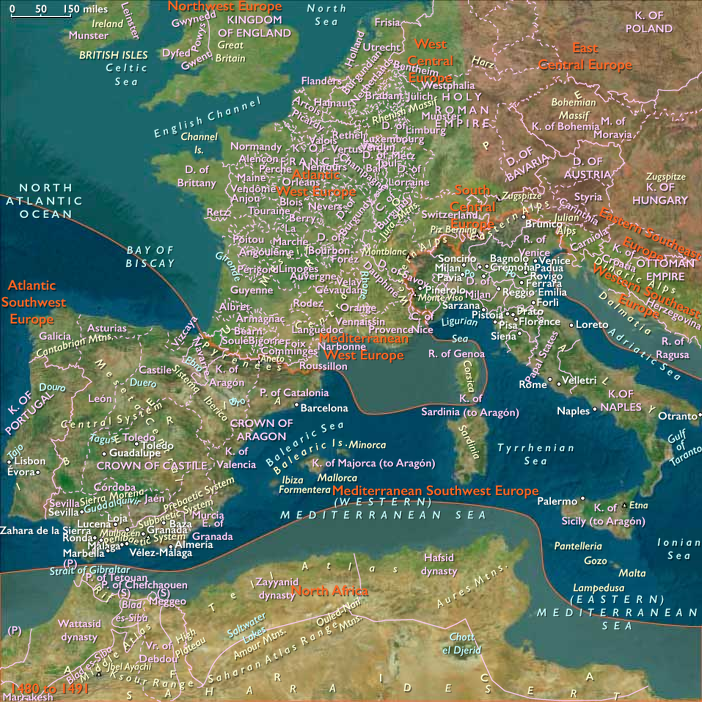
Years: 1480 - 1491
Atlantic Southwest Europe: Unification, Exploration, and Cultural Flowering (1480–1491)
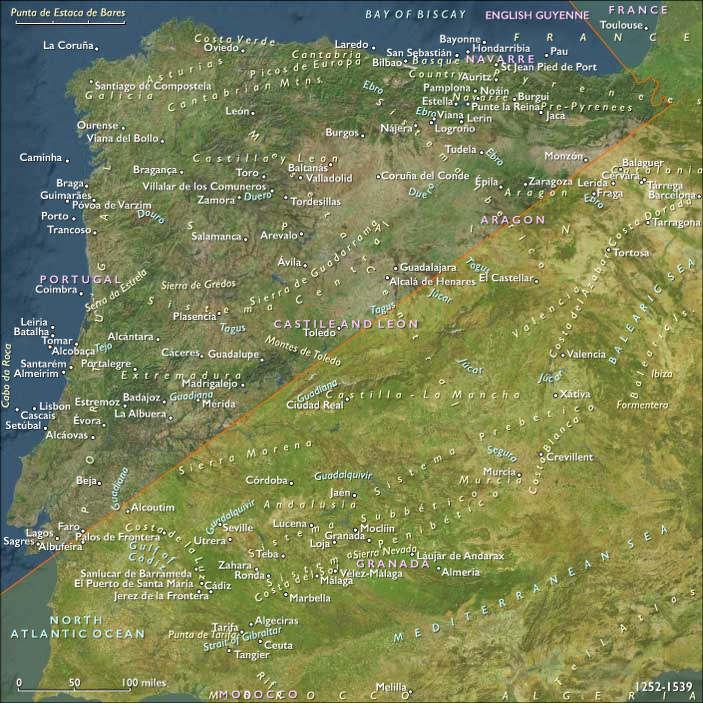
From 1480 to 1491, Atlantic Southwest Europe underwent profound political transformations, economic advancements, and cultural renewal. The marriage and joint rule of Ferdinand II of Aragon and Isabella I of Castile initiated the consolidation of the Spanish kingdoms, while Portugal, under João II, reached new heights of maritime exploration and global influence. Navarre struggled politically but retained its distinct identity, caught between growing Spanish and French interests.
Political and Military Developments
-
Castile and León (including Northern territories):
- The joint monarchy of Isabella I of Castile and Ferdinand II of Aragon (r.1474–1504 and 1479–1516 respectively) effectively unified most of Iberia through the completion of the Reconquista with the conquest of Granada in 1492.
- In the north, the Basque provinces, Galicia, and northern Rioja gradually integrated into the expanding Castilian-Aragonese state, yet maintained considerable autonomy through the reaffirmation of traditional fueros (regional laws).
-
Portugal:
- João II (r. 1481–1495), known as the "Perfect Prince," consolidated royal authority, curtailed noble power, and modernized the Portuguese administration. His rule marked a significant centralization of power and efficiency.
- Militarily, João secured key Atlantic outposts and negotiated crucial treaties, such as the Treaty of Alcáçovas-Toledo (1479–1480) with Castile, stabilizing Portuguese territorial claims and allowing further maritime expansion.
-
Navarre:
- Navarre remained internally divided and politically vulnerable, navigating carefully between Castilian-Aragonese ambitions and French influence.
- The rule of Queen Catherine of Foix (r. 1483–1517) was marked by dynastic fragility and diplomatic balancing, seeking to preserve Navarre’s sovereignty amid growing external pressures.
Economic and Maritime Expansion
-
Portuguese Maritime Achievements:
- Under João II, Portugal greatly expanded its exploration, notably through voyages led by Bartolomeu Dias, who rounded the Cape of Good Hope in 1488, dramatically opening the route to the Indian Ocean.
- These maritime successes cemented Lisbon's position as a global trading hub, significantly boosting the economy and financing further voyages.
-
Economic Integration in Northern Spain:
- Increasing stability under Ferdinand and Isabella revitalized trade in northern Castile, Galicia, and Basque ports, particularly Bilbao and Santander, benefiting from rising wool exports and shipbuilding industries.
- Coastal cities leveraged the Atlantic trade networks, exporting iron, wool, and agricultural products, which enhanced regional prosperity despite heavy royal taxation.
-
Navarre’s Strategic Economy:
- Despite political instability, Navarre maintained a critical position as a trading crossroads between the Iberian Peninsula and France, facilitating economic resilience, particularly in wine trade and agriculture.
Cultural and Social Developments
-
Portuguese Renaissance Flourishes:
- João II’s court attracted intellectuals, astronomers, and mapmakers, fostering the emergence of a Portuguese Renaissance culture that supported extensive scientific exploration and cartographic advancements.
- Lisbon became a leading European center of learning, attracting international scholars who contributed to a rich cultural exchange.
-
Spain’s Cultural Unity and Expansion:
- Ferdinand and Isabella vigorously promoted religious uniformity, culminating in the establishment of the Spanish Inquisition (1478), which had profound social implications across northern Castile and Galicia, although Basque regions largely maintained their traditions.
- The founding of the University of Santiago de Compostela (1495), planned during this period, signified Galicia’s growing cultural prominence.
-
Navarrese Identity and Autonomy:
- Navarre continued nurturing its distinct identity, preserving its autonomous institutions, legal customs, and cultural traditions amid external pressures.
Significance and Legacy
The years 1480–1491 marked a pivotal era for Atlantic Southwest Europe, laying foundations for global imperial competition, especially through Portuguese maritime exploration and Castilian-Aragonese consolidation. Portugal's maritime triumphs under João II opened trade routes that transformed global economics. Simultaneously, the unification of Spain under the Catholic Monarchs profoundly shaped the region's political future. Navarre’s precarious yet resilient existence underscored the complexities of European dynastic politics. Culturally, the period witnessed the blossoming of Renaissance ideas, marking a crucial transition to modernity for the region.
People
- Bartolomeu Dias
- Catherine of Navarre
- Ferdinand II of Aragon
- Isabella I of Castile
- John II of Portugal
Groups
- Galicia, Kingdom of
- Navarre, Kingdom of
- Basque people
- Aragón, Kingdom of
- Aragon, Crown of
- Castile, Crown of
- Portugal, Avizan (Joannine) Kingdom of
- Inquisition, Spanish
Topics
Subjects
Regions
Subregions
Years: 1480 - 1491
People
- Bartolomeu Dias
- Catherine of Navarre
- Ferdinand II of Aragon
- Isabella I of Castile
- John II of Portugal
Groups
- Galicia, Kingdom of
- Navarre, Kingdom of
- Basque people
- Aragón, Kingdom of
- Aragon, Crown of
- Castile, Crown of
- Portugal, Avizan (Joannine) Kingdom of
- Inquisition, Spanish
Topics
Subjects
Regions
Subregions