
Raphael works on the Transfiguration until his …
Years: 1520 - 1520
Raphael works on the Transfiguration until his death in 1520.
Commissioned by Cardinal Giulio de Medici (the later Pope Clement VII) and conceived as an altarpiece for the Narbonne Cathedral in France, the painting exemplifies Raphael's development as an artist and the culmination of his career.
Unusually for a depiction of the Transfiguration of Jesus in Christian art, the subject is combined with an additional episode from the Gospels in the lower part of the painting.
The Transfiguration stands as an allegory of the transformative nature of representation Raphael lives in the Palazzo Caprini in the Borgo, in rather grand style in a palace designed by Bramante.
He never married, but in 1514 had become engaged to Maria Bibbiena, Cardinal Medici Bibbiena's niece; he seems to have been talked into this by his friend the Cardinal, and his lack of enthusiasm seems to be shown by the marriage not having taken place before she dies in 1520.
He is said to have had many affairs, but a permanent fixture in his life in Rome is "La Fornarina", Margherita Luti, the daughter of a baker (fornaro) named Francesco Luti from Siena who lived at Via del Governo Vecchio.
He had been made a "Groom of the Chamber" of the Pope, which gave him status at court and an additional income, and also a knight of the Papal Order of the Golden Spur.
Vasari claims he had toyed with the ambition of becoming a Cardinal, perhaps after some encouragement from Leo, which also may account for his delaying his marriage.
According to Vasari, the cause of Raphael's premature death on Good Friday (April 6, 1520), which is possibly his thirty-seventh birthday, was a night of excessive sex with Luti, after which he fell into a fever and, not telling his doctors that this was its cause, was given the wrong cure, which killed him.
Vasari also says that Raphael had also been born on a Good Friday, which in 1483 fell on March 28.
Whatever the cause, in his acute illness, which lasted fifteen days, Raphael had been composed enough to confess his sins, receive the last rites, and to put his affairs in order.
He dictated his will, in which he left sufficient funds for his mistress's care, entrusted to his loyal servant Baviera, and left most of his studio contents to Giulio Romano and Penni.
At his request, Raphael is buried in the Pantheon.
His funeral is extremely grand, attended by large crowds.
The inscription in his marble sarcophagus, an elegiac distich written by Pietro Bembo, reads: "Ille hic est Raffael, timuit quo sospite vinci, rerum magna parens et moriente mori", meaning: "Here lies that famous Raphael by whom Nature feared to be conquered while he lived, and when he was dying, feared herself to die."
Anticlassical tendencies had begun to manifest themselves in Roman art before the death of Raphael in 1520, which marks the close of the so-called High Renaissance painting style.
In paintings executed in the late Renaissance style sometimes called Mannerism, which emerges around this time, the classical proportions of the figures become exaggerated, the colors harsh, and the composition agitated and asymmetrical.
Italian painter, stage designer, and architect Baldassare Peruzzi becomes a superintendent at Saint Peter's Basilica in 1520.
Little construction is done on the church, but Peruzzi produces several notable drawings. (One of these, a sketched plan and elevation, establishes for later years a new mode of architectural rendering using multiple perspectives.)
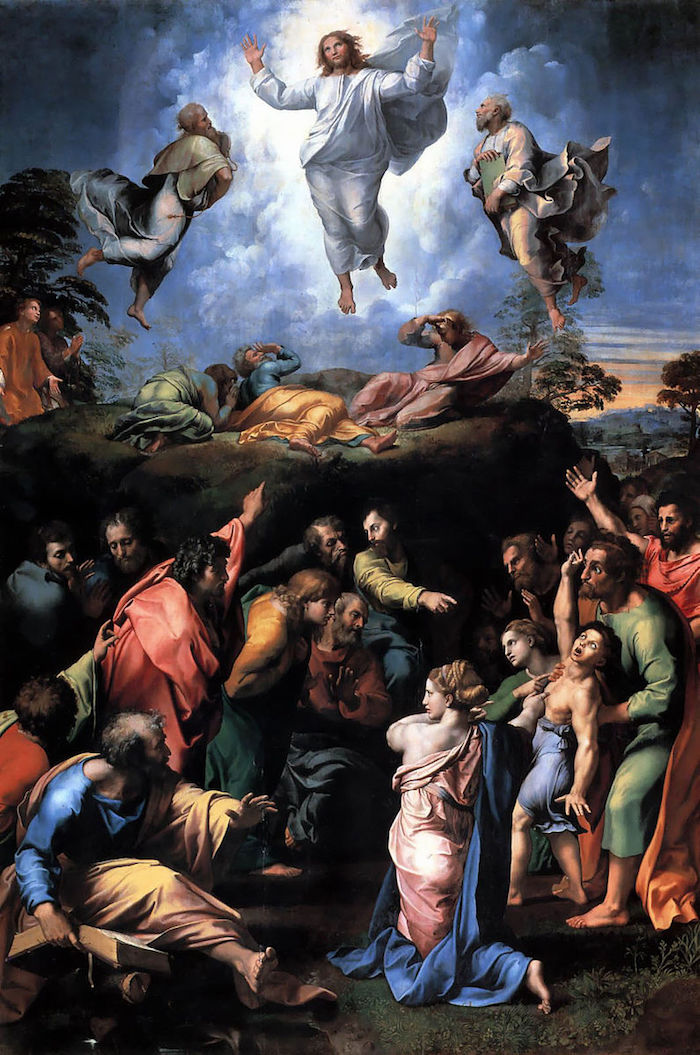
Raphael: The Transfiguration (1516–20); Tempera on wood; 405 cm × 278 cm (159 in × 109 in); Pinacoteca Vaticana, Vatican City
Locations
People
Groups
Topics
Subjects
Regions
Subregions
Years: 1520 - 1520
Raphael: The Transfiguration (1516–20); Tempera on wood; 405 cm × 278 cm (159 in × 109 in); Pinacoteca Vaticana, Vatican City
Locations
People
Groups
Topics
Subjects
Regions
Subregions