
The Transcaspian Railway had been started from …
Years: 1885 - 1885
The Transcaspian Railway had been started from the shores of the Caspian in 1879 in order to secure Russian control over the region and provide a rapid military route to the Afghan border.
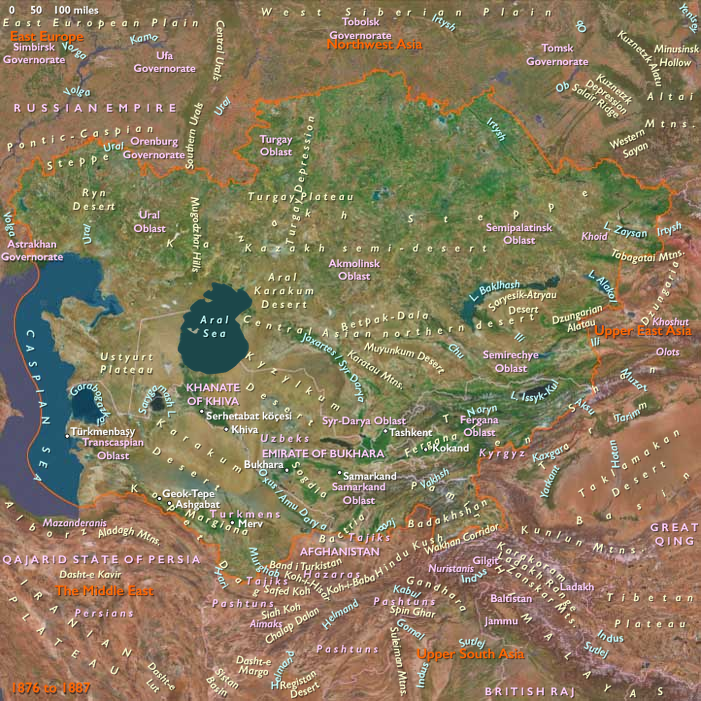
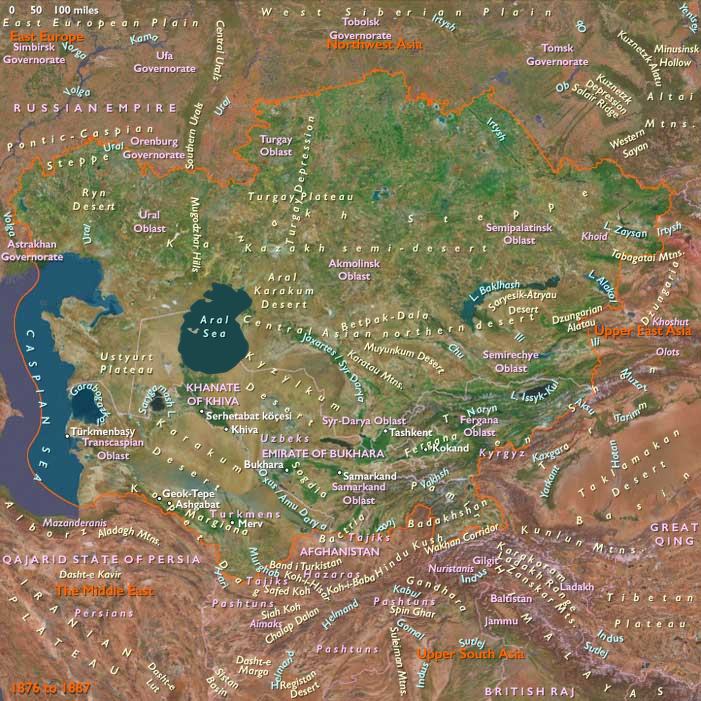
A crisis is precipitated in 1885 by the Russian annexation of the Pandjeh oasis, to the south of Merv, on a territory of modern Afghanistan north of the Oxus River.
An Afghan force is encamped on the west bank of the Kushk River, with a Russian force on the east bank.
The leader of the Russian forces, General Alexander Komarov, sends an ultimatum on March 29, 1885, demanding an Afghan withdrawal.
On their refusal, the Russians attack them at 3 a.m. on March 30 and drive them across the Pul-i-Khishti Bridge with a loss of some forty men.
Afghan troops are reported to have been 'wiped out to a man' in their trenches, with losses of up to six hundred.
This nearly leads to war with Britain, as it is thought that the Russians are planning to march on to Herat in Afghanistan.
The incident sours the relations between Britain and Russia, but the Emir Abdur Rahman, who had been present at the Rawalpindi conference with Lord Dufferin at the time, regardst he matter as a mere frontier scuffle.
However, members of Gladstone's cabinet, namely Lord Ripon (the previous Indian Viceroy), believe withdrawal could lead to a breakdown in law and order and possible intervention from Russia.
Outright war is averted with diplomacy, and Lord Dufferin manages to secure a settlement in which Russia keeps the Merv Oasis, but relinquishes further territories taken in their advance, and promises to respect Afghan territorial integrity in the future.
Following the incident, the Anglo-Russian Boundary Commission is established to delineate the northern frontier of Afghanistan.
The commission does not have any Afghan involvement, and effectively leads to Afghanistan becoming a buffer state between British India and the Russian Empire.
The incident brings the southward expansion of Imperial Russia to a halt.
The Russians establish the border town of Kushka in the conquered territory; it is the southernmost settlement of both the Russian Empire and the Soviet Union.
Locations
People
Groups
- Russian Empire
- Britain (United Kingdom of Great Britain and Ireland)
- Afghanistan, (Barakzai) Emirate of
- Russian Turkestan
Topics
Subjects
Regions
Subregions
Years: 1885 - 1885
Locations
People
Groups
- Russian Empire
- Britain (United Kingdom of Great Britain and Ireland)
- Afghanistan, (Barakzai) Emirate of
- Russian Turkestan
Topics
Subjects
Regions
Subregions