
The Macartney expedition had departed Rio de …
Years: 1793 - 1793
March
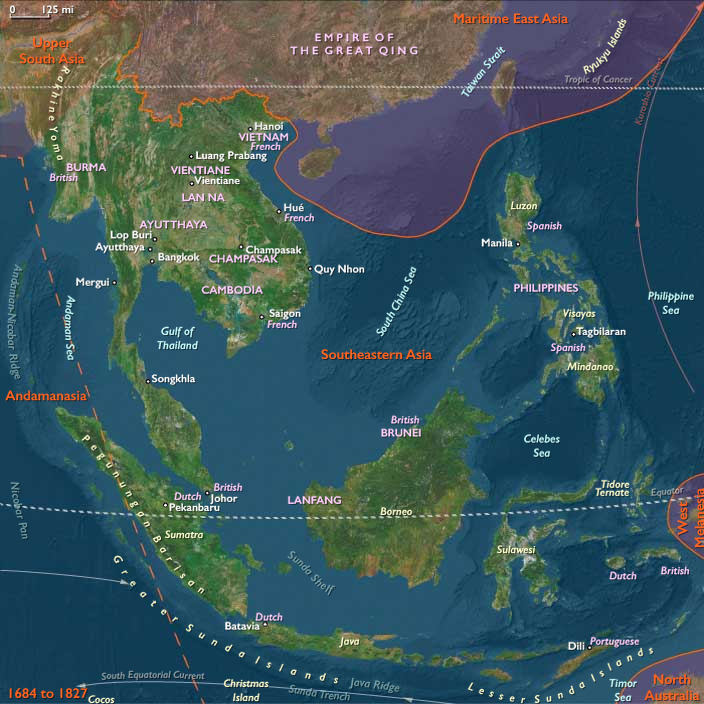
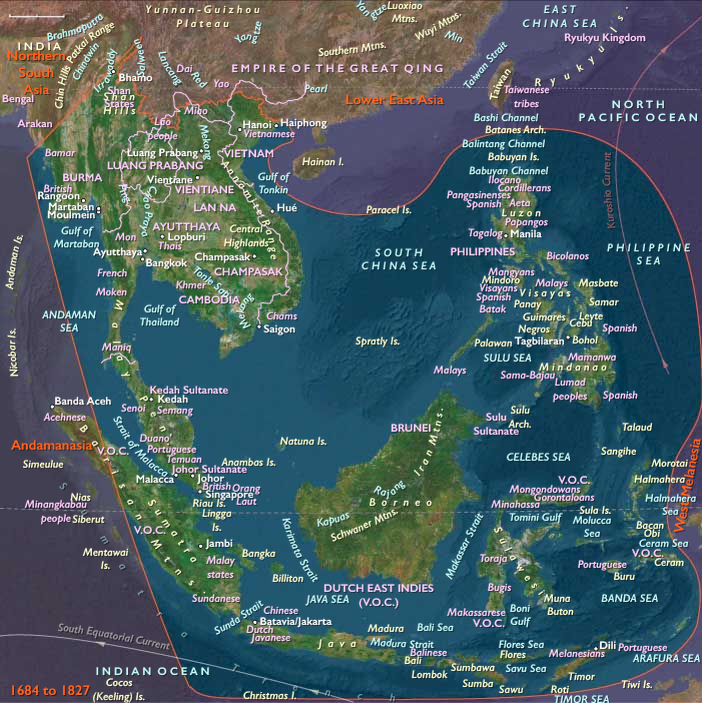
They had passed Java in February, and reach Jakarta (at this time known as Batavia) on March 6.
Here, they buy a French brig, which they christen the Clarence, to replace the missing Jackall.
The Jackall itself, however, rejoins the squadron at Jakarta, after having turned back for repairs after the storm that had struck the ships at the start of their voyage.
Locations
People
- George Macartney, 1st Earl Macartney
- Henry Dundas, 1st Viscount Melville
- James Dinwiddie
- John Barrow, 1st Baronet
- Joseph Banks
- Qianlong Emperor
- Sir George Leonard Staunton
- Sir George Staunton, 2nd Baronet
- Thomas Hickey
- William Alexander
- William Grenville, 1st Baron Grenville
- William Pitt the Younger
Groups
- Chinese Empire, Qing (Manchu) Dynasty
- Britain, Kingdom of Great
- East India Company, British (United Company of Merchants of England Trading to the East Indies)
Topics
Commodoties
Subjects
Regions
Subregions
Related Events
Filter results
Showing 10 events out of 23676 total
The Execution of Louis XVI and the Formation of the First Coalition (1793)
On January 21, 1793, the revolutionary French government executed King Louis XVI following his trial for treason. This event sent shockwaves across Europe, as monarchies feared for their own survival and viewed the French Revolution as an existential threat to the traditional order.
Formation of the First Coalition (1793–1797)
The execution of Louis XVI united European monarchies against revolutionary France, leading to the formation of the First Coalition, a multinational alliance determined to crush the revolution.
- February 1, 1793 – France declares war on Britain and the Netherlands.
- March 7, 1793 – France declares war on Spain.
- March 23, 1793 – The Holy Roman Empire joins the war against France.
- Over the course of 1793, other monarchies—including Portugal, Naples, and the Grand Duchy of Tuscany—join the coalition, creating an aristocratic alliance against the revolution.
The French Response – Mass Conscription and Offensive Warfare
Facing a European-wide conflict, the French government introduced a new mass levy, recruiting hundreds of thousands of men to the army. This policy marked the beginning of large-scale conscription in modern warfare, giving France a numerical advantage over its enemies.
The French strategy was twofold:
- Stay on the offensive, using large revolutionary armies to fight on enemy soil and sustain themselves through war requisitions.
- Outnumber enemy forces, using mass conscription to maintain larger armies than their opponents.
France Attempts to Draw the United States Into the War
As part of its diplomatic efforts, the French government sent Citizen Genêt to the United States, hoping to persuade the new American republic to join the war on France’s side. However, the United States refused, choosing to remain neutral throughout the conflict, unwilling to be drawn into European affairs.
Military Campaigns of 1793 – Early French Victories
While France faced initial setbacks, by the end of 1793, its reorganized armies began to achieve major victories:
- March 1793 – The Austrians defeat the French at Neerwinden, leading to the execution of General Dumouriez for treason.
- October 1793 – France recovers with victories at Wattignies and Wissembourg, pushing Austrian forces back.
- September 1793 – At Hondschoote, the British land forces suffer defeat, marking a major setback for the First Coalition.
Conclusion – France Survives and Expands the Revolutionary War
By the end of 1793, despite fighting against nearly every major European power, France had turned the tide through:
- Mass conscription, which allowed it to field huge armies.
- Aggressive offensive strategies, ensuring that the war was fought on enemy soil.
- Early battlefield successes, which weakened the coalition forces.
Although the First Coalition had formed to destroy the French Revolution, by the end of 1793, it was clear that France would not only survive but would emerge as a dominant force in European warfare.
Following the First Partition of Poland in 1772, in an attempt to strengthen the greatly weakened Commonwealth, King Stanislaus Augustus had put into effect a series of reforms to strengthen Poland's military, political system, economy, and society.
These reforms had reached their climax with the enactment of the May Constitution in 1791, which established a constitutional monarchy with separation into three branches of government, strengthened the bourgeoisie, and abolished many of the privileges of the nobility as well as many of the old laws of serfdom.
In addition, to strengthen Poland's international standings, King Stanislaus had signed the Polish-Prussian Pact of 1790, ceding further territories to Prussia in exchange for a military alliance.
Angered by what is seen as dangerous, Jacobin-style reforms, Russia had invaded Poland in 1792, beginning the War in Defense of the Constitution.
Abandoned by her Prussian allies and betrayed by Polish nobles who desire to restore the privileges they had lost under the May Constitution, Poland is forced to sign the Second Partition of Poland in 1793, which cedes Dobrzyn, Kujavia, and a large portion of Greater Poland to Prussia, and all of Poland’s eastern provinces from Moldavia to Livonia to Russia, reducing Poland to one third of her original size prior to the First Partition.
Russia and Prussia arrange the Second Partition of Poland in 1793.
Russia takes most of eastern Poland; Prussia takes Gdansk (Danzig) and Great Poland.
Sultan Selim, a poet and an accomplished composer of Ottoman classical music, had enjoyed greater freedom before his accession than the Ottoman princes before him.
Influenced by his father, Mustafa III, Selim has acquired a zeal for reform.
Selim attempts to end the social, economic, and administrative chaos facing the empire.
He sets up a committee of reformers (1792–93) and promulgates a series of new regulations collectively known as the nizam-i cedid (“new order”).
These include reforms of provincial governorships, taxation, and land tenure.
More significant are his military reforms: in addition to new military and naval schools, he founds new corps of infantry trained and equipped along European lines and financed by revenues from forfeited and escheated fiefs and by taxes on liquor, tobacco, and coffee.
Finally, to provide for direct contact with the West, Ottoman embassies are opened in the major European capitals.
The Bani Yas Bedouin, originally centered on the Liwa Oasis, about ninety-seven point six kilometers south of the Persian Gulf coast, is the most significant in the area, having over twenty subsections.
In 1793, the Al Bu Falah subsection migrates to the island of Abu Dhabi on the coast of the Persian Gulf due to the discovery of fresh water there.
One family within this section is the Al Nahyan family, which makes up the rulers of Abu Dhabi today.
Ireland has chiefly been controlled by the minority Anglican Protestant Ascendancy since 1691 and the end of the Williamite war.
Constituting members of the established Church loyal to the British Crown, it governs through a form of institutionalized sectarianism codified in the Penal Laws, which discriminate against both the majority Irish Catholic population and non-Anglican Protestants (for example Presbyterians).
Liberal elements among the ruling class in the late eighteenth century are inspired by the example of the American Revolution (1776–1783) and seek to form common cause with the Catholic populace to achieve reform and greater autonomy from Britain.
As in England, the majority of Protestants, as well as all Catholics, are barred from voting because they do not pass a property threshold.
Another grievance is that Ireland, although nominally a sovereign kingdom governed by the monarch and Parliament of the island, in reality has less independence than had most of Britain's North American colonies, due to a series of laws enacted by the English, such as Poynings' law of 1494 and the Declaratory Act of 1720, the former of which had given the English veto power over Irish legislation, and the latter of which had given the British the right to legislate for the kingdom.
When France joined the Americans in support of their Revolutionary War, London had called for volunteers to join militias to defend Ireland against the threat of invasion from France (since regular British forces had been dispatched to America).
Many thousands had joined the Irish Volunteers.
In 1782, they had used their newly powerful position to force the Crown to grant the landed Ascendancy self-rule and a more independent parliament ("Grattan's Parliament").
The Irish Patriot Party, led by Henry Grattan, had pushed for greater enfranchisement.
In 1793, parliament passes laws allowing Catholics with some property to vote, but they can neither be elected nor appointed as state officials.
Liberal elements of the Ascendancy seeking a greater franchise for the people, and an end to religious discrimination, are further inspired by the French Revolution, which has taken place in a Catholic country.
The prospect of reform had inspired a small group of Protestant liberals in Belfast to found the Society of United Irishmen in 1791.
The organization crosses the religious divide with a membership comprising Roman Catholics, Presbyterians, Methodists, other Protestant "dissenters" groups, and some from the Protestant Ascendancy.
The Society openly puts forward policies of further democratic reforms and Catholic emancipation, reforms which the Irish Parliament has little intention of granting.
The outbreak of war with France earlier in 1793, following the execution of Louis XVI, has forced the Society underground and toward armed insurrection with French aid.
The avowed intent of the United Irishmen is to "break the connection with England".
It links up with Catholic agrarian resistance groups, known as the Defenders, who had started raiding houses for arms in early 1793.
The national government, including President George Washington, flees the city.
Mayor Matthew Clarkson, with no formal crisis plan in place, asks volunteers to collect clothing, food and monetary donations; to pitch a makeshift hospital; and to build a home for one hundred and ninety-one children temporarily or permanently orphaned by the epidemic.
Members of the Free African Society, an institution run by and for the city’s black population, provide two-thirds of the hospital staff, transport and bury the dead and perform numerous other medical tasks.
First authorized by the Coinage Act of 1792 on April 2, 1792, the half-cent piece is made of one hundred percent copper and is valued at five milles, or one two-hundredth of a dollar.
The 1793 half-cent is slightly smaller than a modern U.S. quarter, with a diameter of twenty-two millimeters.
He is present at the laying of the cornerstone of the United States Capitol on September 18, at which time he meets President George Washington.
Greenleaf quickly ingratiates himself with several of Washington's closest friends.
One of these is Tobias Lear, who had served as Washington's secretary from 1785 to June 1793.
Greenleaf provides seed money for Lear's mercantile venture, Tobias Lear & Co., in 1793.
Another is Thomas Johnson, whom Washington had appointed as one of three commissioners of the District of Columbia.
Greenleaf purchases fifteen thousand acres (sixty-one square kilometers) of Johnson's land in Frederick County, Maryland, for $14,000 in September.
The Residence Act of 1790, which had established the site for the nation's capital, provided for the appointment of three commissioners by the President (and without the need for Senate confirmation) to govern the District of Columbia, survey its land, purchase property from private landowners, and construct federal buildings.
Greenleaf purchases three thousand city lots from the commissioners on September 23, 1793.
The city offers him the lots at $66.50 each, a significant discount from the going price of $200 to $300 per lot.
To get this low price, Greenleaf is required to construct seventy homes on the lots before 1800, not sell any of the land before 1796, and lend the commissioners $2,200 a month until certain public buildings are constructed.
To raise money to improve the lots, Greenleaf executea a power of attorney on November 2, 1793, with Sylvanus Bourne, the American vice consul in Amsterdam.
Bourne, who had served as vice consul in Amsterdam under Greenleaf, is empowered to sell lots or obtain mortgages on them.
On November 19, 1793, Greenleaf moves into the Pearl Street home of Noah Webster in New York City.
The September 23 agreement with the commissioners is superseded by a new one on December 24, 1793.
For this agreement, Greenleaf has a new business partner, Robert Morris.
Morris, already legendary in the United States, is a merchant who signed the Declaration of Independence, the Articles of Confederation, and the United States Constitution.
He was Chairman of the Pennsylvania Committee of Safety during the Revolutionary War, and was a delegate to the Second Continental Congress, and was Superintendent of Finance for the fledgling United States.
Next to General George Washington, he is considered "the most powerful man in America."
At the time he becomes Greenleaf's business partner, he is one of Pennsylvania's original United States senators (his term will end in 1795).
Morris sells another million acres (four thousand square kilometers) to the Holland Land Company between December 1792 and July 1793 for £112,500, and his son sells 1,800,000 acres (7,300 km2) to the Holland Land Company for $500,000.
Morris sells another 87,000 acres (three hundred and fifty square kilometers) ("the Triangle Tract") to an investor group in January 1793.
Years: 1793 - 1793
March
Locations
People
- George Macartney, 1st Earl Macartney
- Henry Dundas, 1st Viscount Melville
- James Dinwiddie
- John Barrow, 1st Baronet
- Joseph Banks
- Qianlong Emperor
- Sir George Leonard Staunton
- Sir George Staunton, 2nd Baronet
- Thomas Hickey
- William Alexander
- William Grenville, 1st Baron Grenville
- William Pitt the Younger
Groups
- Chinese Empire, Qing (Manchu) Dynasty
- Britain, Kingdom of Great
- East India Company, British (United Company of Merchants of England Trading to the East Indies)
