The tired Xin forces are defeated by …
Years: 23 - 23
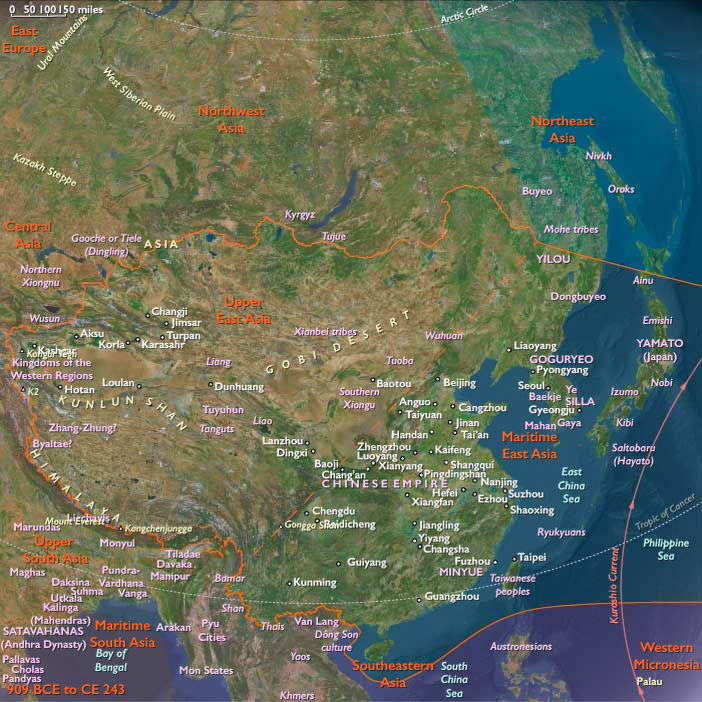
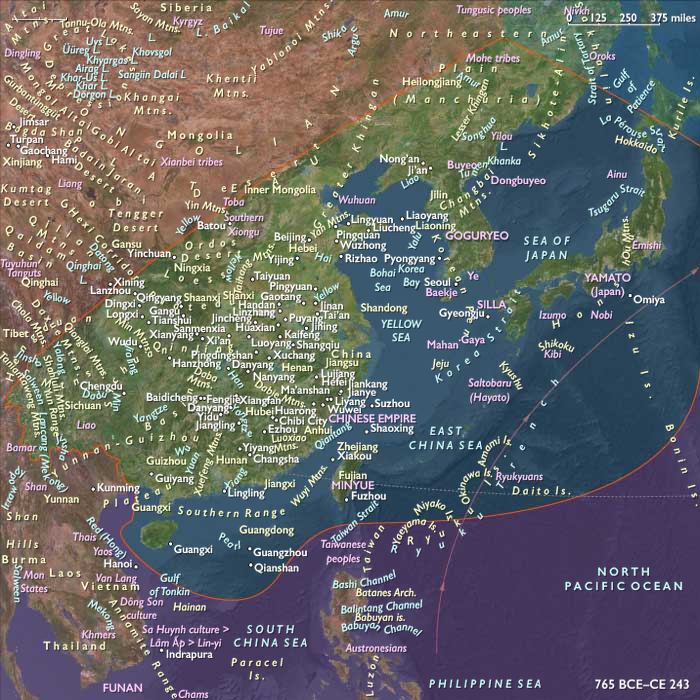
The tired Xin forces are defeated by the Chimei at the battle of Chengchang (in modern Tai'an, Shandong), and collapse.
Lian dies in battle and Wang flees without his troops.
This ends any serious attempt by Xin forces against the Chimei, as the Xin dynasty will soon be confronted with the even closer Lülin threat.
Locations
People
Groups
Topics
Commodoties
Subjects
Regions
Subregions
Related Events
Filter results
Showing 10 events out of 61937 total
The major military confrontation at Kunyang seals Wang Mang's fate in the spring of 23.
He sends his cousin Wang Yi and his prime minister Wang Xun with what he considers to be overwhelming force, some four hundred and thirty thousand men, intending to crush the newly constituted Han regime.
The Han forces are at this point in two groups—one led by Wang Feng, Wang Chang, and Liu Xiu, which, in response to the arrival of the Xin forces, withdraws to the small town of Kunyang (in modern Pingdingshan, Henan) and one led by Liu Yan, which is still besieging Wancheng.
The rebels in Kunyang initially want to scatter, but Liu Xiu opposes this measure; rather, he advocates that they guard Kunyang securely, while he gathers all other available troops in surrounding areas and attack the Xin forces from the outside.
After initially rejecting Liu Xiu's idea, the Kunyang rebels eventually agree.
Liu Xiu carries out his plan, and when he returns to Kunyang, he begins harassing the besieging Xin forces from the outside.
Wang Yi and Wang Xun, annoyed, lead ten thousand men to attack Liu Xiu and order the rest of their troops not to move from their siege locations.
Once they engage in battle, however, after minor losses, the other units are hesitant to assist them, and Liu Xiu kills Wang Xun in battle.
Once this happens, the Han forces inside Kunyang burst forth from the city and attack the other Xin units, and the much larger Xin forces suffer a total collapse.
The soldiers largely desert and go home, unable to be gathered again.
Wang Yi has to withdraw with only several thousand men back to Luoyang.
This is a major psychological blow to the Xin dynasty for which, after this point, all hope is lost.
The joint forces under Liu Yan's leadership have a major victory in 23 over Zhen Fu, the governor of the prefecture of Nanyang, killing him.
The coalition now besieges the important city of Wancheng (the capital of Nanyang prefecture, in modern Nanyang, Henan).
Many other rebel leaders have become jealous of Liu Yan's capabilities by this point, and while a good many of their men admire Liu Yan and want him to become the emperor of a newly declared Han Dynasty, the disgruntled leaders have other ideas.
They find another local rebel leader, Liu Xuan, a third cousin of Liu Yan, who is claiming the title of General Gengshi at the time and who is considered a weak personality, and request that he be made emperor.
Liu Yan initially opposes this move and instead suggests that Liu Xuan carry the title "Prince of Han" first (echoing the founder of the Han Dynasty, Emperor Gao).
The other rebel leaders refuse, and in early 23, Liu Xuan is proclaimed emperor.
Liu Yan becomes prime minister.
Emperor Gengshi is fearful of Liu Yan's capabilities and keenly aware that many of Liu Yan's followers are angry that he had not been made emperor.
One, Liu Ji, is particularly critical of Emperor Gengshi.
Emperor Gengshi arrests Liu Ji and wants to execute him, but Liu Yan tries to intercede.
Emperor Gengshi takes this opportunity to execute Liu Yan as well.
However, ashamed of what he has done, he spares Liu Yan's brother Liu Xiu, and in fact creates Liu Xiu the Marquess of Wuxin.
Emperor Gengshi now commissions two armies, one led by Wang Kuang, targeting Luoyang, and the other led by Shentu Jian and Li Song, targeting Chang'an directly.
All the people along the way gather, welcome, and join the Han forces.
Shentu and Li quickly reach the outskirts of Chang'an.
In response, the young men within Chang'an also rise up and storm Weiyang Palace, the main imperial residence.
Wang died in the battle at the palace, as does his daughter Princess Huanghuang (the former empress of Han).
After Wang dies, the crowd fight over the right to have the credit for having killed Wang, and tens of soldiers die in the ensuing fight.
Wang's body is cut into pieces, and his head is delivered to the provisional Han capital Wancheng, to be hung on the city wall.
Emperor Gengshi temporarily moves his capital from Wacheng to Luoyang after Wang Mang's death.
He then issues edicts to the entire empire, promising to allow Xin local officials who submit to him to keep their posts, and sends diplomats to try to persuade Chimei generals to submit as well.
For a brief period, nearly the entire empire shows at least nominal submission to Emperor Gengshi as the legitimately restored Han emperor—even including the powerful Chimei general Fan Chong, who, indeed, goes to stay in Luoyang under promises of titles and honors.
However, this policy is applied inconsistently, and local governors soon become apprehensive about giving up their power.
Some twenty-odd Chimei generals have gone to Luoyang and been created marquesses but have not been given any actual marches, and, seeing that their men are about to disband, they flee Luoyang for their base at Puyang.
Fan, in particular, leaves the capital and returns to his troops.
In response, Emperor Gengshi sends various generals out to try to calm the local governors and populace; these include Liu Xiu, who is sent to pacify the region north of the Yellow River.
The strategist Liu Lin suggests to Liu Xiu to break the Yellow River levee and destroy the Chimei by this manner, but Liu Xiu refuses.
The people begin to see that the powerful officials around Emperor Gengshi are in fact uneducated men lacking ability to govern; this further makes them lose confidence in his governance.
Emperor Gengshi's governance is in fact immediately challenged by a major pretender in winter 23.
A fortuneteller in Handan named Wang Lang claims to be actually named Liu Ziyu and a son of Emperor Cheng.
He claims that his mother was a singer in Emperor Cheng's service, and that Empress Zhao Feiyan had tried to kill him after his birth, but that a substitute child was killed indeed.
After he spreads these rumors, the people of Handan begin to believe that he is a genuine son of Emperor Cheng, and the prefectures north of the Yellow River quickly pledge allegiance to him as emperor.
Liu Xiu is forced to withdraw to the northern city of Jicheng (in modern Beijing).
Drusus, who had become a consul in the year 15, had served as governor of Illyricum from 17 to 20.
In 21 he was consul again, significantly with his father Tiberius as his colleague, while in 22 he had received tribunicia potestas (tribunician power), a distinction reserved solely for the emperor or his immediate successor.
Drusus had married his paternal cousin Livilla in 4; their daughter Julia was born shortly after.
They had twin sons in 19: Tiberius Gemellus and Tiberius Claudius Caesar Germanicus II Gemellus, the latter of whom dies still an infant in 23.
Germanicus’ death in 19 had made Drusus the new heir; Germanicus' wife Agrippina suspects Tiberius of having killed him to allow Drusus to become his heir, but this is unlikely.
Before the birth of the twins, Livilla may already have been in a relationship with Sejanus, who, in his capacity of Praetorian prefect Sejanus had quickly become a trusted advisor to Tiberius.
By 23, he already exerts a considerable influence over the decisions of the emperor, who referrs to Sejanus as "Socius Laborum" (my partner in my toils).
By this time he has been raised to the rank of praetor, a position which is not normally granted to Romans of the equestrian class.
A statue has been erected in his honor in the Theater of Pompey, and his followers in the Senate are advanced with public offices and governorships.
However, this privileged position causes resentment among the senatorial class and the imperial family, in particular earning him the enmity of Drusus.
The history of Sejanus and Drusus dates to at least 15 CE, in which year a mutiny had broken out among legions posted in Pannonia and Germania.
While his adopted son Germanicus restored order in Germania, Tiberius' biological son Drusus had been sent to quell the uprising in Pannonia, accompanied by Sejanus and two Praetorian cohorts.
In part due to what the soldiers believed to be bad omens, Drusus had quickly managed to restore the stability in the army and publicly put the chief instigators to death.
The camp had been purged of mutineers by the Praetorians and the legions returned to the winter barracks.
Despite this success, the following years have witnessed a growing animosity between Drusus and Sejanus.
Since the accession of Tiberius, Drusus has been systematically groomed as the successor of his father, successfully commanding legions in Illyricum in 18, and sharing the consulship with Tiberius in 21.
In practice, however, it is still Sejanus who is the second man in the empire, and he is ambitious to further expand his power.
As early as 20, Sejanus had sought to solidify his connection with the imperial family by betrothing his daughter Junilla to the son of Claudius, Claudius Drusus.
At the time the girl was only four years old but the marriage was nonetheless prevented when the boy accidentally died a few days later of asphyxiation.
When this failed it seems Sejanus had turned his attention toward eliminating Drusus.
By 23, the enmity between the two men has reached a critical point.
During an argument Drusus had struck the prefect with his fist, and he openly lamented that "a stranger was invited to assist in the government while the emperor's son was alive" (Tacitus, Annals IV.7).
With Tiberius already in his sixties, there is a real possibility of Drusus succeeding his father in the near future.
Ancient sources (Tacitus, Suetonius, Cassius Dio) agree that, to secure his position, Sejanus secretly plotted against him and succeeded in seducing his wife Livilla.
With her as an accomplice, Drusus is slowly poisoned and dies of seemingly natural causes on September 13, 23.
If Drusus was indeed murdered, then it was done so skillfully that his death gives rise to no suspicion, having as he does a reputation for heavy drinking.

After some difficulties, Liu Xiu is able to unify the northern prefectures still loyal to Emperor Gengshi and besiege Handan in 24, killing Wang Lang.
Emperor Gengshi puts Liu Xiu in charge of the region north of the Yellow River and creates him the Prince of Xiao, but Liu Xiu, still aware that he is not truly trusted and secretly angry about his brother's death, secretly plans to depart from Emperor Gengshi's rule.
He begins to strip other Emperor Gengshi-commissioned generals of their powers and troops, and concentrates the troops under his own command.
Also in 24, Emperor Gengshi moves his capital again, back to the Western Han capital of Chang'an.
The people of Chang'an had previously been offended by Emperor Gengshi's officials, who did not appreciate their rising up against Wang Mang but in fact considered them traitors.
Once Emperor Gengshi is back in the capital, he issues a general pardon, which calms the situation for a while.
At this time, Chang'an is still largely intact, except for Weiyang Palace, destroyed by fire.
However, Emperor Gengshi's timidity quickly causes problems.
When the imperial officials gather or an official meeting, Emperor Gengshi, who had never seen such solemn occasions, panics.
Later, when generals submit reports to him, he asks questions such as, "How much did you pillage today?"
This type of behavior further reduces the confidence of the people in him.
Emperor Gengshi entrusts his government to Zhao Meng, whose daughter he takes as an imperial consort.
He himself engages in frequent drinking bouts and as a result is often unable to receive officials or make important decisions.
Zhao greatly abuses his power, and once, when an honest official reveals Zhao's crimes to Emperor Gengshi, Emperor Gengshi has him executed.
The other powerful officials also abuse their power greatly, often commissioning duplicating local officials throughout the empire, causing great confusion and anger.