
The History and Formation of Aunis as …
Years: 1373 - 1373
The History and Formation of Aunis as a Separate Province (6th–14th Century)
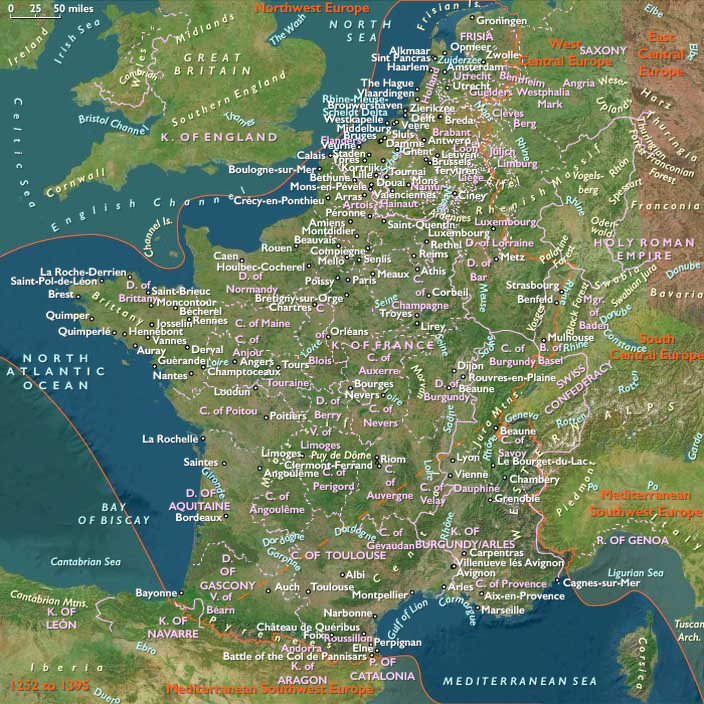
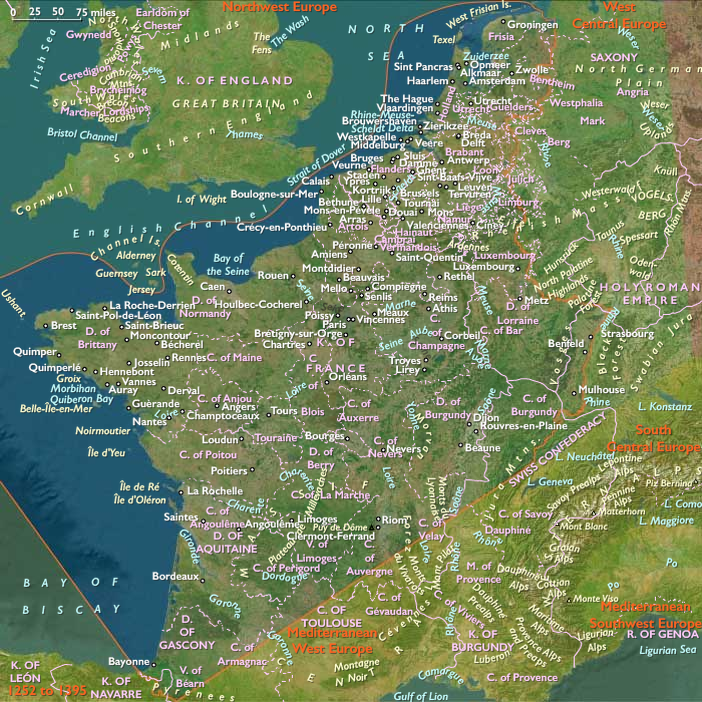
The province of Aunis, a small but strategically important coastal region, is bordered by the Sèvre Niortaise River (north), the Charente River (south), and the Atlantic Ocean (west), with its islands Île de Ré and Île d'Aix. To the east, it is framed by the valleys of the Mignon, Trézence, and Boutonne Rivers and the hills of Saintonge. Over the centuries, Aunis underwent numerous territorial changes, from an unstable Frankish region to a separate province under King Charles V in 1374.
Early History: Frankish Settlement and Carolingian Rule (6th–9th Century)
- Power in Aunis was unstable and autarchic from the time of Frankish settlement in the 6th century until the Carolingian dynasty in the 9th century.
- The region is first recorded in 785 as Pagus Alnensis, under the control of the Counts of Poitou.
- Repeated Viking raids, carried out by way of the region’s rivers and streams, made Aunis a high-risk frontier zone.
- In response to the Viking threat, the Counts of Poitou fortified the coast in the 9th and 10th centuries, constructing a four-tower fortress at Châtelaillon.
Separation from Saintonge and Fortification (10th–11th Century)
- Following the collapse of Carolingian power in the late 10th century, Aunis separated from Saintonge and established its first capital at Châtelaillon.
- To provide greater inland protection, the Duke of Poitou built Surgères (also called the castrum of Benon)as a fortified city.
Expansion and Economic Growth: 11th–13th Century
- The Counts of Poitou expanded inland in the late 11th century, encouraging the clearing of forests to develop settlements and agriculture.
- The first Cistercian abbey in Aunis, Grâce-Dieu Abbey, was founded in Benon, leading the forest-clearing movement that:
- Created space for villages and farmland (growing wheat, oats, and barley).
- Expanded vineyards, laying the foundation for Aunis' wine trade.
- By the end of the 11th century, Aunis had become prosperous due to its salt production, making it a major trading hub.
Rise of La Rochelle and Aunis' Shifting Allegiances (12th–14th Century)
- Châtelaillon became the most important port city in Aunis for salt and wine transport but was eclipsed by La Rochelle after its demise in 1130.
- In 1130, Aunis came under the control of William X, Duke of Aquitaine, whose daughter, Eleanor of Aquitaine, brought the region as part of her dowry first to Louis VII of France, and after their divorce, to King Henry II of England in 1152.
- Aunis was briefly returned to France in 1224 under Louis VIII, but was ceded back to England under the Treaty of Brétigny (1360), part of the Hundred Years’ War.
- By 1371, Aunis revolted against English rule, leading to its restoration to King Charles V of France.
Aunis Becomes an Independent Province (1374)
- In 1374, Charles V officially separated Saintonge and established Aunis as a distinct province, marking the culmination of its long and complex territorial history.
Significance and Legacy
- Aunis' geographic position made it a valuable maritime and trade region, fueling its economic and strategic importance.
- Its gradual separation from Saintonge and integration into France marked it as a contested territorythroughout the Middle Ages.
- La Rochelle remained its most significant city, growing into one of France’s leading ports in later centuries.
The formation of Aunis as an independent province in 1374 symbolized the final consolidation of French control over the region, bringing an end to centuries of territorial disputes and foreign domination.
Locations
Groups
Topics
Commodoties
Subjects
Regions
Subregions
Related Events
Showing 10 events out of 43786 total
Years: 1373 - 1373
Locations
Groups
Topics
Commodoties
Subjects
Regions
Subregions