
The three Tartaria tablets, which date to …
Years: 5373BCE - 5230BCE
The three Tartaria tablets, which date to around 5300 BCE, bear incised symbols, the Vinca signs, which have been the subject of considerable controversy among archaeologists, some of whom claim that the symbols represent the earliest known form of writing in the world.
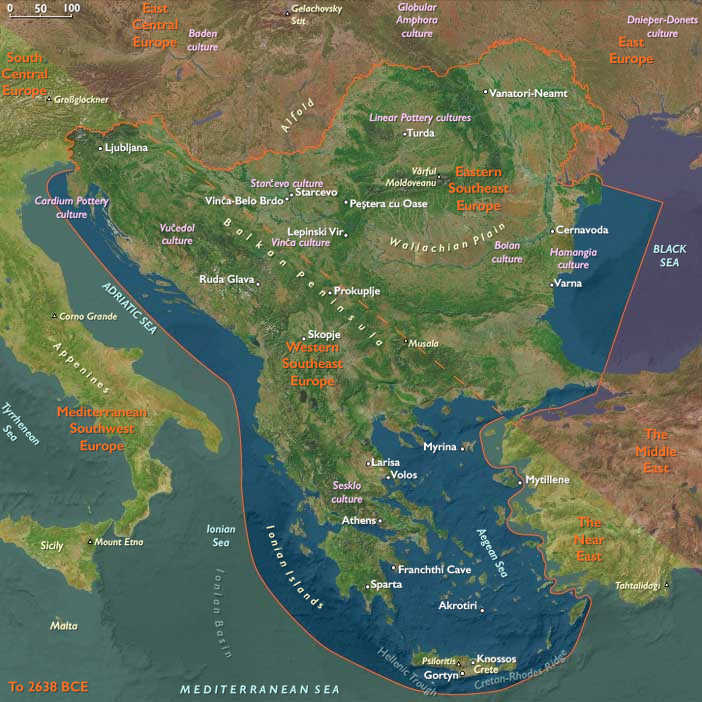
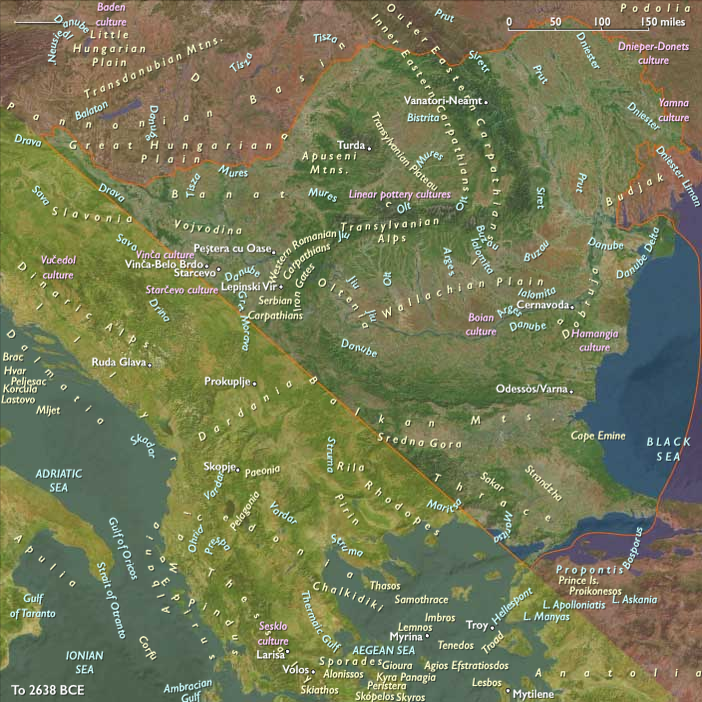
Known since the late nineteenth century excavation at the Neolithic site of Turdas (in Romanian), Tordos (in Hungarian) in Transylvania, by Zsófia Torma, they will be found in 1961 at about thirty kilometers (nineteen miles) from the well-known site of Alba Iulia.
Nicolae Vlassa, an archaeologist at the Cluj Museum, unearthed three inscribed but unbaked clay tablets, together with twenty-six clay and stone figurines and a shell bracelet, accompanied by the burnt, broken, and disarticulated bones of an adult male.
Two of the tablets are rectangular and the third is round.
They are all small, the round one being only six centimeters (two and a half inches) across, and two—one round and one rectangular—have holes drilled through them.
Vlassa baked the originally unbaked clay tablets to preserve them.
Because of this, direct dating of the tablets themselves through thermoluminescence is not possible.
All three have symbols inscribed only on one face.
Similar motifs have been found on pots excavated at Vinca in Serbia and a number of other locations in the southern Balkans.
The unpierced rectangular tablet depicts a horned animal, another figure, and a branch or tree.
The others have a variety of mainly abstract symbols.
The purpose of the burial is unclear, but it has been suggested that the body was that of a shaman or spirit-medium.
The tablets are generally believed to have belonged to the Vinca-Turdas culture, which at the time was believed by Serbian and Romanian archaeologists to have originated around 2700 BCE.
Vlassa interpreted the Tartaria tablets as a hunting scene and the other two with signs as a kind of primitive writing similar to the early pictograms of the Sumerians.
The discovery caused great interest in the archaeological world as it predated the first Minoan writing, the oldest known writing in Europe.
Locations
Groups
Topics
Subjects
Regions
Subregions
Years: 5373BCE - 5230BCE
Locations
Groups
Topics
Subjects
Regions
Subregions