
The Three Kingdoms period in China’s history, …
Years: 388 - 399
The Three Kingdoms period in China’s history, part of an era of disunity called the Six Dynasties immediately following the loss of de facto power of the Han dynasty emperors, refers in a strict academic sense to the period between the foundation of the Wu in 222 and the conquest of the Shu by the Kingdom of Wei in 263.
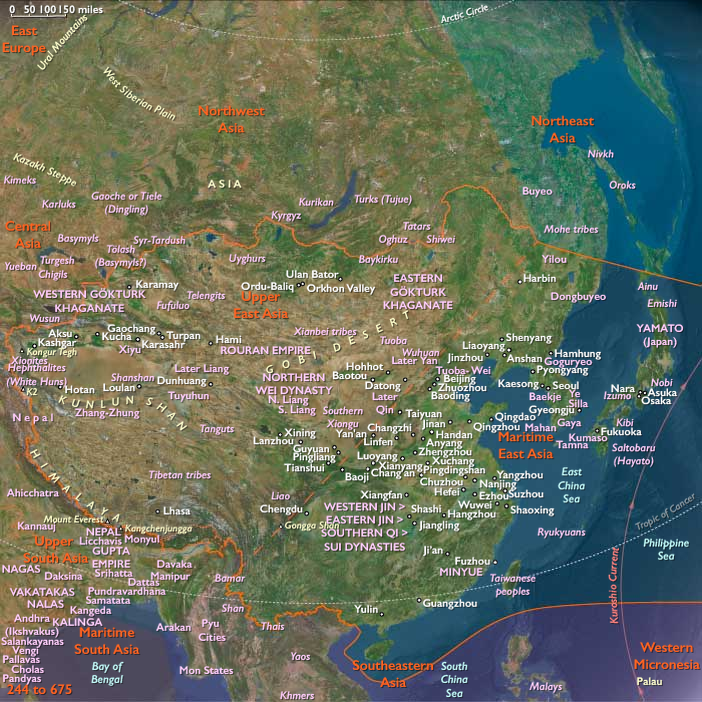
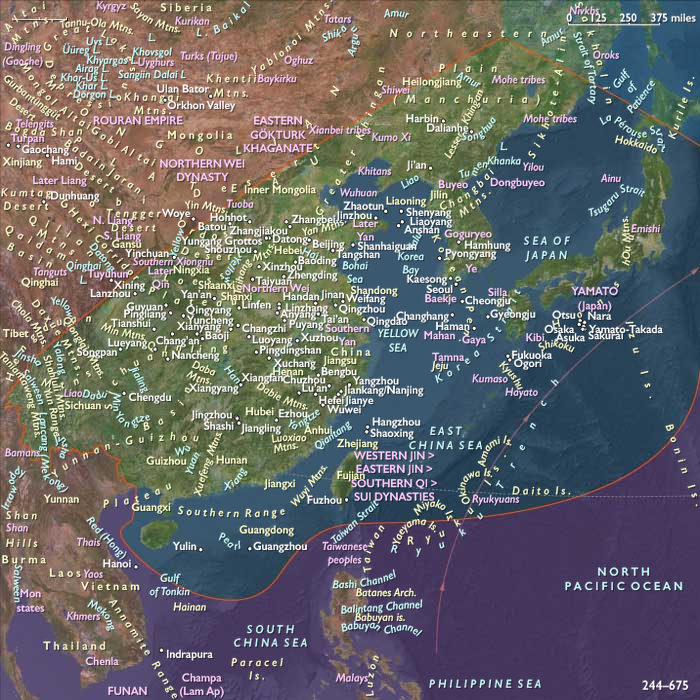
Although the three kingdoms had been reunited temporarily in 278 by the Jin Dynasty founded in 265 by the Sima family, the contemporary non-Han Chinese Wu Hu ethnic groups had controlled much of the country in the early fourth century and provoked large-scale Han Chinese migrations to south of the Chang Jiang.
The Di people had rebelled in 303 and later captured Chengdu, establishing the state of Cheng Han.
Under Liu Yuan, the Xiongnu had rebelled near today's Linfen County and established the state of Han Zhao.
His successor Liu Cong had captured and executed the last two Western Jin emperors.
The Sixteen Kingdoms, or less commonly the Sixteen States, are a collection of numerous short-lived sovereign states that have coalesced in China proper and its neighboring areas from 304 after the retreat of the Jin Dynasty to South China in 317.
Almost all rulers of the kingdoms are part of the Wu Hu ethnicity and claim to be the emperors and wangs (kings).
Many nomadic ethnic groups are involved, including ancestors of the Turks, Mongolians, and Tibetans, most of which peoples had to some extent been "Sinicized" long before their ascent to power.
Some of them, notably the Qiang and the Xiongnu, had already been allowed to live in the frontier regions within the Great Wall since late Han times.
The Han Chinese have founded Former Liang and the state of Wei.
Six Chinese rulers of the Former Liang remained titularly under the government of the Jin Dynasty, whose emperors, who are of Chinese stock, now rule southern China from Nanjing.
The Tuoba seizure of China’s northern border areas in 386 has little affected the Chinese heartland, which boasts a large population and a well-integrated social and economic system organized along Confucianist and Buddhist principles.
By the close of the fourth century, a series of sixteen nomadic kingdoms have ruled North China since the erection of the first Xiongnu kingdom in the century’s first decade.
Emperors of Chinese stock rule southern China from Nanjing.
Prominent figure painter Gu Kaizhi, who flourishes in the latter half of the fourth century, is the putative creator of a hand scroll (the earliest surviving example) entitled Admonitions of the Instructress of the Ladies of the Palace.
Such scrolls typically portray human figures as edifying exemplars of good character.
The creator of Admonitions, employing a needle-fine brush point, brings a keen psychological sense to the delineation of his subjects, embodying them by their clothes, rather than by their flesh.
The Admonition Scroll, dated between the sixth and eighth century CE—probably an early Tang dynasty copy —illustrates nine stories from a political satire about Empress Jia Nanfeng written by Zhang Hua, who lived from about 232 to 302.
Beginning in the eighth century, many collectors and emperors left seals, poems, and comments on the scroll.
The Admonition Scroll will be stored in the emperor's treasure until it is looted by the British army in the Boxer Uprising in 1900.
It is today in the British Museum collection, missing the first three scenes.
There is another surviving copy of this painting, made during the Song Dynasty and is now held in the Palace Museum in Beijing.
The Song version is complete in twelve scenes.
Locations
People
Groups
- Qiang people
- Buddhism
- Confucianists
- Xiongnu (Hsiung-nu)
- Xianbei
- Tuoba
- Di (Wu Hu)
- Chouchi, Di state of
- Chinese Empire, Tung (Eastern) Jin Dynasty
- Former Qin, Di kingdom of
- Later Liang, Di kingdom of
- Later Yan, Xianbei kingdom of
- Western Yan, Xianbei state of
- Later Qin, Qiang kingdom of
- Northern Wei, Xianbei, or Tuoba Empire
- Wei, Dingling state of
- Tibetan people
Topics
- Silk Road transmission of Buddhism
- Six Dynasties Period in China
- Sixteen Kingdoms Period in China
- Civil Wars in China triggered by the Wu Hu Invasion
Commodoties
Subjects
Regions
Subregions
Years: 388 - 399
Locations
People
Groups
- Qiang people
- Buddhism
- Confucianists
- Xiongnu (Hsiung-nu)
- Xianbei
- Tuoba
- Di (Wu Hu)
- Chouchi, Di state of
- Chinese Empire, Tung (Eastern) Jin Dynasty
- Former Qin, Di kingdom of
- Later Liang, Di kingdom of
- Later Yan, Xianbei kingdom of
- Western Yan, Xianbei state of
- Later Qin, Qiang kingdom of
- Northern Wei, Xianbei, or Tuoba Empire
- Wei, Dingling state of
- Tibetan people
Topics
- Silk Road transmission of Buddhism
- Six Dynasties Period in China
- Sixteen Kingdoms Period in China
- Civil Wars in China triggered by the Wu Hu Invasion
Commodoties
Subjects
Regions
Subregions