
The Third Carnatic War had spread beyond …
Years: 1760 - 1760
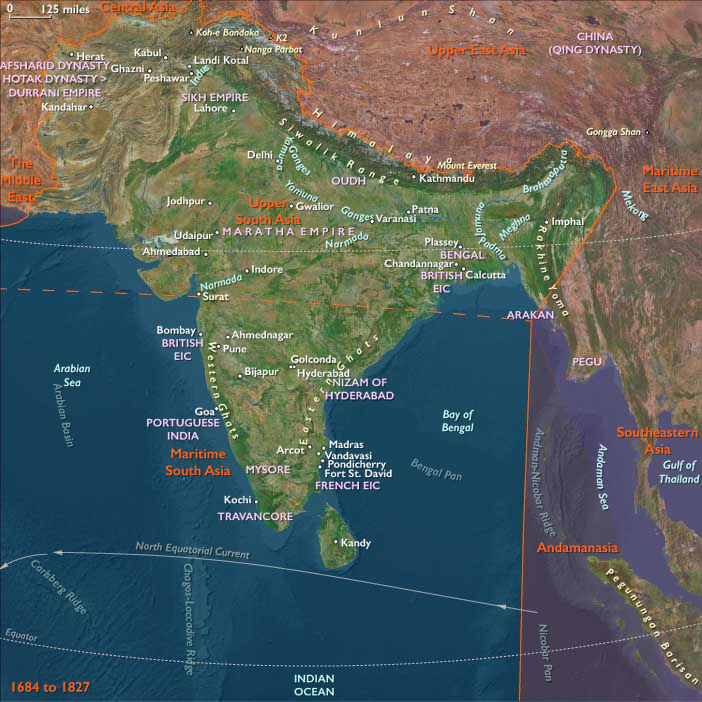
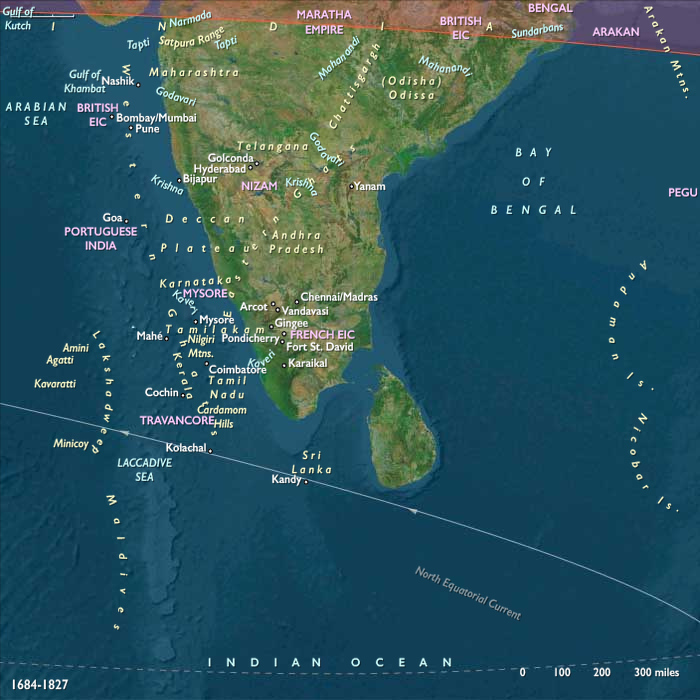
The Third Carnatic War had spread beyond southern India and into Bengal, where British forces had captured the French settlement of Chandernagore (now Chandannagar) in 1757.
The war is decided, however, in the south, as British commander Sir Eyre Coote decisively defeats the French under the Comte de Lally at the Battle of Wandiwash in 1760.
Locations
People
Groups
- France, (Bourbon) Kingdom of
- Carnatic, Nawabs of the
- Britain, Kingdom of Great
- East India Company, British (United Company of Merchants of England Trading to the East Indies)
- French Company of the Indies
- Hyderabad, State of
Topics
Commodoties
Subjects
Regions
Subregions
Related Events
Filter results
Showing 10 events out of 26415 total
The general Fouqué is defeated by the Austrians in the Battle of Landshut.
The French capture Marburg, and the Swedes part of Pomerania.
The Hanoverians are victorious over the French at the Battle of Warburg, their continued success preventing France from sending troops to aid the Austrians against Prussia in the east.
Despite this, the Austrians, under the command of General Laudon, capture Glatz (now Kłodzko, Poland) in Silesia.
In the Battle of Liegnitz, Frederick scores a strong victory despite being outnumbered three to one.
The Russians under General Saltykov and Austrians under General Lacy briefly occupy his capital, Berlin, in October, but cannot hold it for long.
Still, the loss of Berlin to the Russians and Austrians is a great blow to Frederick's prestige as many point out that the Prussians have no hope of occupying temporarily or otherwise St. Petersburg or Vienna.
The end of this year sees Frederick once more victorious, defeating the able Daun in the Battle of Torgau; but he suffers very heavy casualties, and the Austrians retreat in good order.
Meanwhile, after the battle of Kunersdorf, the Russian army has been largely inactive due mostly to their tenuous supply lines.
Russian logistics were so poor that in October 1759, an agreement was signed under which the Austrians undertook to supply the Russians as the quartermaster's department of the Russian Army was badly strained by the demands of Russian armies operating so far from home.
As it is, the requirement that the Austrian quartermaster's department supply both the Austrian and Russian armies proves beyond its capacity, and in practice, the Russians receive little in the way of supplies from the Austrians.
At Liegnitz (now Legnica, Poland), the Russians arrive too late to participate in the battle.
They make two attempts to storm the fortress of Kolberg, but neither succeed.
The tenacious resistance of Kolberg allows Frederick to focus on the Austrians instead of having to split his forces.
The Frankists continue their sectarian ways despite their mass baptism into Roman Catholic Christianity.
As a result, the Roman Inquisition imprisons Frank in 1760 in the fortress of Czestochowa.
Under Peshwa Baji Rao, Gujarat, Malwa and Rajputana had come under Maratha control.
Finally, in 1737, Baji Rao had defeated the Mughals on the outskirts of Delhi and brought much of the former Mughal territories south of Delhi under Maratha control.
Baji Rao's son Balaji Baji Rao (popularly known as Nana Saheb) had further increased the territory under Maratha control by invading Punjab in 1758.
This had brought the Marathas into direct confrontation with the Durrani empire of Ahmad Shah Abdali.
In 1759 he had raised an army from the Pashtun and Baloch tribes and made several gains against the smaller Maratha garrisons in Punjab.
He now joinswith his Indian allies—the Rohilla Afghans of the Gangetic Doab—forming a broad coalition against the Marathas.
The Marathas, under the command of Sadashivrao Bhau, respond by gathering an army of between forty-five thousand to sixty thousand, which is accompanied by roughly two hundred thousand non-combatants, a number of whom are pilgrims desirous of making pilgrimages to Hindu holy sites in northern India.
The Marathas had started their northward journey from Patdur on March 14, 1760.
Both sides had tried to get the Nawab of Awadh, Shuja-ud-Daulah, into their camp.
By late July Shuja-ud-Daulah had made the decision to join the Afghan-Rohilla coalition, preferring to join what is perceived as the "army of Islam".
This is strategically a major loss for the Marathas, since Shuja provides much-needed finances for the long Afghan stay in North India.
The Marathas had gained control of a considerable part of India in the intervening period (1707–1757).
In 1758 they had occupied Delhi, captured Lahore and driven out Timur Shah Durrani, the son and viceroy of the Afghan ruler, Ahmad Shah Abdali.
This is the high-water mark of the Maratha expansion, where the boundaries of their empire extend in the north to the Indus and the Himalayas, and in the south nearly to the extremity of the peninsula.
This territory is ruled through the Peshwa, who talks of placing his son Vishwasrao on the Mughal throne.
However, Delhi still remains under the nominal control of Mughals, key Muslim intellectuals including Shah Waliullah and other Muslim clergy in India who are alarmed at these developments.
In desperation they appeal to Ahmad Shah Abdali, the ruler of Afghanistan, to halt the threat
Britain drives the French out of India in 1760 and achieves superiority on the subcontinent.
This is a form of absolute monarchy or despotism in which rulers embrace the principles of the Enlightenment, especially its emphasis upon rationality, and apply them to their territories.
They tend to allow religious toleration, freedom of speech and the press, and the right to hold private property.
Most foster the arts, sciences, and education.
Charles shares these ideals with other monarchs, including Maria Theresa of Austria, her son Joseph, and Catherine II of Russia, (the Great).
The principles of the Enlightenment had been applied to his rule in Naples and he intends to do the same in Spain, though on a much larger scale.
Charles goes about his reform with the help of the Marquis of Esquilache, Count of Aranda, Count of Campomanes, Count of Floridablanca, Ricardo Wall and the Genoan aristocrat Jerónimo Grimaldi.
Thanks to these principles, the king decides to forbid bullfighting, a practice regarded by the king himself as brutal and uncivilized.
The first crisis that Charles has to deal with is the death of his beloved wife Maria Amalia, who dies unexpectedly at aged thirty-five on September 27, 1760, at the Palace of Buen Retiro on the eastern outskirts of Madrid.
She is buried at the El Escorial in the royal crypt.
In this paper he introduces the idea that earthquakes spread out as waves through the Earth and that they involve the offsets in geological strata now known as faults.
He is able to estimate both the epicenter and the focus of the Lisbon earthquake, and may also have been the first to suggest that a tsunami is caused by a submarine earthquake.
Michell’s essay not only provides insights on earthquakes but also, more broadly, represents an advance in the understanding of the geology of the Earth’s crust.
He recognizes that the Earth is composed "of regular and uniform strata", some of which have been interrupted by upheavals.
Exhibiting a remarkable knowledge of the geological strata in various parts of England and abroad, he draws on his own observations to advance the understanding of sedimentary stratigraphy and is the first to define the Mesozoic stratigraphy in the U.K.
In 1760, as a result of this work, he was elected a member of the Royal Society.
King George III of Hanover assumes the British Throne in 1760.
The French forces retreat to Montreal, where on September 8 they surrender to overwhelming British numerical superiority.
The Seven Nations of Canada, seeing French and native defeat, resign from the war in 1760 and negotiate the Treaty of Kahnawake with the British.
Among its conditions is their unrestricted travel between Canada and New York, as the nations have extensive trade between Montreal and Albany as well as populations living throughout the area.
In February 1760, they attack Fort Prince George in an attempt to rescue their hostages.
The fort's commander is killed.
His replacement massacres all of the hostages and fends off the attack.
The Cherokee also attack Fort Ninety Six, but it withstands the siege.
The Cherokee expand their retaliatory campaign into North Carolina, as far east as modern day Winston-Salem.
An attack on Fort Dobbs in North Carolina is repulsed by General Hugh Waddell.
However, lesser settlements in the North and South Carolina back-country quickly fall to Cherokee raids.
Governor Lyttleton appeals for help to Jeffrey Amherst, the British commander in North America.
Amherst sends Archibald Montgomerie with an army of twelve hundred troops (the Royal Scots and Montgomerie's Highlanders) to South Carolina.
Montgomerie's campaign razes some of the Cherokee Lower Towns, including Keowee.
It ends with a defeat at Echoee (Itseyi) Pass when Montgomerie tried to enter the Middle Towns territory.
Later in 1760, the Overhill Cherokee defeat the British colonists at Fort Loudoun and take it over.
British authorities, assuming control of New France, grant Jews the right of residence in Canada in 1760. (Canada's first synagogue will be established eight years later in Montréal.)
Beginning in 1760 much of the Acadians' former land is distributed under grant to the New England Planters.
The lack of available farmland compels many Acadians to seek out a new livelihood as fishermen on the west coast of Nova Scotia, known as the French Shore.
The British authorities scatter other Acadians in small groups along the shores of the Atlantic Ocean and the Gulf of Saint Lawrence.
Years: 1760 - 1760
Locations
People
Groups
- France, (Bourbon) Kingdom of
- Carnatic, Nawabs of the
- Britain, Kingdom of Great
- East India Company, British (United Company of Merchants of England Trading to the East Indies)
- French Company of the Indies
- Hyderabad, State of
