
The Third Anglo-Ashanti War lasts from 1873 …
Years: 1874 - 1874
The Third Anglo-Ashanti War lasts from 1873 to 1874.
In 1869 a German missionary family and a Swiss missionary had been taken to Kumasi.
They had been hospitably treated, but a ransom had been required for them.
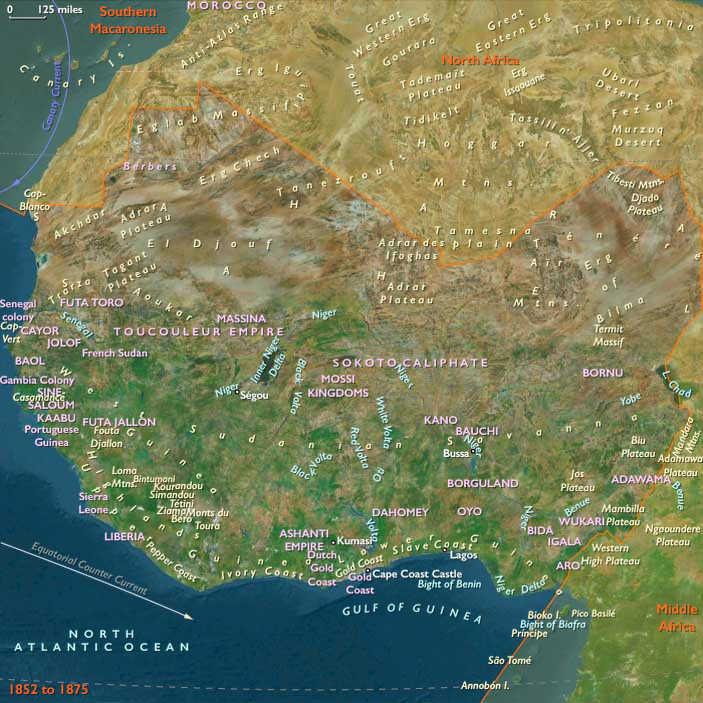
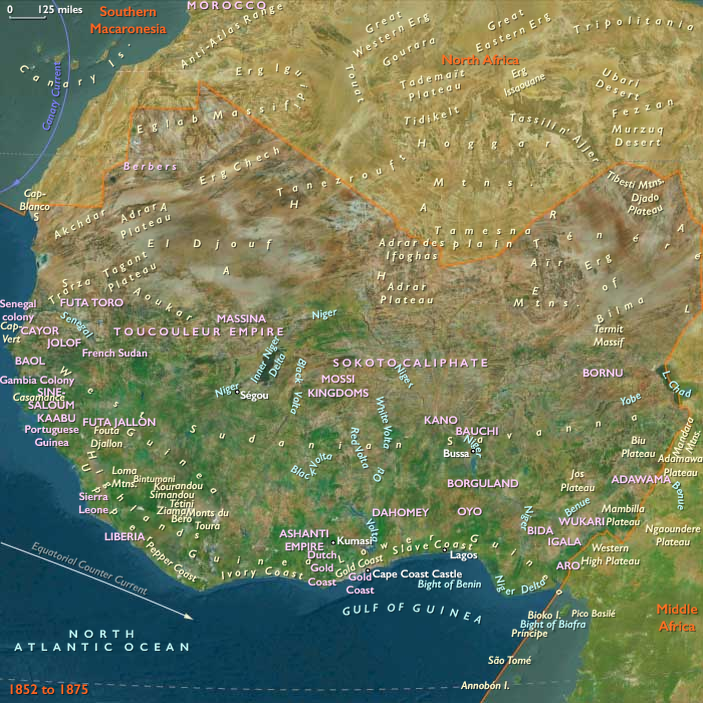
In 1871, Britain had purchased the Dutch Gold Coast from the Dutch, including Elmina, which is claimed by the Ashanti.
The Ashanti had invaded the new British protectorate.
General Garnet Wolseley, with twenty-five hundred British troops and several thousand West Indian and African troops (including some Fante), had been sent against the Ashanti, and will subsequently become a household name in Britain.
The war is covered by war correspondents, including Henry Morton Stanley and G. A. Henty.
Military and medical instructions are printed for the troops.
The British government refuses appeals to interfere with British armaments manufacturers who sell to both sides.
Wolseley had gone to the Gold Coast in 1873, and made his plans before the arrival of his troops in January 1874.
He fights the Battle of Amoaful on January 31 of that year, and, after five days' fighting, ends with the Battle of Ordashu.
The capital, Kumasi, is abandoned by the Ashanti and is briefly occupied by the British and burned.
The British are impressed by the size of the palace and the scope of its contents, including "rows of books in many languages.”
The Asantahene, the ruler of the Ashanti, signs a harsh British treaty, the Treaty of Fomena, in July 1874, to end the war.
Among articles of the treaty between H.M. Victoria, Queen of Great Britain and Ireland and H.M. Kofi Karikari, King of Ashanti are that "The King of Ashanti promises to pay the sum of 50,000 ounces of approved gold as indemnity for the expenses he has occasioned to Her Majesty the Queen of England by the late war..."
The treaty also states that "There shall be freedom of trade between Ashanti and Her Majesty's forts on the [Gold] Coast, all persons being at liberty to carry their merchandise from the Coast to Kumasi, or from that place to any of Her Majesty's possessions on the Coast."
Furthermore, the treaty stated that "The King of Ashanti guarantees that the road from Kumasi to the River Pra shall always be kept open..." ("The Treaty with the King of the Ashantees" (11 June 1874) Wanganui Herald, New Zealand, Volume VIII, Issue 2195)
Wolseley completes the campaign in two months, and re-embarks them for home before the unhealthy season begins.
There had been three hundred British casualties.
From this point on, Asante power will steadily decline.
Locations
People
Groups
- Fante people
- Ashanti of Kumasi, Kingdom of the
- Britain (United Kingdom of Great Britain and Ireland)
- Gold Coast, British colony
- Fante Confederacy
- Gold Coast Crown Colony
Topics
Commodoties
Subjects
Regions
Subregions
Years: 1874 - 1874
Locations
People
Groups
- Fante people
- Ashanti of Kumasi, Kingdom of the
- Britain (United Kingdom of Great Britain and Ireland)
- Gold Coast, British colony
- Fante Confederacy
- Gold Coast Crown Colony
Topics
Commodoties
Subjects
Regions
Subregions