
Alexander the Molossian, the Epirote king called …
Years: 302BCE - 302BCE
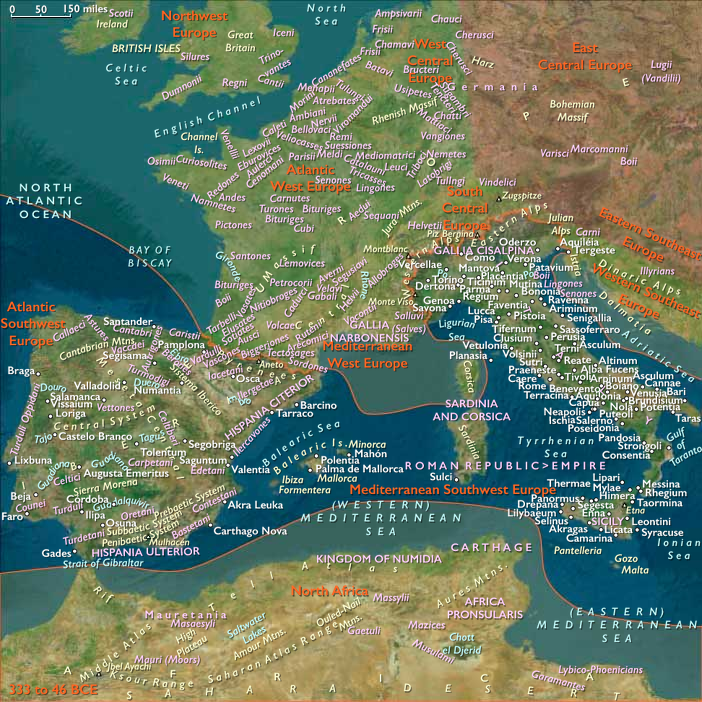
Alexander the Molossian, the Epirote king called to the aid of Taras, had claimed a victory over the Messapians between 333 BCE and 330 BCE.
The Messapians had joined forces with the Tarentines ater his death in 330 BCE to face an even greater force, that of Rome.
Taranto, attacked by the Lucanians in 304 BCE, asks for the help of Agathocles, who arrives in southern Italy and takes control of Bruttium (present-day Calabria), but is later called back to Syracuse.
Cleonymus of Sparta establishes an alliance with Taranto against the Lucanians in 303 BCE - 302 BCE, and fights against them.
To help Taranto against the Lucani, Cleonymus had gone as mercenary leader to southern Italy in 303 BCE with the backing of the Spartan administration..
There are two different accounts of his Italian expedition; one written by Diodorus Siculus and one by Livy, but the relations between the two sources are unclear.
The historian Thomas Lenschau supposes that they describe two different campaigns of Cleonymus: that one described by Diodorus Siculus would have taken place in 303 BCE and that one described by Livy in 302 BCE.
According to Diodorus Siculus, Cleonymus raises such a large army that the Lucani immediately conclude peace.
Then the Spartan prince takes the city of Metaponto and sails to Corcyra, which island he also quickly captures.
Learning that Taranto and other cities have broken with him, he sails back and is at first successful, but then he is defeated at a night attack.
As many of his ships are destroyed by a storm at the same time, he has to withdraw to Corcyra ion 303 or 302 BCE).
Probably in the next year (302 BCE) Cleonymus returns to Italy and—according to Livy—first conquers a city called Thuriae, location unknown, but Roman armies force him back to his ships.
The alliance with Taras and with Cleonymus of Sparta is essentially an anti-Roman campaign.
Thus, towards the end of the fourth century, Rome had become a common enemy for both the Iapygians and the Tarentines, even as far as ending the prolonged battles and causing them to make an alliance.
Locations
People
Groups
- Italy, classical
- Iapydes
- Sparta, Kingdom of
- Taras (Dorian Greek) city-state of
- Roman Republic
- Lucani
- Greece, Hellenistic
Topics
Commodoties
Subjects
Regions
Subregions
Related Events
Showing 10 events out of 64140 total
Years: 302BCE - 302BCE
Locations
People
Groups
- Italy, classical
- Iapydes
- Sparta, Kingdom of
- Taras (Dorian Greek) city-state of
- Roman Republic
- Lucani
- Greece, Hellenistic
Topics
Commodoties
Subjects
Regions
Subregions