
A French expeditionary force had departed from …
Years: 1797 - 1797
January
A French expeditionary force had departed from Brest on an expedition to invade Ireland in December 1796.
This army of eighteen thousand French soldiers is intended to link up with the secret organization of Irish nationalists known as the United Irishmen and provoke a widespread uprising throughout the island.
It is hoped that the resulting war will force Britain to make peace with the French Republic or risk losing control of Ireland altogether.
Led by Vice-Admiral Morard de Galles, General Lazare Hoche and leader of the United Irishmen Wolfe Tone, the invasion fleet includes seventeen ships of the line, twenty-seven smaller warships and transports, and carries extensive field artillery, cavalry and military stores to equip the Irish irregular forces they hope to raise.
During December 1796 and early January 1797, the French army has repeatedly attempted to land in Ireland.
Early in the voyage, the frigate Fraternité carrying de Galles and Hoche had been separated from the fleet and missed the rendezvous at Mizen Head.
Admiral Bouvet and General Grouchy decided to attempt the landing at Bantry Bay without their commanders, but severe weather made any landing impossible.
For more than a week the fleet had waited for a break in the storm, until Bouvet abandoned the invasion on December 29 and, after a brief and unsuccessful effort to land at the mouth of the River Shannon, ordered his scattered ships to return to Brest.
During the operation and subsequent retreat a further eleven ships have been wrecked or captured, with the loss of thousands of soldiers and sailors.
By January 13 most of the survivors of the fleet have limped back to France in a state of disrepair.
One ship of the line that remaind at sea, the sevnty-four-gun Droits de l'Homme, is commanded by Commodore Jean-Baptiste Raymond de Lacrosse and carries over thirteen hundred men, seven hundred to eight hundred of them soldiers, including General Jean Humbert.
Detached from the main body of the fleet during the retreat from Bantry Bay, Lacrosse had made his way to the mouth of the Shannon alone.
Recognizing that the weather was still too violent for a landing to be made, Lacrosse had acknowledged the failure of the operation and ordered the ship to return to France, capturing the British privateer Cumberland en route.
British admiral Sir Edward Pellew too is on his way back to Brest in HMS Indefatigable, accompanied by HMS Amazon under the command of Captain Robert Carthew Reynolds.
While the rest of the Channel Fleet had been pursuing the French without success, Pellew had had his ships refitted and resupplied at Falmouth so that both frigates are at full complement, well armed and prepared for action
The two ships drive the Droits de l'Homme aground on the coast of Brittany in weather in the so-called Action of 13 January 1797.
Locations
People
Groups
- Ireland, (English) Kingdom of
- Britain, Kingdom of Great
- United Irishmen, Society of
- French First Republic
Topics
- First Coalition, War of the
- French Revolutionary Wars, or “Great French War”
- French Revolutionary Wars: Campaigns of 1797
- Action of 13 January 1797
Subjects
Regions
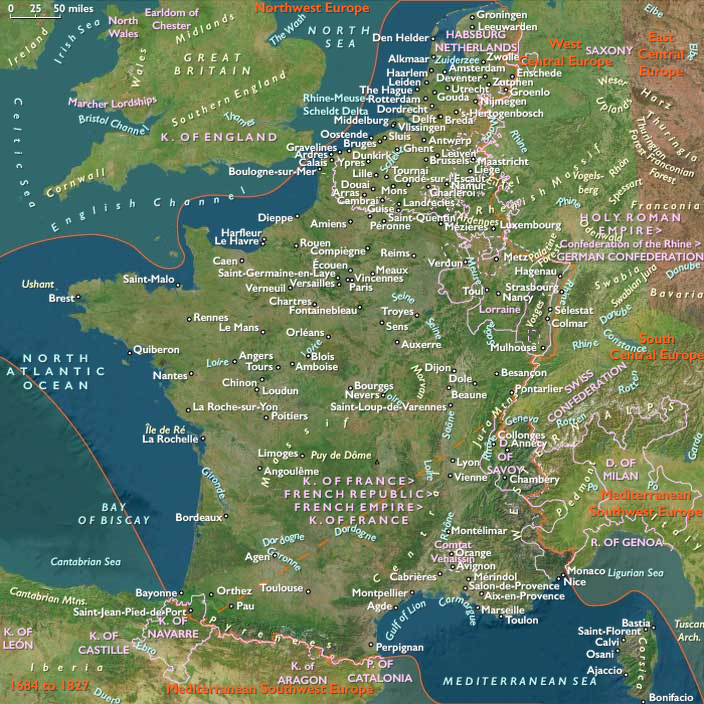
Subregions
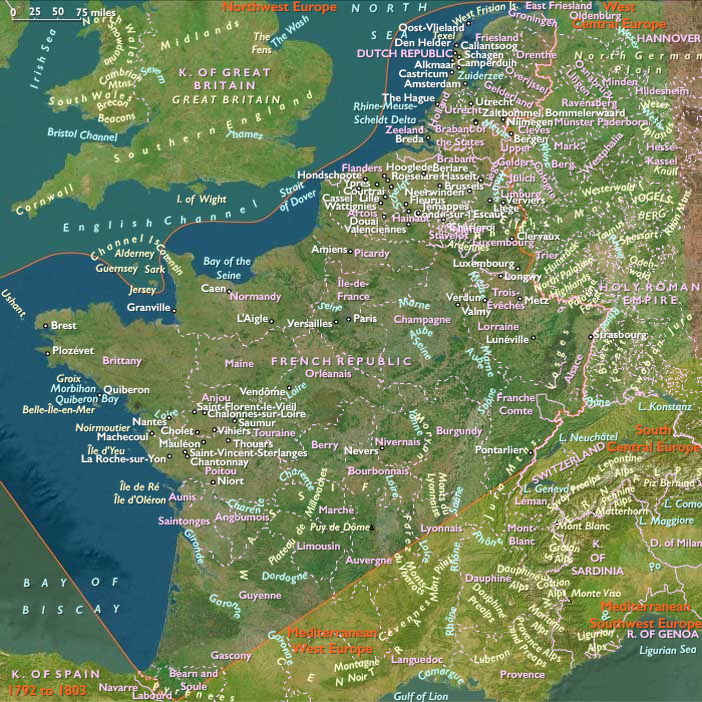
Related Events
Showing 10 events out of 23144 total
Years: 1797 - 1797
January
Locations
People
Groups
- Ireland, (English) Kingdom of
- Britain, Kingdom of Great
- United Irishmen, Society of
- French First Republic
Topics
- First Coalition, War of the
- French Revolutionary Wars, or “Great French War”
- French Revolutionary Wars: Campaigns of 1797
- Action of 13 January 1797
Subjects
Regions
Subregions