
The Teutonic army has around nine thousand …
Years: 1454 - 1454
September
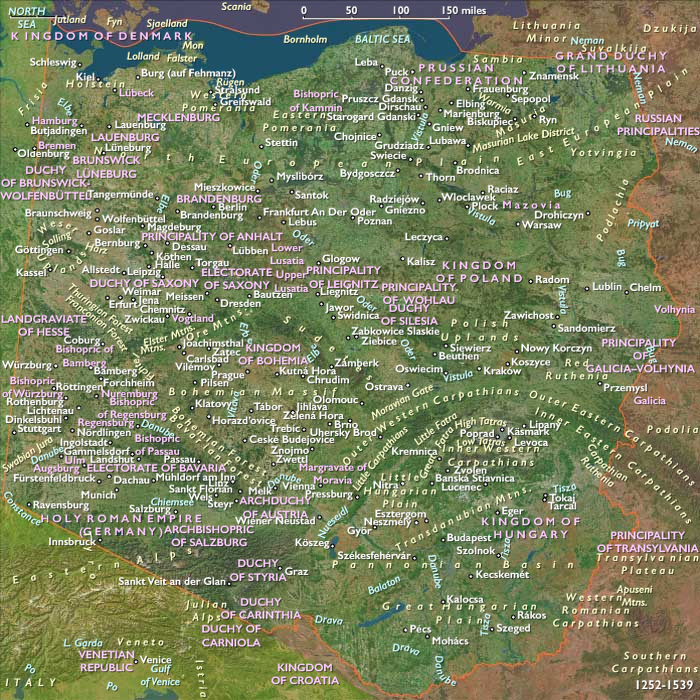
The Teutonic army has around nine thousand cavalry and six thousand infantry under Bernard Szumborski.
The Polish army has sixteen thousand cavalry, a few thousand servants (who can be and usually are used in battles), a few hundred infantry, plus five hundred mercenaries and burghers from Gdańsk and two thousand mercenaries hired by the Prussian Confederacy, all under the command of King Casimir IV, advised by chancellor Jan Koniecpolski and Piotr from Szczekociny.
The Polish commanders are counting on the battle of Chojnice being won by the Polish heavy cavalry, not caring much about either artillery or infantry.
They had not thought that their opponents could change their traditional strategy, or that the Teutonic soldiers besieged in Chojnice could be anything more than spectators.
Bernard Szumborski, nonetheless, has planned a totally different kind of battle.
The Polish defeat is complete.
Three thousand bodies are left on the battlefield, three hundred knights are captured by the Teutons, including three main commanders: Mikolaj Szarlejski, Łukasz Górka, and Wojciech Kostka from Postupice.
The Teutonic Knights lose only around a hundred men.
Bernard Szumborski, is however, formally a Polish prisoner, since he had given a knight's word.
The battle proves that discipline and improved tactics, combined with a talented commander, can win against a larger, but more traditional army.
The Poles pay the price for ignoring terrain, infantry and artillery.
Locations
People
Groups
- Prussians, Old, or Baltic (Western Balts)
- Germans
- Papal States (Republic of St. Peter)
- Kashubians
- Bohemia, Kingdom of
- Livonian Order
- Teutonic Knights of Prussia, or Monastic state of the Teutonic Knights (House of the Hospitalers of Saint Mary of the Teutons in Jerusalem)
- France, (Valois) Kingdom of
- Moscow, Grand Principality of
- Hanseatic League
- Poland of the Jagiellonians, Kingdom of
- Lithuania, Grand Duchy of
- Sweden, autonomous Kingdom of
- Kalmar Union (of Denmark, Norway and Sweden)
- England, (Plantagenet, Lancastrian) Kingdom of
- Holy Roman Empire
- Prussian Confederation
- Ottoman Empire
- Ordensstaat (Monastic state of the Teutonic Knights)
Topics
- Ostsiedlung (German: Settlement in the East), a.k.a. German eastward expansion
- Renaissance Papacy
- Thirteen Years' War, or War of the Cities
Commodoties
Subjects
Regions

Subregions
Related Events
Showing 10 events out of 15 total
Years: 1454 - 1454
September
Locations
People
Groups
- Prussians, Old, or Baltic (Western Balts)
- Germans
- Papal States (Republic of St. Peter)
- Kashubians
- Bohemia, Kingdom of
- Livonian Order
- Teutonic Knights of Prussia, or Monastic state of the Teutonic Knights (House of the Hospitalers of Saint Mary of the Teutons in Jerusalem)
- France, (Valois) Kingdom of
- Moscow, Grand Principality of
- Hanseatic League
- Poland of the Jagiellonians, Kingdom of
- Lithuania, Grand Duchy of
- Sweden, autonomous Kingdom of
- Kalmar Union (of Denmark, Norway and Sweden)
- England, (Plantagenet, Lancastrian) Kingdom of
- Holy Roman Empire
- Prussian Confederation
- Ottoman Empire
- Ordensstaat (Monastic state of the Teutonic Knights)
Topics
- Ostsiedlung (German: Settlement in the East), a.k.a. German eastward expansion
- Renaissance Papacy
- Thirteen Years' War, or War of the Cities
Commodoties
Subjects
Regions
Subregions