
The territories of Indo-Greek king Menander I …
Years: 150BCE - 150BCE
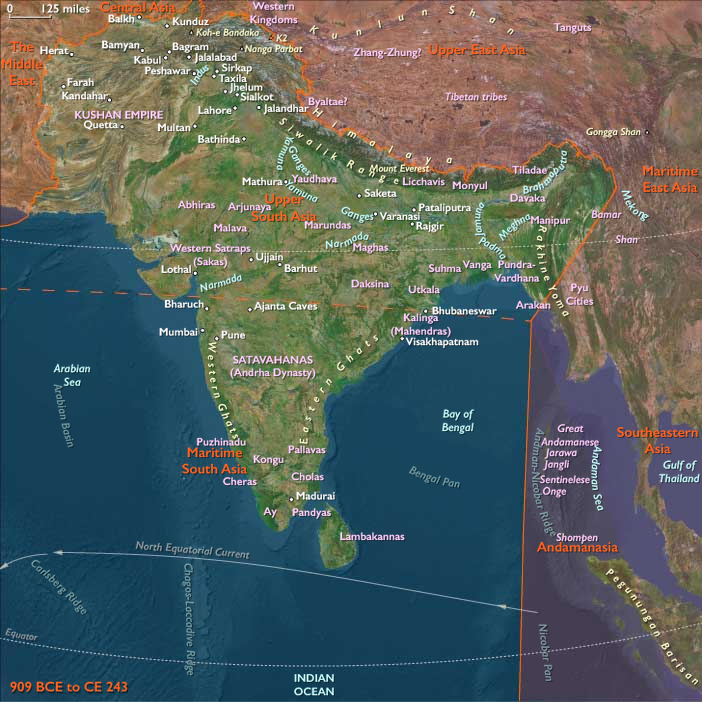
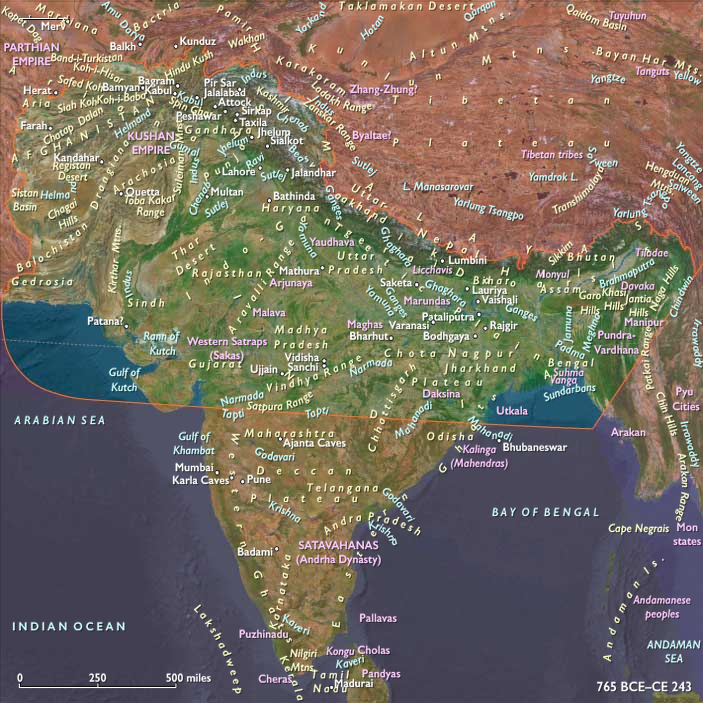
The territories of Indo-Greek king Menander I cover the eastern dominions of the divided Greek empire of Bactria and extend to India (modern day Pakistani provinces of the NWFP, Punjab and parts of Himachal Pradesh and the Jammu region).
His capital is supposed to have been Sagala, a prosperous city in northern Punjab (believed to be modern Sialkot), Pakistan.
He is one of the few Bactrian kings mentioned by Greek authors, among them Apollodorus of Artemita, quoted by Strabo, who claims that the Greeks from Bactria were even greater conquerors than Alexander the Great, and that Menander was one of the two Bactrian kings, with Demetrius, who extended their power farthest into India: "The Greeks who caused Bactria to revolt grew so powerful on account of the fertility of the country that they became masters, not only of Ariana, but also of India, as Apollodorus of Artemita says: and more tribes were subdued by them than by Alexander-- by Menander in particular (at least if he actually crossed the Hypanis towards the east and advanced as far as the Imaüs), for some were subdued by him personally and others by Demetrius, the son of Euthydemus the king of the Bactrians; and they took possession, not only of Patalena, but also, on the rest of the coast, of what is called the kingdom of Saraostus and Sigerdis.
In short, Apollodorus says that Bactriana is the ornament of Ariana as a whole; and, more than that, they extended their empire even as far as the Seres and the Phryni."
(Strabo 11.11.1) Strabo also suggests that these Greek conquests went as far as the capital Pataliputra in northeastern India (today Patna): "Those who came after Alexander went to the Ganges and Pataliputra" (Strabo, 15.698).
The Indian records also describe Greek attacks on Mathura, Panchala, Saketa, and Pataliputra.
This is particularly the case of some mentions of the invasion by Patanjali around 150 BCE, and of the Yuga Purana, which describes Indian historical events in the form of a prophecy: "After having conquered Saketa, the country of the Panchala and the Mathuras, the Yavanas (Greeks), wicked and valiant, will reach Kusumadhvaja.
The thick mud-fortifications at Pataliputra being reached, all the provinces will be in disorder, without doubt.
Ultimately, a great battle will follow, with tree-like engines (siege engines)."
(Gargi-Samhita, Yuga Purana chapter, No.
5).
In the West, Menander seems to have repelled the invasion of the dynasty of Greco-Bactrian usurper Eucratides, and pushed them back as far as the Paropamisadae, thereby consolidating the rule of the Indo-Greek kings in the northern part of the Indian Subcontinent.
The Milinda Panha gives some glimpses of his military methods: "Has it ever happened to you, O king, that rival kings rose up against you as enemies and opponents?
-Yes, certainly.
-Then you set to work, I suppose, to have moats dug, and ramparts thrown up, and watch towers erected, and strongholds built, and stores of food collected?
-Not at all.
All that had been prepared beforehand.
-Or you had yourself trained in the management of war elephants, and in horsemanship, and in the use of the war chariot, and in archery and fencing?
-Not at all.
I had learnt all that before.
-But why?
-With the object of warding off future danger."
(Milinda Panha, Book III, Chap 7)
Locations
People
Groups
Topics
Commodoties
Subjects
Regions
Subregions
Related Events
Showing 10 events out of 63144 total
Years: 150BCE - 150BCE
Locations
People
Groups
Topics
Commodoties
Subjects
Regions
Subregions