
The term Tocharian or Tokharian is based …
Years: 141BCE - 130BCE
The term Tocharian or Tokharian is based on the ethnonym Tokharoi used by Greek historians (e.g.
Ptolemy VI, 11, 6).
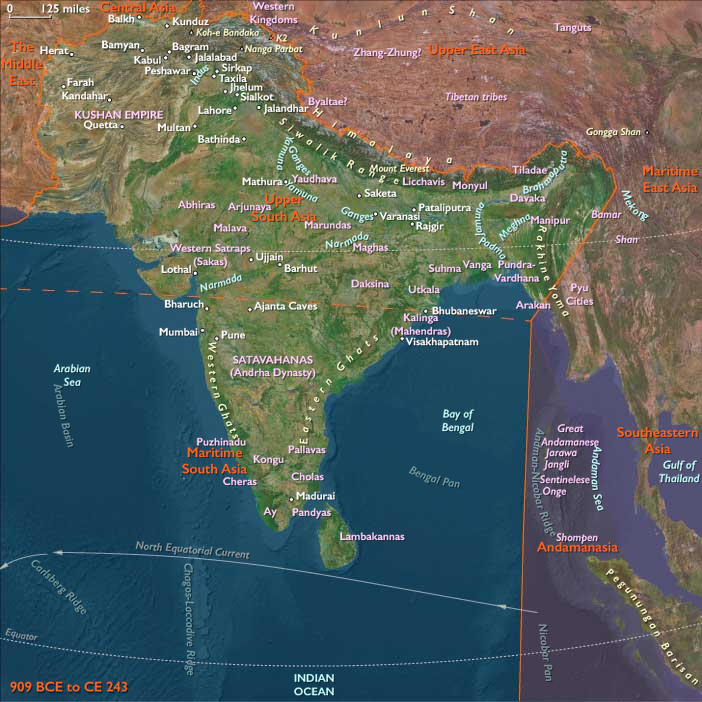
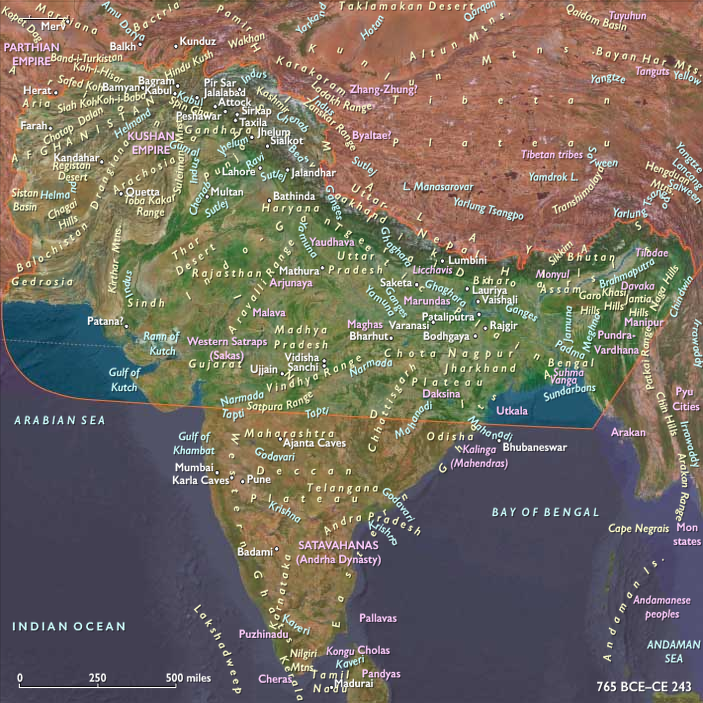
The first Greek mention of the Tocharians appeared in the first century BCE, when Strabo presented them as a Scythian tribe, and explained that the Tocharian—together with the Assianis, Passianis and Sakaraulis—had taken part in the destruction of the Greco-Bactrian kingdom (present day Afghanistan-Pakistan) in the second half of the second century BCE.
These Tocharians have frequently been identified with the Yuezhi and the later (and probably related) Kushan peoples.
Many scholars believe the Yuezhi originally spoke a Tocharian language.
However, the debate about the origins and original language(s) of the Yuezhi and the Kushan continues, and there is no general consensus.
The geographical term Tokharistan usually refers to first millennium Bactria.
Today, the term is associated with those Indo-European languages known as "Tocharian".
Tocharian A is also known as East Tocharian, or Turfanian (of the city of Turpan), and Tocharian B is also known as West Tocharian, or Kuchean.
Based on a Turkic reference to Tocharian A as twqry, these languages were associated with the Kushan ruling class, but the exact relation of the speakers of these languages and the Kushan Tokharoi is uncertain, and some consider "Tocharian languages" a misnomer.
The term is so widely used, however, that this question is somewhat academic.
Tocharians in the modern sense are, then, defined as the speakers of the Tocharian languages.
The last Greco-Bactrian king, Heliocles I, retreats and moves his capital to the Kabul Valley.
The eastern part of Bactria is eventually occupied by Pashtun people.
Locations
People
Groups
- Tocharians
- Yuezhi
- Pashtun people (Pushtuns, Pakhtuns, or Pathans)
- Greeks, Hellenistic
- Greco-Bactrian Kingdom
- Han Dynasty (Western)
- Kucha
Topics
Commodoties
Subjects
Regions
Subregions
Years: 141BCE - 130BCE
Locations
People
Groups
- Tocharians
- Yuezhi
- Pashtun people (Pushtuns, Pakhtuns, or Pathans)
- Greeks, Hellenistic
- Greco-Bactrian Kingdom
- Han Dynasty (Western)
- Kucha
Topics
Commodoties
Subjects
Regions
Subregions