
Filters:
The term Muscadin, meaning "wearing musk perfume" …
Years: 1795 - 1795
April
The term Muscadin, meaning "wearing musk perfume" has come to these refer mobs of young men, relatively well-off and dressed in a dandyish manner, who are the street fighters of the Thermidorian Reaction in Paris in the French Revolution.
After the coup against Robespierre and the Jacobins of 9 Thermidor Year II, or 27 July 1794, they had taken on the remaining Jacobins and sans-culottes, and have largely succeeded in intimidating them over the next year or two.
In prints, they are often seen carrying large wooden clubs, which they like to call "constitutions".
Supposedly organized by the politician and journalist Louis-Marie Stanislas Fréron, they will eventually number two thousand to three thousand.
They in fact seem to have mostly consisted of the lower middle-classes, and are quietly encouraged by the shaky new government, who have good reason to fear Jacobin mobs, and wider unrest as the hard winter of 1794-5 has seen increasing hunger among the Parisian working-class.
The Muscadin are considered to be part of the First White Terror in response to the preceding Reign of Terror of the Jacobins.
The "jeunesse dorée" come to have a considerable influence on the National Convention, and after the Jacobin revolt of 12 Germinal, Year III (April 1, 1795), are held to have forced the arrest of the three main "ring-leaders" remaining from the Jacobin regime: Jean-Marie Collot d'Herbois, Bertrand Barère, and Jacques Nicolas Billaud-Varenne, who are all transported to French Guiana.
The law of 18 Germinal, Year III (April 7, 1795) defines five units of measure.
This system continues the tradition of having separate base units for geometrically related dimensions:
The mètre for length
The are (100 m2) for area [of land]
The stère (1 m3) for volume of stacked[40] firewood
The litre (1 dm3) for volumes of liquid
The gramme for mass.
The hectare, equal to a hundred ares, is the area of a square 100 metres on a side (about 2.47 acres), and is still in use.
The early metric system included only a few prefixes from milli (one thousandth) to myria (ten thousand), and they were based on powers of 10 unlike later prefixes added in the SI, which are based on powers of 1,000.
Originally the kilogram was called the "grave"; the "gram" being an alternative name for a thousandth of a grave.
However, the word "grave", being a synonym for the title "count" has aristocratic connotations and is renamed the kilogram.
After the coup against Robespierre and the Jacobins of 9 Thermidor Year II, or 27 July 1794, they had taken on the remaining Jacobins and sans-culottes, and have largely succeeded in intimidating them over the next year or two.
In prints, they are often seen carrying large wooden clubs, which they like to call "constitutions".
Supposedly organized by the politician and journalist Louis-Marie Stanislas Fréron, they will eventually number two thousand to three thousand.
They in fact seem to have mostly consisted of the lower middle-classes, and are quietly encouraged by the shaky new government, who have good reason to fear Jacobin mobs, and wider unrest as the hard winter of 1794-5 has seen increasing hunger among the Parisian working-class.
The Muscadin are considered to be part of the First White Terror in response to the preceding Reign of Terror of the Jacobins.
The "jeunesse dorée" come to have a considerable influence on the National Convention, and after the Jacobin revolt of 12 Germinal, Year III (April 1, 1795), are held to have forced the arrest of the three main "ring-leaders" remaining from the Jacobin regime: Jean-Marie Collot d'Herbois, Bertrand Barère, and Jacques Nicolas Billaud-Varenne, who are all transported to French Guiana.
The law of 18 Germinal, Year III (April 7, 1795) defines five units of measure.
This system continues the tradition of having separate base units for geometrically related dimensions:
The mètre for length
The are (100 m2) for area [of land]
The stère (1 m3) for volume of stacked[40] firewood
The litre (1 dm3) for volumes of liquid
The gramme for mass.
The hectare, equal to a hundred ares, is the area of a square 100 metres on a side (about 2.47 acres), and is still in use.
The early metric system included only a few prefixes from milli (one thousandth) to myria (ten thousand), and they were based on powers of 10 unlike later prefixes added in the SI, which are based on powers of 1,000.
Originally the kilogram was called the "grave"; the "gram" being an alternative name for a thousandth of a grave.
However, the word "grave", being a synonym for the title "count" has aristocratic connotations and is renamed the kilogram.
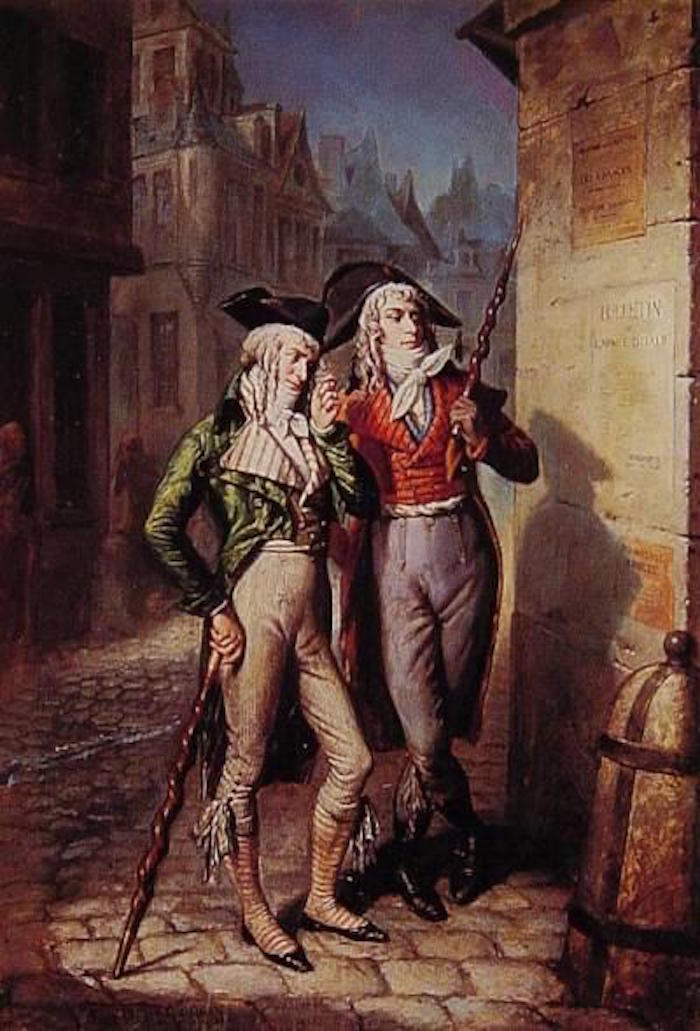
Two muscadins, or Incroyables, in 1795, carrying their "constitutions" (Painting by Louis Alexandre Eustache Loursay)
Locations
People
- Bertrand Barère
- Jacques Nicolas Billaud-Varenne
- Jean-Marie Collot d'Herbois
- Louis-Marie Stanislas Fréron
Groups
- Austria, Archduchy of
- Netherlands, United Provinces of the (Dutch Republic)
- Habsburg Monarchy, or Empire
- Saint Domingue, French Colony of
- French Guiana (French colony)
- Spain, Bourbon Kingdom of
- Britain, Kingdom of Great
- Netherlands, Southern (Austrian)
- Sardinia, Kingdom of (Savoy)
- Naples and Sicily, Bourbon Kingdom of
- French First Republic
Topics
- French Revolution
- Haitian Revolution
- First Coalition, War of the
- French Revolutionary Wars, or “Great French War”
- Vendée, War in the
- Thermidorian Reaction
- French Revolutionary Wars: Campaigns of 1795
Commodoties
Subjects
Regions
Subregions
Years: 1795 - 1795
April
Two muscadins, or Incroyables, in 1795, carrying their "constitutions" (Painting by Louis Alexandre Eustache Loursay)
Locations
People
- Bertrand Barère
- Jacques Nicolas Billaud-Varenne
- Jean-Marie Collot d'Herbois
- Louis-Marie Stanislas Fréron
Groups
- Austria, Archduchy of
- Netherlands, United Provinces of the (Dutch Republic)
- Habsburg Monarchy, or Empire
- Saint Domingue, French Colony of
- French Guiana (French colony)
- Spain, Bourbon Kingdom of
- Britain, Kingdom of Great
- Netherlands, Southern (Austrian)
- Sardinia, Kingdom of (Savoy)
- Naples and Sicily, Bourbon Kingdom of
- French First Republic
Topics
- French Revolution
- Haitian Revolution
- First Coalition, War of the
- French Revolutionary Wars, or “Great French War”
- Vendée, War in the
- Thermidorian Reaction
- French Revolutionary Wars: Campaigns of 1795
Commodoties
Subjects
Regions
Subregions