
The tentative balance between the different ethnic …
Years: 1072 - 1072
The tentative balance between the different ethnic groups within the Fatimid army had collapsed by the 1060s as Egypt suffered through a serious span of drought and famine.
The declining resources had accelerated the problems among the different ethnic factions, and outright civil war had begun, primarily between the Turks and black African troops, while the Berbers shift alliance between the two sides.
The Turkish forces of the Fatimid army had by 1067 seized most of Cairo and held the city and Caliph at ransom, while the Berber troops and remaining Sudanese forces roam the other parts of Egypt, making an already bad situation much worse by ravaging the countryside, destroying the embankments and canals of the Nile.
Badr al-Jamali, ethnically an Armenian, had been purchased by a Syrian emir, Jamal ud-Dawla ibn Ammar, for a relatively small price and converted to Islam.
Later he had joined the Mamluks serving the Fatimid Caliphate.
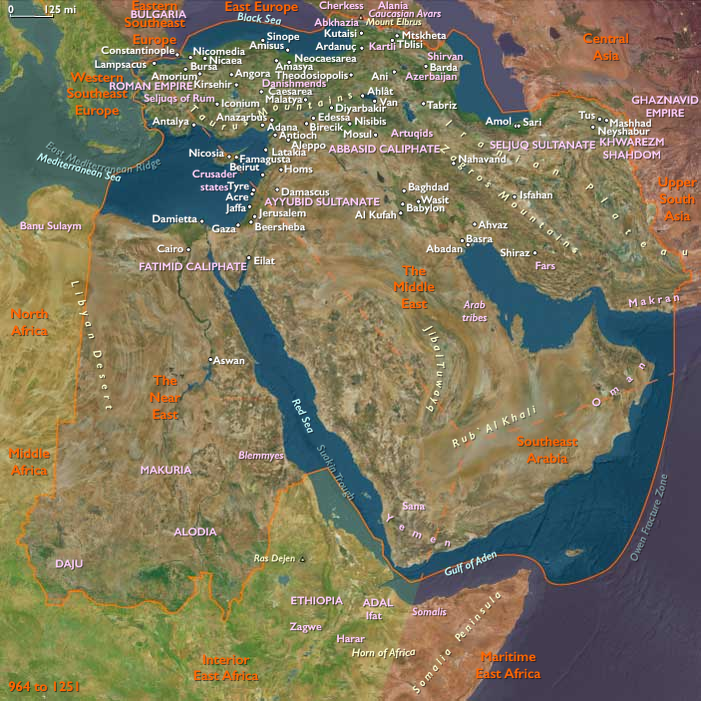
The Fatimid Caliph Abū Tamīm Ma'ad al-Mustansir Billah, in a desperate attempt to save Egypt, by 1072 recalls Badr al-Jamali, who is at this time the governor of Acre, Palestine.
The ten thousand animals that al-Mustansir's stables once held reportedly deteriorated to the point where only three thin horses were left; it is said that eventually al-Mustansir alone possessed a horse, and that when he rode out, the courtiers followed on foot, having no beast to carry them; it is also said that his escort once fainted from hunger as it accompanied him through the streets.
As long as the calamity lasts, the condition of the country continues to decline.
The protracted famine is followed inevitably by plague; whole districts are absolutely denuded of population and house after house lies empty.
Concurrently, the Turkish mercenaries have drained the treasury; many of the works of art and valuables of all sorts in the palace have been sold to satisfy their demands—often they themselves are the purchasers, at merely nominal prices, and resell the articles thus gained at a profit.
Emeralds valued at three hundred thousand dinars had been bought by one Turkish general for five hundred dinars, and in one fortnight of the year 1068, articles to the value of thirty million dinars had been sold off to provide pay for the Turks.
The precious library, which had been rendered available to the public and was one of the attractions for many who visited Cairo, has been scattered; the books have been torn up, thrown away, or used to light fires.
At length, the Turks had begun fighting among themselves.
Nasir ad-Dawla, the Turkish general of the Fatimid army, has invested the city, which is defended by the rival faction of the Turkish guard; after burning part of Fustat and defeating the defenders, he enters as conqueror.
When he reaches the palace, he finds al-Mustansir lodged in rooms which have been stripped bare, waited on by only three slaves, and subsisting on two loaves which are sent him daily by the daughters of Ibn Babshand, the grammarian.
Badr al-Jamali leads his troops into Egypt and is able to successfully suppress the different groups of the rebelling armies, largely purging the Turks in the process.
Although the Caliphate is saved from immediate destruction, the decade long rebellion has devastated Egypt and it will never able to regain much power.
As a result, Badr al-Jamali is also made the vizier of the Fatimid caliph, becoming one of the first military viziers ("Amir al Juyush", Arabic: Commander of Forces of the Fatimids) to dominate late Fatimid politics.
Locations
People
Groups
- Egyptians
- Berber people (also called Amazigh people or Imazighen, "free men", singular Amazigh)
- Oghuz Turks
- Islam
- Egypt in the Middle Ages
- Muslims, Shi'a
- Ismailism
- Fatimid Caliphate
Commodoties
Subjects
- Commerce
- Writing
- Engineering
- Environment
- Labor and Service
- Conflict
- Mayhem
- Faith
- Government
- Technology
Regions
Subregions

Years: 1072 - 1072
Locations
People
Groups
- Egyptians
- Berber people (also called Amazigh people or Imazighen, "free men", singular Amazigh)
- Oghuz Turks
- Islam
- Egypt in the Middle Ages
- Muslims, Shi'a
- Ismailism
- Fatimid Caliphate
Commodoties
Subjects
- Commerce
- Writing
- Engineering
- Environment
- Labor and Service
- Conflict
- Mayhem
- Faith
- Government
- Technology
Regions
Subregions