
The Massacre of the Usipetes and Tencteri …
Years: 55BCE - 55BCE
The Massacre of the Usipetes and Tencteri (55 BCE): Caesar’s Ruthless Suppression of Germanic Tribes
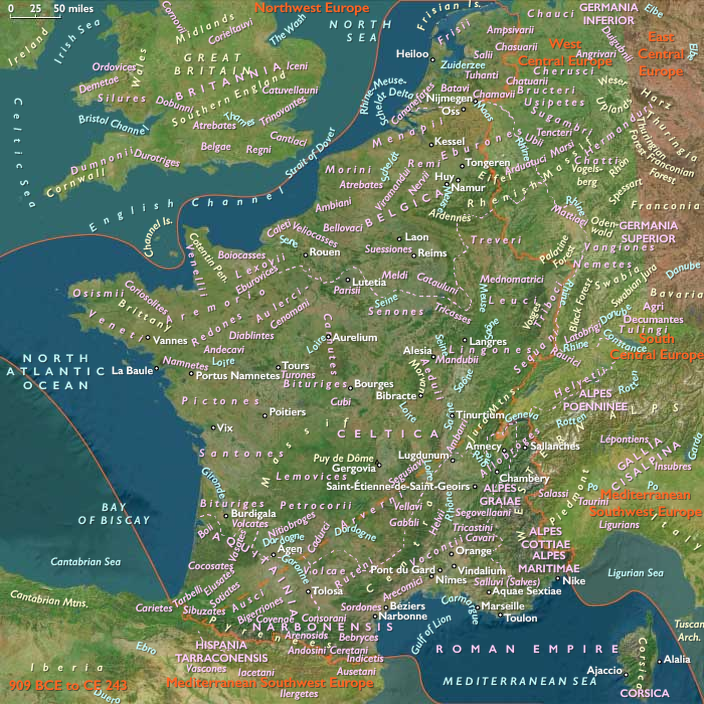
In the winter of 55 BCE, the Tencteri and Usipetes, two Germanic tribes, arrived at the mouth of the Rhine after being driven from their homeland by the expansionist Suebi, who had dominated the region through constant warfare and military pressure. Failing to find new lands elsewhere in Germania, the Tencteri and Usipetes entered the territory of the Menapii, a Belgic tribe that controlled lands on both sides of the Rhine.
The Germans' Tactical Deception and Conquest of Menapian Lands
- Alarmed by the large-scale incursion, the Menapii withdrew from their lands east of the Rhine and successfully blocked the Germanic tribes from crossing the river.
- The Tencteri and Usipetes feigned a retreat, luring the Menapii into reoccupying their abandoned eastern lands.
- In a night attack, the Germanic cavalry returned, ambushed the Menapii, seized their ships, and crossed the river into their villages and towns.
- They spent the rest of the winter living off Menapian supplies, securing a temporary base in Gaul.
Caesar’s Response: Political Maneuvering and War Preparation
- Julius Caesar, fearing a Germanic-Gallic alliance, quickly moved against the Tencteri and Usipetes, knowing their presence threatened his authority in the region.
- Some Gallic tribes attempted to bribe the Germans to leave, but the Tencteri and Usipetes interpreted this as a sign of weakness and moved further into Gallic lands, reaching the territories of the Condrusi and Eburones, under the protection of the Treveri.
- Caesar summoned Gallic chieftains, pretending to be unaware of their attempted bribery, and demanded both provisions and cavalry for his campaign.
Failed Negotiations Between Caesar and the Germanic Tribes
-
As Caesar’s army advanced, the Tencteri and Usipetes sent ambassadors, boasting of their military prowess and offering an alliance with Rome.
-
They requested that Caesar assign them land, but Caesar refused any agreement while they remained in Gaul.
-
He offered to resettle them across the Rhine in the territory of the Ubii, a Germanic tribe seeking Roman protection from the Suebi.
-
The ambassadors requested a three-day truce to consult their leaders, but Caesar suspected delays were meant to buy time for their cavalry, which had crossed the Meuse to plunder the Ambivariti.
-
Caesar refused the request, offering only one day and instructing his officers to hold position and not provoke battle.
The Roman Attack and the Massacre of the Usipetes and Tencteri
-
Despite being outnumbered, the Germanic cavalry struck first, forcing the Roman Gallic horsemen to retreat.
-
Caesar accused them of breaking the truce, refused further negotiations, and arrested their ambassadors.
-
Without further warning, Caesar ordered his entire army to attack the Germanic camp.
-
The Tencteri and Usipetes were thrown into chaos, attempting to flee toward the confluence of the Rhine and Meuse.
-
Roman cavalry relentlessly pursued them, and thousands died by the sword, spear, or while attempting to cross the river.
-
Many women and children drowned as they tried to escape across the Rhine.
Caesar’s Claim vs. Modern Estimates of the Death Toll
- Caesar boasted that his troops had killed 430,000 people, nearly exterminating the Tencteri and Usipetes.
- Some survivors escaped across the Rhine and found refuge among the Sicambri, another Germanic tribe.
- A 2015 archaeological discovery near Kessel has led historians to revise the actual death toll to between 150,000 and 200,000 people.
Significance and Legacy
- The massacre of the Usipetes and Tencteri was one of Caesar’s most ruthless actions during the Gallic Wars, demonstrating his brutality in dealing with non-Gallic adversaries.
- The event outraged the Roman Senate, with Cato the Younger demanding that Caesar be handed over to the Germans as punishment for violating diplomatic protocol.
- The slaughter sent a chilling message to other Germanic and Gallic tribes, reinforcing Rome’s military dominance and Caesar’s willingness to annihilate those who opposed him.
- The battle also set the stage for Caesar’s later crossing of the Rhine, as he sought to demonstrate Rome’s ability to strike beyond its borders.
The massacre of the Tencteri and Usipetes remains one of the darkest episodes in Caesar’s conquests, marking a turning point in Rome’s expansion into Germania while solidifying Caesar’s reputation as both a strategic genius and a ruthless conqueror.
Locations
People
Groups
- Gauls
- Roman Republic
- Menapii (Gaulish tribe)
- Condrusi (Germanic tribe)
- Ubii (Germanic tribe)
- Sicambri (Germanic tribe)
- Eburones (Gaulish tribe)
- Treveri (Gaulish tribe)
- Suebi (Germanic tribe)
- Tencteri and Usipetes (Germanic tribe or tribes)
Topics
- Classical antiquity
- Pre-Roman Iron Age of Northern Europe
- Roman Age Optimum
- Roman Republic, Crisis of the
- Gallic Wars
Commodoties
Subjects
Regions
Subregions

Years: 55BCE - 55BCE
Locations
People
Groups
- Gauls
- Roman Republic
- Menapii (Gaulish tribe)
- Condrusi (Germanic tribe)
- Ubii (Germanic tribe)
- Sicambri (Germanic tribe)
- Eburones (Gaulish tribe)
- Treveri (Gaulish tribe)
- Suebi (Germanic tribe)
- Tencteri and Usipetes (Germanic tribe or tribes)
Topics
- Classical antiquity
- Pre-Roman Iron Age of Northern Europe
- Roman Age Optimum
- Roman Republic, Crisis of the
- Gallic Wars
Commodoties
Subjects
Regions
Subregions