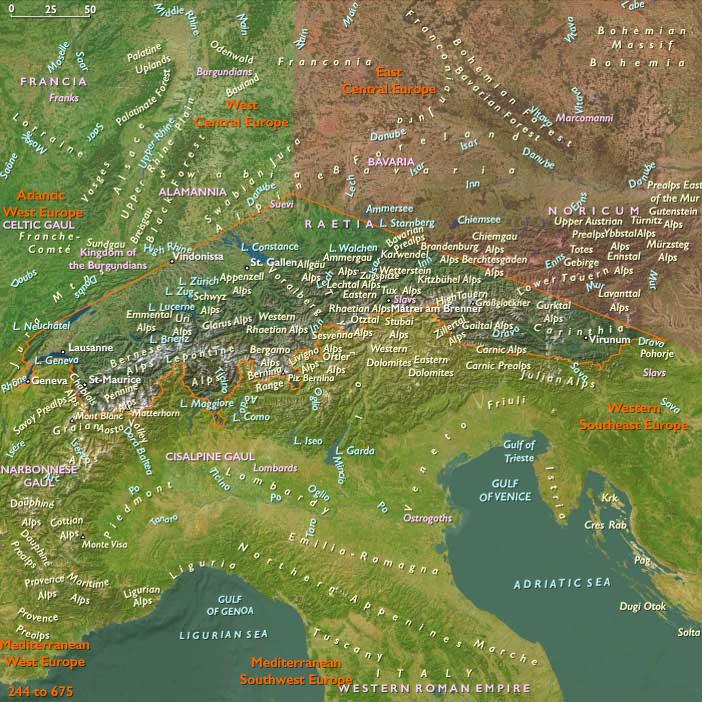
The Tauredunum event, a mountain landslide into …
Years: 563 - 563
The Tauredunum event, a mountain landslide into the Rhone river, destroys a fort and two villages and creates a tsunami in Lake Geneva.
The wave that reaches Lausanne is thirteen meters high, and …
Locations
People
Groups
Commodoties
Subjects
Regions
Subregions
Related Events
Filter results
Showing 10 events out of 57509 total
Justinian pardons Belisarius in 563, ordering his release from prison and the restoration of his the properties and honors.
He permits the great general to live in obscurity and awards him a "veteran" pension.
The new Hagia Sophia with its numerous chapels and shrines, octagonal dome and mosaics, and a price tag of twenty thousand pounds of gold, becomes the center and most visible monument of Eastern Orthodoxy.
Bayan had eyed the plain of Moesia, just south of the Lower Danube, what would become northern Bulgaria, as his promised land, but, as Constantinople is adamant the Avars should not in any case cross the river, Bayan and his horde in 563 ride around the northern Carpathians to Germany, where they are soundly stemmed along the river Elbe by the Frankish king Sigebert I of Austrasia.
This defeat induces them to retrace their path to the Lower Danube region.
Justinian, during whose reign new construction of buildings defines the Roman Byzantine style, has undertaken a substantial reconstruction of St. Helena's fourth century Church of the Nativity, which had been destroyed by fire in the Samaritan revolt of 529, to create its present form (It is thus one of the oldest Christian churches extant.)
...eight meters high by the time it hits Geneva.
Describing the event, Marius Aventicensis writes that the tsunami "devastated very old villages with their men and cattle, it even destroyed many sacred places", and swept away "the bridge in Geneva, windmills and men". (”Des chercheurs reconstituent le tsunami du lac Léman de l’an 563", Le Monde, October 28, 2012).
There is evidence of four previous mudslides, suggesting that tsunamis may be a recurrent phenomenon on Lake Geneva.
Gao Wei succeeds his father Emperor Wucheng as ruler of the Chinese Northern Qi Dynasty.
Wu Cheng Di becomes a regent and Grand Emperor.
The Avars, after vainly trying to force the Danubian border when the new emperor Justin II denies them both entry and wage, renew their ride to Thuringia, taking it from the Franks in 565, but are stopped here.
Intermittent wars have occurred between the Lombards, or Langobards, and the Gepidae, who are allied to Constantinople, from 536.
When Alboin succeeds his father, Audoin, about 563 or 565, the Lombards occupy Noricum and Pannonia (now in Austria and western Hungary), while their long-standing enemies the Gepidae border them on the east in Dacia (now Hungary).
As is customary among the Lombards, Alboin had taken the crown after an election by the tribe's freemen, who traditionally select the king from the dead sovereign's clan.
Shortly afterwards, in 565, a new war erupts with the Gepids, now led by Cunimund.
According to multiple sources, the former king, Thurisind,had been Cunimund's own father, and the enmity that both had for the Lombards was allegedly partly a result of Alboin's murder of Cunimund's brother (Thurisind's son), Turismod.
The true cause of the conflict is uncertain, as the sources are divided; the Lombard Paul the Deacon accuses the Gepids, while the Byzantine historian Menander Protector places the blame on Alboin, an interpretation favored by historian Walter Pohl.
An account of the war by the Byzantine Theophylact Simocatta sentimentalizes the reasons behind the conflict, claiming it originated with Alboin's vain courting and subsequent kidnapping of Cunimund's daughter Rosamund, that Alboin proceeded then to marry.
The tale is treated with skepticism by Walter Goffart, who observes that it conflicts with the Origo Gentis Langobardorum, where she was captured only after the death of her father.
The Gepids obtain the support of the Emperor in exchange for a promise to cede him the region of Sirmium, the seat of the Gepid kings.
Thus, in 565 or 566, Justinian's successor Justin II sends his son-in-law Baduarius as magister militum (field commander) to lead an imperial army against Alboin in support of Cunimund, ending in the Lombards' complete defeat.
Procopius of Caesarea probably retires to Constantinople after Belisarius’ disgrace.
In the Wars, he narrates Justinian's achievements to 553.
In The Buildings, completed two years later, Procopius writes a further paean to Justinian for his public works.
In the posthumously published and highly scurrilous Secret History, Procopius, who dies around 565, claims to reveal information about the emperor's personality and policy that he could not present in the earlier books because he feared the emperor’s wrath.
He alleges that the emperor’s late wife, Theodora, was formerly and actress and a prostitute.
Justinian, who had always had a keen interest in theological matters and actively participated in debates on Christian doctrine, has become even more devoted to religion during the later years of his life.
When he dies, on November 14, 565, he leaves the empire exhausted by his wars and public spending, but enriched by his law code and monuments.
Justinian's body is entombed in a specially built mausoleum in the Church of the Holy Apostles (the tomb will be desecrated and robbed during the pillage of Constantinople in 1204 by the Latin States of the Fourth Crusade).
Along with Justin, the kouropalates, another of the late emperors’ nephews, Justin, son of the late Germanus, is the leading contender for the vacant throne, due to his titles and reputation as a commander, as well his army's proximity to the imperial capital.
The former, however, is already present at Constantinople, and can count on the support of the Senate, and especially of Patriarch John Scholasticus and the Count of the Excubitors Tiberius (the future Tiberius II), whom he had helped secure his post.
Callinicus, the praepositus sacri cubiculi, seems to have been the only witness to his dying moments, and later claimed that Justinian had designated "Justin, Vigilantia's son" as his heir in a deathbed decision.
Modern historians suspect Callinicus may have fabricated the last words of Justinian to secure the succession for his political ally, who is the son of Justinian’s sister Vigilantia, and married to Sophia, the niece of the late Empress Theodora.
In any case, Callinicus starts alerting those most interested in the succession, originally various members of the Byzantine Senate.
Then they jointly inform Justin and Vigilantia, offering the throne.
Justin accepts after the traditional token show of reluctance, and with his wife Sophia, he is escorted to the Great Palace of Constantinople.
The Excubitors block the palace entrances during the night, and early in the morning, John Scholasticus, Patriarch of Constantinople, crowns the new Augustus.
Only then is the death of Justinian and the succession of Justin publicly announced in the Hippodrome of Constantinople.
Both the Patriarch and Tiberius, commander of the Excubitors, had been recently appointed, with Justin having played a part in their respective appointments, in his role as Justinian's curopalates.
Their willingness to elevate their patron and ally to the throne is hardly surprising.
In the first few days of his reign Justin pays his uncle's debts, administers justice in person, and proclaims universal religious toleration.
Contrary to his uncle, Justin relies completely on the support of the aristocratic party.
Proud of character, and faced with an empty treasury, he discontinues Justinian's practice of buying off potential enemies.
Immediately after his accession, Justin halts the payment of subsidies to the Avars, ending a truce that has existed since 558.
According to the contemporary historian Evagrius Scholasticus, the two Justins had reached an agreement whereby whoever would be crowned emperor would make the other the "second man" in the empire.
When Justin II recalls his cousin to Constantinople, it seems that this is the reason.
The general is warmly received at first, but soon the new emperor begins to make accusations against him, dismisses his bodyguard and places him under house arrest, before sending him to exile in Alexandria, ostensibly as the new augustal prefect of Egypt.

The general Justin is murdered in his sleep in Alexandria in 565, ostensibly because he was plotting to seize the throne, and his head is cut off and brought to Constantinople.
In reality, he was too great a threat to the new emperor to be left alive; the Visigoth chronicler John of Biclaro explicitly attributes the murder to the wife of Justin II, the Empress Sophia.