
The Tatar khanate of Kazan, one of …
Years: 1552 - 1552
February
The Tatar khanate of Kazan, one of Russia’s three Tatar states, is a successor state of the Golden Horde, together with the khanates of Astrakhan and of the Crimea.
Its capital city, Kazan', had been established on the left bank of the Volga River in the early fifteenth century.
Kazan’s reinforcement of Crimea had displeased the pro-Moscow elements of the Kazan Khanate, and some of these noblemen had provoked a revolt in 1545.
The result was the deposition of the khan, Safa Giray, the son of Sahib Giray of the Crimean Khanate.
A Moscow supporter, Şahğäli, had occupied the throne.
Moscow had organized several subsequent campaigns to impose control over Kazan, but these have been unsuccessful.
Safa Giray had returned to the throne with the help of the Nogai Horde, a confederation of Turkic nomads that has occupied the Pontic-Caspian steppe from about 1500.
He had executed seventy-five noblemen, and the rest of his opposition had escaped to Russia.
Dying in 1549, his three-year old son Ütämeşgäräy had been recognized as khan; his mother Söyembikä, who acts as regent, is the khanate's de facto ruler.
The administration of the ulan Qoşçaq, head of government during the reigns of Safagäräy and Söyembikä, gains a degree of independence under her rule.
At this time Safa Giray's relatives (including Devlet I Giray) are in Crimea.
Their invitation to the throne of Kazan is vitiated by a large portion of the nobility.
Relations with Russia have continued to worsen under Qoşçaq's government.
A group of disgruntled noblemen had at the beginning of 1551 invited a supporter of Tsar Ivan the Terrible, Şahğäli, for the second time.
Qoşçaq had been forced to escape from Kazan after Şahğäli's successful coup d'etat, but Russian troops had caught him and executed him after he refused baptism.
At the same time, the Kazan lands to the east of the Volga River are ceded to Russia, and Ütämeşgäräy, along with his mother, has been sent to a Moscow prison.
Şahğäli occupies the Kazan throne until February 1552, when anti-Moscow elements in the Kazan government exile him and invite the Astrakhan prince Yadegar Moxammad, along with the Nogays, to aid them.
Locations
People
Groups
- Polytheism (“paganism”)
- Christians, Eastern Orthodox
- Nogai Horde
- Kazan, Khanate of
- Crimean Khanate
- Astrakhan Khanate
- Russia, Tsardom of
Topics
Commodoties
Subjects
Regions
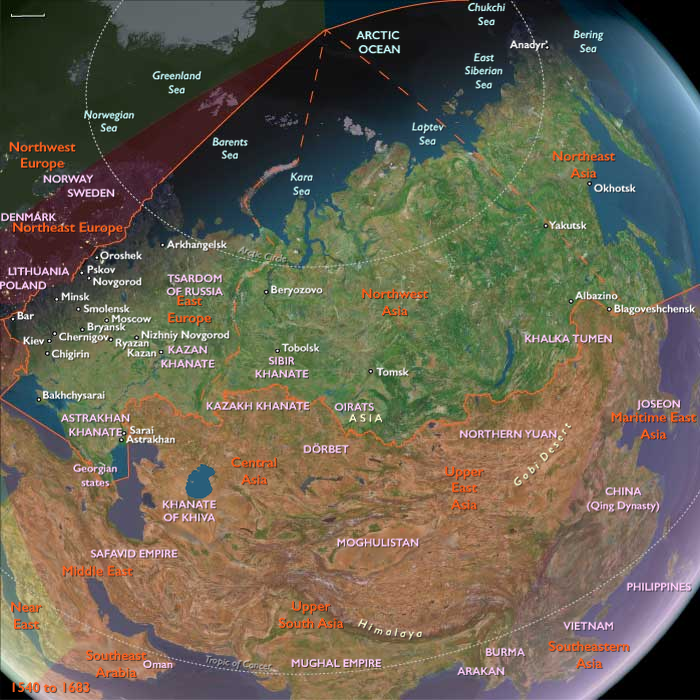
Subregions
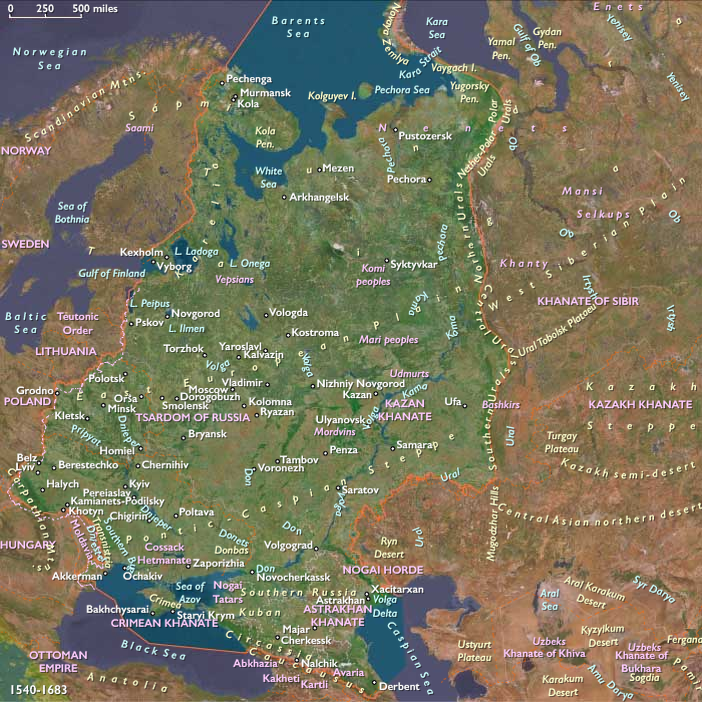
Years: 1552 - 1552
February
Locations
People
Groups
- Polytheism (“paganism”)
- Christians, Eastern Orthodox
- Nogai Horde
- Kazan, Khanate of
- Crimean Khanate
- Astrakhan Khanate
- Russia, Tsardom of
Topics
Commodoties
Subjects
Regions
Subregions