
Archaeologists have discovered the buried remains of …
Years: 1917BCE - 1774BCE
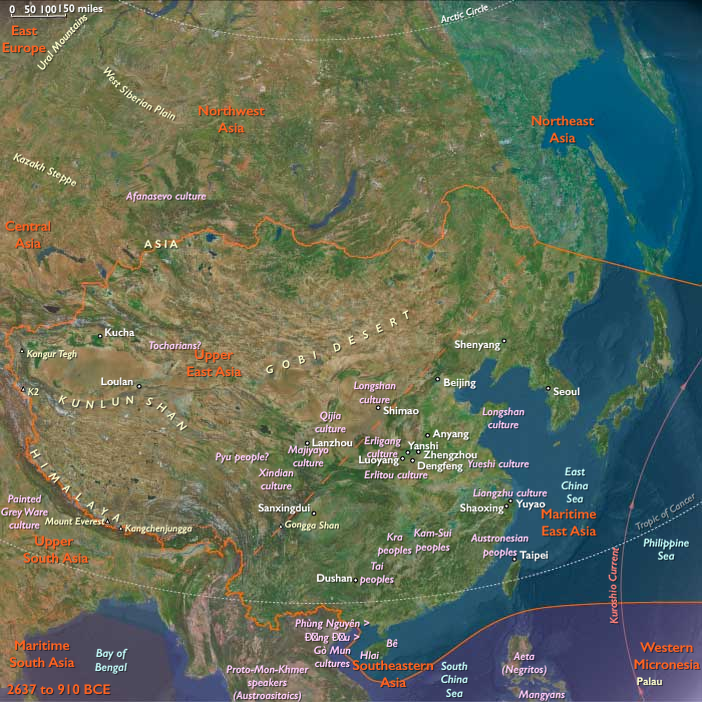
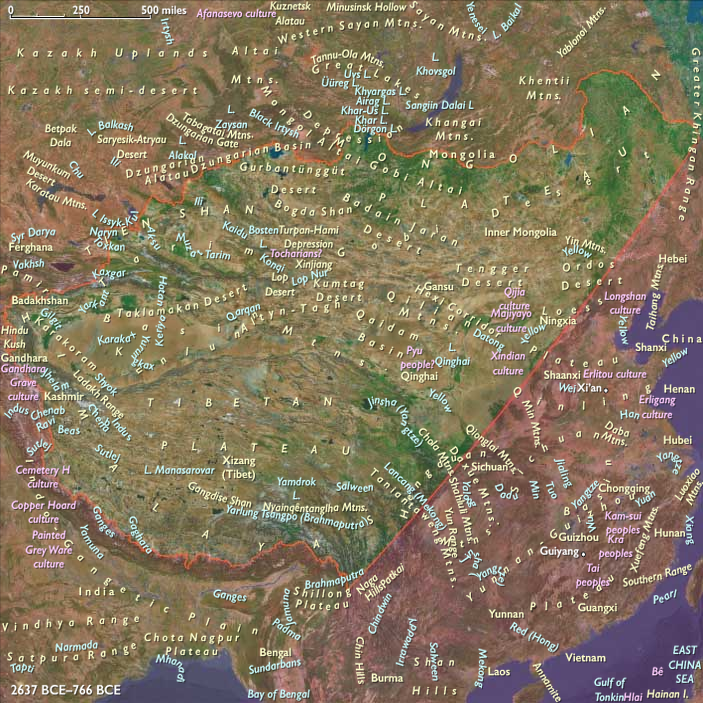
Archaeologists have discovered the buried remains of settlements, as well as several of the Tarim mummies, along the ancient shoreline of Tarim Lake.
Some of the mummies are frequently associated with the presence of the Indo-European Tocharian languages in the Tarim Basin, although the evidence is inconclusive.
DNA studies of mummies from the Xiaohe burial site, located in Lop Nur, suggest that an admixed population of both west and east Eurasian origin lived in the Tarim basin since the early Bronze Age.
The maternal lineages were predominantly east Eurasian haplogroup C with smaller numbers of H and K, while the paternal lines were all west Eurasian R1a1a.
The admixture likely took place in south Siberia before the population's migration into the Tarim Basin.
The earliest Tarim mummies, found at Qäwrighul and dated to 1800 BCE, are of a Caucasoid physical type.
Their closest affiliation is to the Bronze Age populations of southern Siberia, Kazakhstan, Central Asia, and the Lower Volga.
Locations
Groups
Topics
Commodoties
Subjects
Regions
Subregions
Years: 1917BCE - 1774BCE
Locations
Groups
Topics
Commodoties
Subjects
Regions
Subregions