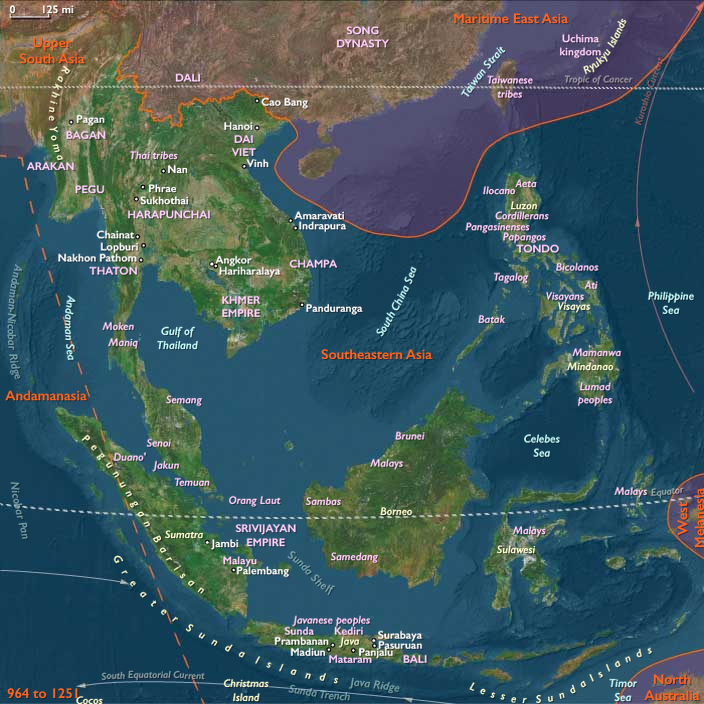
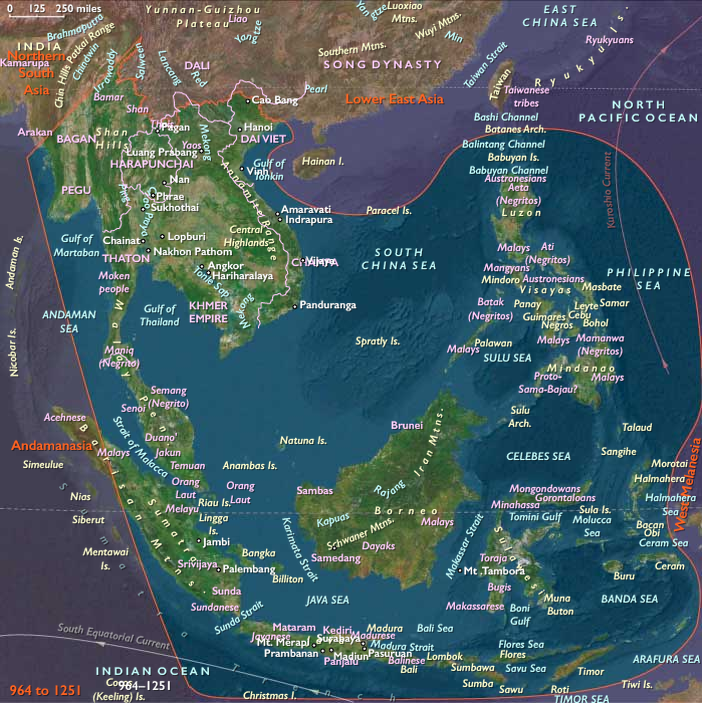
The Tai migrants have by 1100 established …
Years: 1100 - 1100
The Tai migrants have by 1100 established themselves as Po Khuns (ruling fathers) at Nan, …
Locations
Groups
Subjects
Regions
Subregions
Related Events
Filter results
Showing 10 events out of 50063 total
…Phrae, …
…Sawankhalok, …
…Songkwae, Chakangrao, etc., on the upper Chao Phraya valley.
These southern Tai princes face Khmer influence from Lavo.
Some of them become subordinates to the Lavo-Khmer polity.
Emperor Zhezong has lowered taxes, stopped negotiations with the Tangut Empire and resumed armed conflict, which had eventually forced the Xia to enter a more peaceful stance with the Song.
Overall, Zhezong's reign has provided the Song dynasty with fresh energy but Zhezong has been unable to stop fighting between conservative members in his government and the more liberal members catering to Wang Anshi's reforms.
This situation will eventually lead to the Northern Song's demise in the twelfth century.
Zhezong dies in 1100 in Kaifeng at the age of twenty-four and is succeeded by his younger brother.
His temple name means "Wise Ancestor".
At the accession of Emperor Huizong of Song, China's population is roughly one hundred million.
In the Song Dynasty capital of Kaifeng, the number of registered people within the walls is one million fifty thousand the army stationed here boosts the overall populace to some one million four hundred thousand people.
King Inge and Queen Helena establish Vreta Abbey near present-day Linköping in Östergötland around the year 1100.
The abbey houses Sweden's first nunnery and is one of the oldest in Scandinavia.
The abbey belongs to the Benedictine order and has been founded on the orders of Pope Paschal II.
Coloman "assembles the magnates of the kingdom and reviews with the advice of the entire council the text of the laws of" King Saint Stephen around 1100.
The assembly of Tarcal passes new decrees which regulate several aspects of economy and temper the harshness of the legislation of Coloman's predecessor.
One of the decrees prohibits the persecution of strigae—vampires—because they "do not exist".
The same law also deals with malefici or "sorcerers", punishing their misdeeds.
Taxes on trade are increased under Coloman, implying that commerce flourishes in his reign.
On the other hand, his legislation prohibits the export of Hungarian slaves and horses.
Coins minted under Coloman are smaller in size than those issued in his predecessor's reign, which prevents the cutting down of their smooth edge.
Hasan-e Sabbah and other Isma'ilites in Iran have refused to recognize the new Fatimid caliph in Cairo and have transferred their allegiance to his deposed elder brother, Nizar, and the latter's descendants.
There thus will grow up the sect of the Nizari Isma'ilites, who are at odds with the Fatimid caliphs in Cairo and are also deeply hostile to the 'Abbasids.
The Nizaris will make many changes in Isma'ilite doctrine, the most significant, from the point of view of the outside world, being the adoption of terrorism as a sacred religious duty.
From Alamut, by the end of the eleventh century, Hasan, as grand master or leader of the sect, commands a chain of strongholds all over Iran and Iraq, a network of propagandists, a corps of devoted terrorists, and an unknown number of agents in enemy camps and cities.
The Seljuq sultanate's attempts to capture Alamut fail, and soon the Assassins are claiming many victims among the generals and statesmen of the 'Abbasid caliphate, including two caliphs.
(This group, joining with Sabbah's terrorists, becomes known in the West as Assassins, a designation that derives from the Arabic “hashashin”, meaning “users of hashish”, based on stories—unconfirmed in any Ismaili sources—related by Marco Polo and others that the group employs hallucinatory drugs to stimulate them to their murderous acts.)

The crusaders in 1100 gain control of Hebron.
The mosaic program of the Byzantine Greek-cross church at Daphni near Athens, constructed in about 1100, depicts the Pantocrator—Christ as Lord of the Universe—at the summit of the central dome.
The Virgin is represented in the apse above the altar as the instrument of Christ's incarnation; the saints, below her, represent the church on earth.
Arranged around the upper parts of the vaults are major scenes from the life of Christ, which closely correspond to the major feast days of the Byzantine religious calendar.
Bertrand, the eldest son of Raymond IV of Toulouse, has ruled Toulouse since Raymond left on the First Crusade in 1095—although, between 1098 and 1100, had been dispossessed by his cousin Philippa and her husband Duke William IX of Aquitaine, who had marched into Toulouse and captured it, before mortgaging it back to Bertrand in 1100 to fund Duke William's expedition to the Holy Land.