
The Tai kingdom of Ayutthaya has experienced …
Years: 1590 - 1590
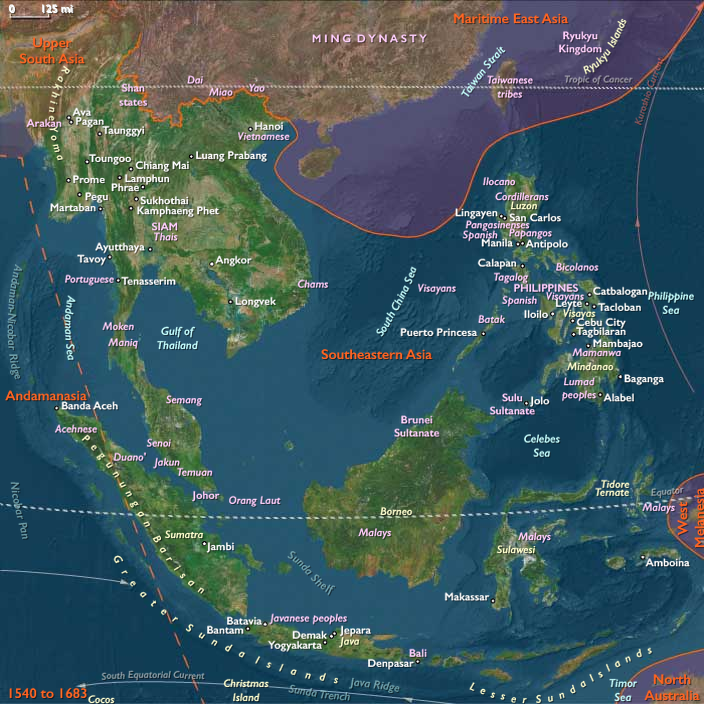
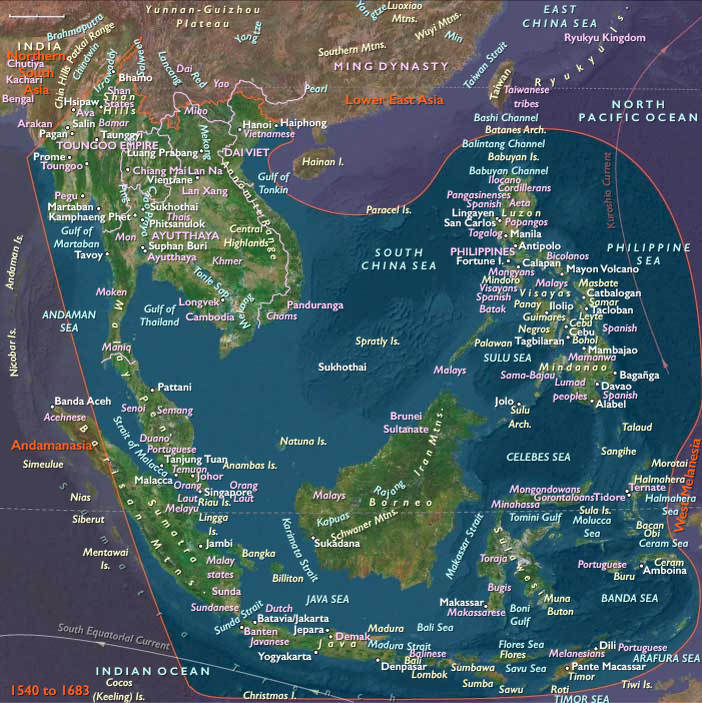
The Tai kingdom of Ayutthaya has experienced three years of relative peace.
War with the Toungoo kingdom of Burma has devastated the countryside, however, and earthquakes and famine have created additional hardships.
Prince Naresuan, called the “Black Prince,” long the actual ruler of Ayutthaya, becomes king in 1590 at the death of his father Maha Tammaraja, who had become king of the Ayutthaya kingdom after its occupation by the Burmese in 1569.
Locations
People
Groups
- Ayutthaya (Siam), Thai state of
- Toungoo Empire, First
- Lanna, or Lan Na (Siam), Burmese principality of
Commodoties
Subjects
Regions
Subregions
Related Events
Filter results
Showing 10 events out of 34447 total
Hideyoshi, having defeated the clan of Shimazu, in 1590 eradicates the power of the Hōjō clan in the Siege of Odawara, banishing Hōjō Ujinao and his wife Toku Hime (a daughter of Tokugawa Ieyasu) to Mount Kōya.
He now pursues his plan to conquer China.
Thousands of troops are mobilized and trained; weapons, and supplies gathered; hundreds of arquebuses imported from Portugal; and hundreds of ships built quickly to carry the entire Japanese army across the sea.
Those who oppose Hideyoshi's plan to invade China through Korea include Tokugawa Ieyasu, and Konishi Yukinaga and So Yoshitoshi are among those who attempt to arbitrate between Hideyoshi and the Joseon court.
Hideyoshi sends ambassadors to request the Joseon court to allow his troops to move through the Korean peninsula to China: his first request is ignored.
Abbas gains strong support from the common people.
Sources will report him spending much of his time among them throughout his reign, personally visiting bazaars and other public places in Isfahan.
Abbas can go for long periods without needing to sleep or eat and can ride great distances.
Short in stature, he will remain physically strong until his health declines in his final years.
Abbas shaves off his beard at the age of nineteen, keeping only his mustache, thus setting a fashion in Iran.
The Assumption of the Virgin is the name of two paintings by the Italian Baroque painter Annibale Carracci, with the subject of the Assumption of the Virgin Mary.
The first canvas is completed in 1590 (and is now housed in the Prado Museum in Madrid).
Venice's Biblioteca Marciana is completed in 1590 on the Piazza San Marco after more than a century of construction following a plan by the late Jacopo Sansovino.
Sansovino had died in 1570, but in 1588, Vincenzo Scamozzi had undertaken the construction of the additional five bays, still to Sansovino's design, which brought the building down to the molo or embankment, next to Sansovino's building for the Venetian mint, the Zecca.
The Biblioteca Marciana is today one of the earliest surviving public manuscript depositories in Italy, holding one of the greatest classical texts collections in the world.
Luis de Carabajal y Cueva, a Spanish-Portuguese adventurer, slave-trader, and from 1579 governor of Nuevo León, had been allowed one hundred soldiers and sixty married laborers, accompanied by their wives and children, to pacify and colonize the new territory.
It is safe to assume that a number of these early colonists were Spanish Jews, who, as conversos like the Carabajal family, had hoped to escape persecution and find prosperity in the New World.
In this expectation they are disappointed, for within a decade after their settlement a score of them are openly denounced and more or less severely punished for Judaizing.
There seems to be an extensive colony of them in Mexico in 1590.
Don Luis had brought with him to Mexico his brother-in-law, Don Francisco Rodríguez de Matos, and his sister, Doña Francisca Nuñez de Carabajal, with their children.
While in the midst of prosperity, and seemingly leading Christian lives, they are seized in 1590 by the Inquisition.
Doña Isabel is tortured until she implicates the whole of the Carabajal family, who, with the exception of Don Baltasar, are imprisoned.
The latter succeeds in escaping to Tasco, and is condemned to death in his absence.
Carabajal, also accused by the Inquisition of heresy, is condemned to a six-year exile from New Spain, but will die in prison in 1595 while awaiting the execution of his sentence.
Count Maurice of Nassau, a son of William the Silent and Princess Anna of Saxon, only sixteen when his father was murdered in Delft in 1584, had soon taken over as stadtholder (Stadhouder), though this title was not inheritable (the monarchs of England and France had refused, and there simply was no one else to take the job).
Supported by Oldenbarnevelt, he had in 1585 become stadtholder of Holland and Zeeland, and in 1590 of Guelders, Overijssel and Utrecht
Appointed captain-general of the army in 1587, bypassing the Earl of Leicester, who had returned to England on hearing this news, Maurice has reorganized the army together with Willem Lodewijk, studied military history, strategy and tactics, mathematics and astronomy.
He will prove himself to be among the best strategists of his age.
A group of English merchants gains the right to trade in Ottoman territory in return for supplying the sultan with iron, steel, brass and tin for his war with Persia.
After the failure of the Spanish Armada, Alexander, or Alessandro, Farnese, Duke of Parma and Piacenza from 1586 to 1592, and Governor of the Spanish Netherlands from 1578 to 1592, was to have turned his attention back to the northern Netherlands, where the Dutch had regrouped, but following the assassination of the French king Henry III, Farnese had been ordered into France, in support of the Catholic opposition to Henry of Navarre.
This enables the Dutch rebels to turn the tide in favor of the Dutch Revolt, which had been in ever deeper trouble since 1576.
Maurice of Nassau, as commander of the Dutch armies and paying special attention to the siege theories of Simon Stevin, has instituted a series of reforms that enable him to win the first of a series of victories over the Spanish forces: Maurice takes Breda in March 1590 by concealing sixty-eight of his best men in a peat-boat to get through the impregnable defenses.
Henry had moved rapidly to besiege Dreux, a town controlled by the League.
As Mayenne had followed, intending to raise the siege, Henry had withdrawn but stayed within sight, deploying his army on the plain of Saint André between the towns of Nonancourt and Ivry.
The army of the Catholic League consists of citizens led by priests and rebellious nobles, Swiss infantry under Appenzell, pikemen brought from Flanders by Philip, Count of Egmont, and the troopers of the Guise family with Mayenne in command.
The battle occurs on March 14 on the plain of Épieds near Ivry (later renamed Ivry-la-Bataille), Normandy, located on the Eure River and about thirty miles west of Paris, at the boundary between the Île-de-France and the Beauce regions.
Henry's forces are victorious: Mayenne is driven back, the Duke of Aumale forced to surrender, and the Count of Egmont killed.
The Duke of Mayenne has lost the battle.
Henry, now the only credible claimant to the throne of France, pursues the losers, many of whom surrender for fear of falling into worse hands, their horses being in no condition to get them away from danger.
The countryside is full of Leaguers and Spaniards in flight, with the king's victorious army pursuing and scattering the remnants of the larger groups that disperse and re-gather; he goes on to lay siege to Paris.
The wedding of James and Anne of Denmark had been followed by a month of celebrations, and James, cutting his entourage to fifty, had on on December 22 visited his new relations at Kronborg Castle in Elsinore, where the newlyweds were greeted by Dowager Queen Sophie, twelve-year-old King Christian IV, and Christian's four regents.
The couple moved on to Copenhagen on March 7 and attended the wedding of Anne's older sister Elisabeth to Henry Julius, Duke of Brunswick, sailing two days later for Scotland in a patched up Gideon.
They had arrived on May 1 in the Water of Leith.
Anne makes her state entry into Edinburgh five days later in a solid silver coach brought over from Denmark, James riding alongside on horseback.
Anne is crowned on May 17, 1590, in the Abbey Church at Holyrood; this is the first Protestant coronation in Scotland.
During the seven-hour ceremony, the Countess of Mar opens Anne's gown for presiding minister Robert Bruce to pour "a bonny quantity of oil" on "parts of her breast and arm," so anointing her as queen. (Kirk ministers had objected vehemently to this element of the ceremony as a pagan and Jewish ritual, but James had insisted that it dated from the Old Testament.)
The king hands the crown to Chancellor Maitland, who places it on Anne's head.
She then affirms an oath to defend the true religion and worship of God and to "withstand and despise all papistical superstitions, and whatsoever ceremonies and rites contrary to the word of God."
Years: 1590 - 1590
Locations
People
Groups
- Ayutthaya (Siam), Thai state of
- Toungoo Empire, First
- Lanna, or Lan Na (Siam), Burmese principality of
