
The Taensa, who live in seven villages …
Years: 1696 - 1707
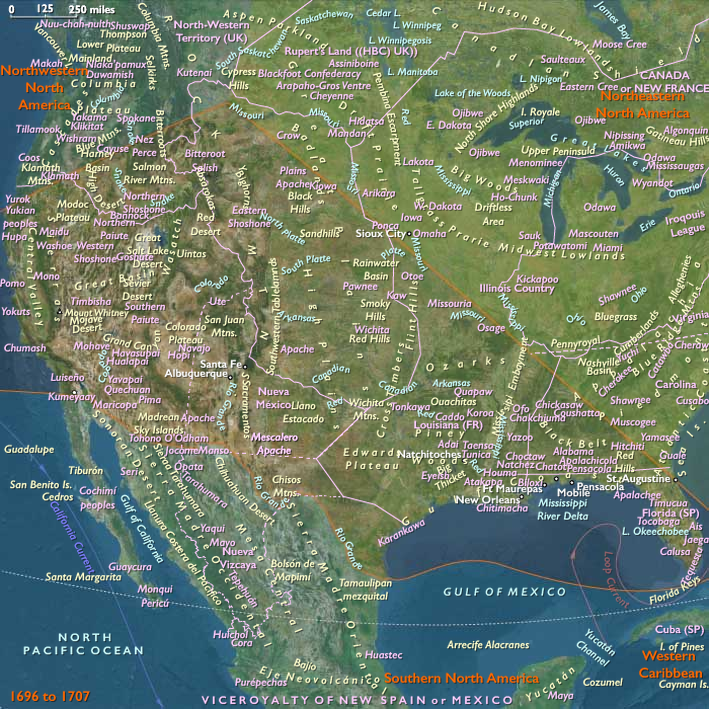
The Taensa, who live in seven villages along the Mississippi River south of the Tunica, near the Yazoo River, are visited in 1699, by French Catholic missionaries, who settle among the Taensa, Tunica people, and Natchez.
The Taensa are an agricultural and canoeing people who live in large houses described as having walls of earth.
It is more probable that these were made of wattle and daub structures roofed with mats of woven cane splits.
Their chiefs have absolute power and are treated with great respect.
This varies greatly from the custom among the northern tribes.
The chief, during a ceremonial visit to La Salle, was reported to have been accompanied by attendants who swept the road in front of him with their hands as he advanced.
The missionaries note the complex religion of the Taensa tribe, which has retained chiefdom characteristics after they had disappeared elsewhere.
Their society has similarity to the Natchez people in its practice of sacrificial rites and hierarchical social classes.
Their chief deities seem to have been the Sun and the Serpent.
Their dome-shaped temple is surmounted by the figures of three eagles facing the rising sun, the outer walls and the roof being of cane mats painted entirely red.
The whole is surrounded with a palisade of stakes, on each of which is set a human skull, the remains of a former sacrifice.
Inside is an altar, with a rope of human scalp locks, and a perpetual fire guarded day and night by two old priests.
When a chief dies, his wives and personal attendants are killed so that their spirits might accompany him to the other world.
At one chief's funeral, thirteen victims are sacrificed.
When a Catholic priest stops one of these ceremonies, the temple is struck by lightning.
The Taensa take this as evidence that their beliefs are valid.
The lightning encourages women to volunteer to be sacrificed.
Locations
People
Groups
- Natchez (Amerind tribe)
- Taensa (Amerind tribe)
- Tunica people
- New France (French Colony)
- New Spain, Viceroyalty of
- Spain, Habsburg Kingdom of
- Florida (Spanish Colony)
- France, (Bourbon) Kingdom of
- Carolina, Province of (English Colony)
- Louisiana (New France)
Topics
Subjects
Regions
Subregions
Related Events
Showing 10 events out of 29101 total
Years: 1696 - 1707
Locations
People
Groups
- Natchez (Amerind tribe)
- Taensa (Amerind tribe)
- Tunica people
- New France (French Colony)
- New Spain, Viceroyalty of
- Spain, Habsburg Kingdom of
- Florida (Spanish Colony)
- France, (Bourbon) Kingdom of
- Carolina, Province of (English Colony)
- Louisiana (New France)
Topics
Subjects
Regions
Subregions