
The Synod of Constantinople (543), a local …
Years: 543 - 543
The Synod of Constantinople (543), a local synod convened to condemn Origen and his views, is accompanied by an edict of Justinian I (543 or 544); it will later ratified by the Fifth General Council (553).
A concept of preexistence had been advanced by Origen, a Church Father who lived in the second and third century CE.
Origen believed that each human soul was created by God at some time prior to conception.
Locations
People
Groups
- East, or Oriens, Praetorian prefecture of
- Christians, Monophysite
- Christianity, Chalcedonian
- Roman Empire, Eastern: Justinian dynasty
Topics
Subjects
Regions
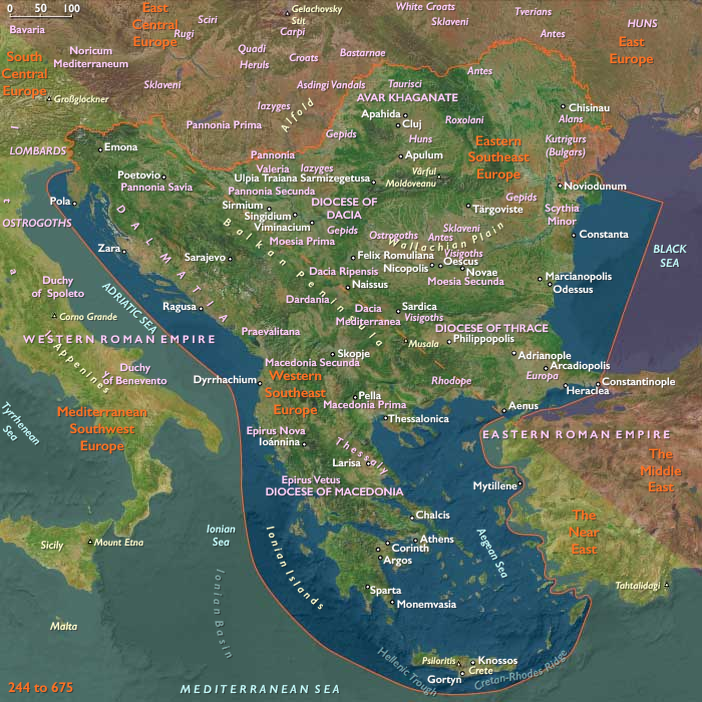
Subregions
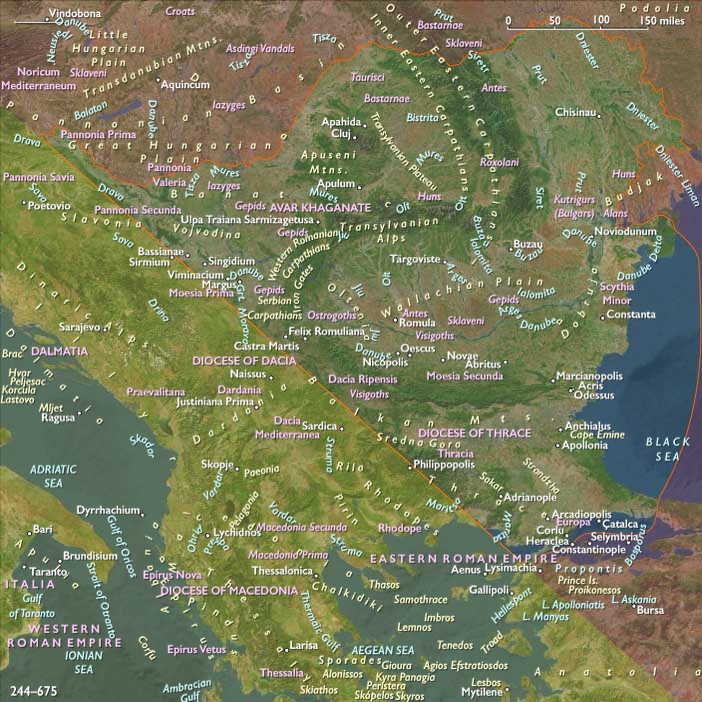
Related Events
Filter results
Showing 10 events out of 57710 total
China has undergone constant civil warfare under the Southern and Northern Dynasties Period.
The imperial province of Jiaozhou, known at this time as Giao Châu, comprises much of present northern Vietnam.
Ly Bon, a Vietnamese of Chinese descent and a regional magistrate, had become increasingly frustrated with the corruption in the government and hostility toward the local population.
Resigning his post in 541, he had led an insurrection, gathering the local nobility and tribes within the Red River Valley, mobilizing the imperial troops and naval fleet of Jiaozhou, and successfully expelled the Chinese administration by 543.
In February of the following year Ly Bon had been declared "Emperor" by the people with the intention of demonstrating equal in power to China’s rulers.
He had renamed the empire Van Xuan, “Eternal Spring.” Two years later, his imperial armies repel attacks from the south by the Chams, who have allied with the Chinese court.
As the founder of Vietnam’s Early Lý, or Li/Lee/Le, Dynasty, which is to last until 603, Ly Bon can be considered the first emperor of Vietnam.
The Chinese will defeat and kill him in 549 to restore their control over the province.
Khosrau again invades Syria and turns south towards Edessa to besiege the fortress city.
Jayasimha Vallabha (500 – 520) and his son, Ranaranga (520 – 540) must have been petty chiefs under the Kadambas, but we know little about their activities and achievements.
In 543, Ranaranga's son Pulakesi, an outsider and former petty chieftain who claims royal (Rajput) descent, earns the distinction of being the first independent king and the real founder of the dynasty.
Successfully defying the waning power of the Kadambas, he proclaims Chalukyan independence in 543.
He captures the hill fort of Vatapi (Badami), chooses it as his capital, and constructs a strong hill fortress on a defensible location surrounded by rivers and steep mountains.
He seizes territories between the western Deccan and the Western Ghats from their Vakataka rulers, giving him access to the valuable Arabian Sea trade routes.
South India’s Western Ganga Dynasty, with their capital in Talakad, had in 470 gained control over the Kongu region in modern Tamil Nadu, and the Sendraka (modern Chikkamagaluru and Belur), Punnata and Pannada regions (comprising modern Heggadadevanakote and Nanjangud) in modern Karnataka.
King Durvinita had ascended the throne in 529 after waging a war with his younger brother, who his father, King Avinita, had favored.
Some accounts suggest that in this power struggle, the Pallavas of Kanchi had supported Avinita's choice of heir and the Badami Chalukya King Vijayaditya supported his father-in-law, Durvinita.
It is known from the inscriptions that these battles had been fought in Tondaimandalam and Kongu regions (northern Tamil Nadu) prompting historians to suggest that Durvinita fought the Pallavas successfully.
Considered the most successful of the Ganga kings, Durvinita is well versed in arts such as music, dance, ayurveda, and the taming of wild elephants.
Some inscriptions sing paeans to him by comparing him to Yudhishtira and Manu—figures from Hindu mythology known for their wisdom and fairness.
During Durvinita's rule, the hostilities between the Pallavas and Gangas had come to the fore and the two kingdoms have fought several pitched battles, but Durvinita had defeated the Pallavas in the battle of Anderi.
Though the Pallavas had sought the assistance of the Kadambas to the north to tame Durvinita, the Gummareddipura inscription states that Durvinita had overcome his enemies at Alattur, Porulare and Pernagra.
It is possible that these victories enabled him to extend his power over the Kongudesa and Tondaimandalam regions of Tamil country.
He may have also made Kittur his capital.
Although the early Gangas are worshipers of Vishnu, Durvinita has a Jaina guru called Pujyapada and his court is attended by several Jaina scholars.
The plague, which may have attacked the Persian armies on campaign in 543, soon reaches Africa and Italy, where Totila has meanwhile proven an able leader, having in 542 taken the offensive in southern Italy, reconquering the Gothic cities and strongholds taken by the imperial forces.
The imperial garrison (one thousand men) in Naples, pressed by famine and demoralized by the failure of two relief efforts, surrenders to the Ostrogoths.
The defenders are well treated by king Totila, and the garrison is allowed safe departure, but the city walls are partly razed.
Several revolts against Chinese rule in the period between the beginning of the Six Dynasties to the end of the Tang Dynasty take place in the region of present Vietnam, such as those of Ly Bon and his general and heir Trieu Quang Phuc; and those of Mai Thúc Loan and Phùng Hung.
All of them ultimately fail, yet most notable are Ly Bon and Trieu Quang Phuc, whose Anterior Ly Dynasty will rule for almost half a century, from 544 to 602, before the Chinese Sui Dynasty reconquers their kingdom, Van Xuan.
The Six Dynasties is a collective term for six Chinese dynasties in China during the periods of the Three Kingdoms, Jin dynasty, and Southern and Northern Dynasties.
East Central Europe (544–555 CE): Lombard Ascendancy, Battle of Asfeld, Gepid Weakening, and Early Byzantine-Avar Diplomacy
Between 544 and 555 CE, East Central Europe—encompassing Poland, Czechia, Slovakia, Hungary, and those portions of Germany and Austria lying east of 10°E and north of a line stretching from roughly 48.2°N at 10°E southeastward to the Austro-Slovenian border near 46.7°N, 15.4°E—underwent significant geopolitical shifts, primarily characterized by Lombard territorial expansion and the corresponding weakening of the Gepid kingdom. Under King Audoin (546–560 CE), the Lombards expanded their influence significantly, culminating in their decisive victory at the Battle of Asfeld (552 CE). This defeat severely weakened the Gepids under King Thurisind, although the Gepids retained limited control of their eastern territories, primarily in modern-day eastern Hungary and Transylvania. Concurrently, the Byzantine Empire actively engaged in diplomatic efforts, skillfully balancing regional rivalries to secure its northern frontier. Near the close of this era (around 558–562 CE), the first arrival of the Pannonian Avars from Central Asia near the Danube further complicated regional dynamics, as Byzantium began forming initial alliances with them.
Political and Military Developments
-
Lombard territorial expansion under King Audoin reached a peak in 552 CE with the Lombard victory at the Battle of Asfeld, significantly reducing Gepid military strength and territorial integrity.
-
Gepids, though greatly weakened, maintained limited regional authority eastward in Transylvania, under continued pressure from Lombard aggression.
-
Byzantine diplomacy actively balanced alliances, supporting the Lombards strategically to prevent Gepid resurgence while simultaneously preparing for the emergence of the newly arriving Avars.
Economic and Cultural Developments
-
Economic stability persisted across Lombard territories, characterized by vibrant agricultural communities, robust livestock economies, and stable trade routes linking settlements such as Augusta Vindelicorum (Augsburg), Vindobona, and Aquincum.
-
Lombard cultural expressions flourished, blending Germanic traditions with Byzantine influences in their metalwork, pottery, and decorative arts.
Slavic Expansion and Consolidation
-
The clearly differentiated Slavic groups (Sclaveni, Antes, and West Slavic tribes like Polanes, Sorbs, Obotrites, Veleti, and White Croats) rapidly expanded into territories progressively vacated or weakened by Gepid setbacks, significantly increasing their demographic and cultural presence.
Long-Term Consequences
This era marked a turning point, setting the stage for greater geopolitical upheavals. The severe weakening of the Gepids following Asfeld (552 CE) created power vacuums soon exploited by incoming Avars and rapidly expanding Slavic populations, fundamentally reshaping East Central Europe's demographic and cultural landscape.
Audoin is the founder of the Lombard dynasty that will crush the Gepidae, absorb the survivors into the Lombard nation, and establish Lombard power in the Italian peninsula, much of which it will rule for the next two centuries.
The Longobards, or Lombards, now Arian Christians, attack the Gepids on behalf of Justinian, who awards them with land in Pannonia and Noricum (modern Hungary and eastern Austria).
Slavic tribes have settled in Moravia and Bohemia along the valleys of the Moravia and upper Elbe Rivers by the first half of the sixth century.
Years: 543 - 543
Locations
People
Groups
- East, or Oriens, Praetorian prefecture of
- Christians, Monophysite
- Christianity, Chalcedonian
- Roman Empire, Eastern: Justinian dynasty
