
The Swiss plateau lies in the western …
Years: 1197BCE - 1054BCE
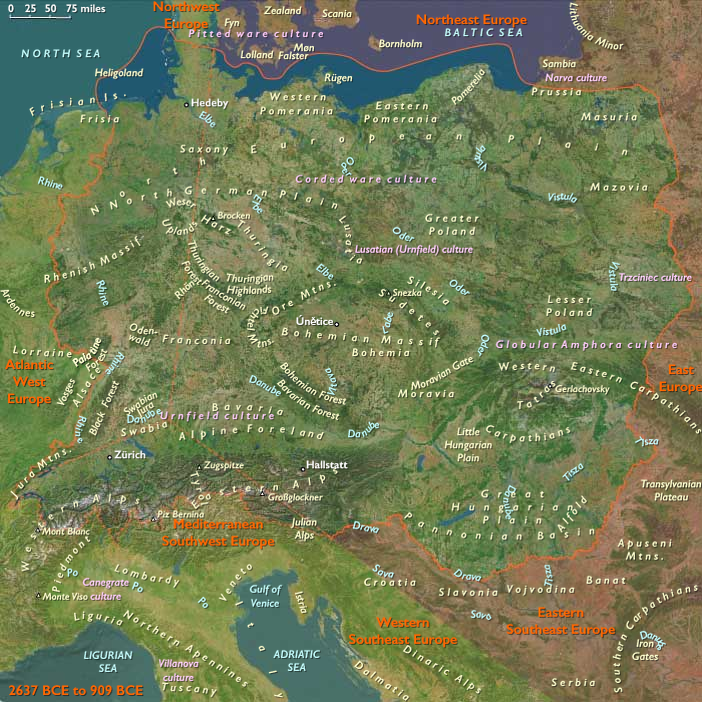
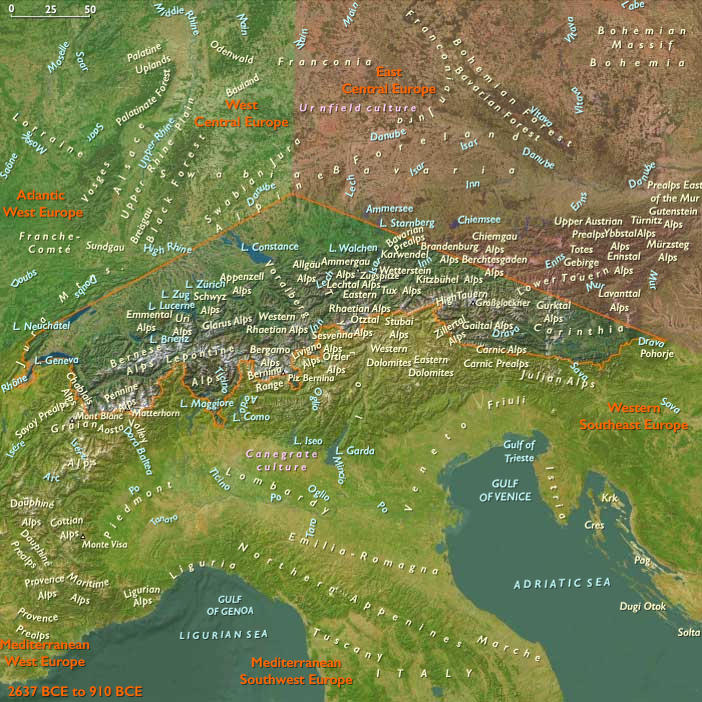
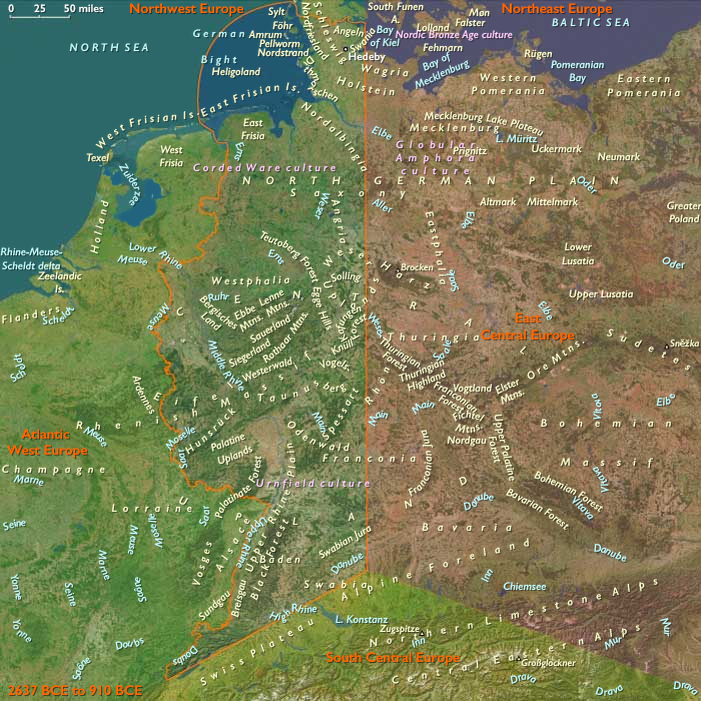
The Swiss plateau lies in the western part of the pre- or proto-Celtic Halstatt culture from about 1200 BCE.
Groups
Topics
Subjects
Regions
Subregions
Related Events
Filter results
Showing 10 events out of 67182 total
The Arctic Small Tool tradition (ASTt) was a broad cultural entity that developed along the Alaska Peninsula, around Bristol Bay, and on the eastern shores of the Bering Strait around 2500 BC, with ASTt groups being the first human occupants of Arctic Canada and Greenland. The Denbigh Flint complex were the first members of the wide material assemblage known as the Arctic Small Tool tradition.
The Cape Denbigh Flint Complex, recognized by its excavator J.L. Giddings as ancestral to later expressions of Eskimo culture in Alaska, faded around 3000-3300 years ago (roughly 1000-1300 BCE).
Giddings found tiny, intricately chipped stone tools at the Iyatayet Site, and this particular stone tool style is known as the Denbigh Flint Complex. The multicomponent site of Iyatayet, at Cape Denbigh, Alaska, was originally excavated by J. L. Giddings in the early 1950s.
Giddings published "The Denbigh Flint Complex" in American Antiquity in 1951, describing a thin layer of pebbles and flinty artifacts that furnished concrete evidence in support of theories of a Bering Strait gateway to America in remote times.
This particular stone tool style is known as the Denbigh Flint Complex and recognized as ancestral to later expressions of Inupiat culture in Alaska. Distant ancestors of modern Inupiat and Inuit, Denbigh people pioneered new lands and innovated new technologies that set the stage for the next four millennia of high latitude living across the American Arctic.
Maritime East Asia (1197–1054 BCE): Cultural Achievements and Ritual Life under the Late Shang
Between 1197 BCE and 1054 BCE, Maritime East Asia—comprising lower Primorsky Krai, the Korean Peninsula, the Japanese Archipelago below northern Hokkaido, Taiwan, and southern, central, and northeastern China—continues to flourish culturally under the Shang Dynasty, even as signs of internal unrest become evident. This era is distinguished by significant developments in Chinese script, music, ritual practices, and the establishment of early zoological collections, demonstrating both sophisticated cultural expression and complex social structures.
Early Zoological Collections
In the 12th century BCE, powerful Shang rulers begin to gather collections of exotic animals to display their wealth and power, impress foreign dignitaries, and showcase the marvels of nature. These collections constitute the first real zoological gardens (zoos) in Chinese history, reflecting both the extensive reach of Shang diplomatic and trade networks, and the dynasty’s opulent cultural tastes.
Development of Chinese Writing
The late Shang period produces the earliest significant corpus of Chinese writing, notably inscriptions on oracle bonesand contemporary bronze artifacts. These inscriptions, dating roughly from 1200 to 1050 BCE, represent the earliest clearly documented ancestors of modern Chinese script. Shang writing is critically important to the study of Chinese etymology, as many current Chinese characters trace their origins directly back to these late Shang forms. Although the creation and evolution of Chinese characters likely began centuries earlier, the Shang oracle bone inscriptions provide the earliest tangible foundation of the Chinese script family.
Flourishing of Chinese Music
By the late Shang Dynasty, Chinese music experiences a remarkable flowering. Although music’s origins certainly predate this era, written evidence from oracle bones and other contemporary sources suggests significant developments from the 14th through 12th centuries BCE. New instruments appear during this time, notably the sheng, a Chinese free-reed wind instrument first recorded in oracle bone inscriptions as he and yu.
The earliest known sheng consists of a gourd body fitted with a mouthpiece and between twelve to seventeen vertically arranged cane pipes. While a few of these pipes remain silent ("non-speaking"), the instrument produces harmonic sounds by inhalation and exhalation, with pitches determined by covering finger holes. The sheng primarily produces chords using a pentatonic (five-tone) scale, rather than melodic lines. Over time, this instrument evolves into a more refined form featuring a lacquered wooden bowl as a base and thin metal reeds, creating an enduring element in Chinese musical culture.
Royal Rituals and Ancestor Worship
During the Shang Dynasty’s late period, elaborate court rituals evolve to appease ancestral and natural spirits, becoming integral to governance and daily life. The Shang king plays a central religious role, serving as both the secular leader and head of ancestor worship rituals. Frequently, the king himself engages in oracle bone divinations, especially in times of crisis or uncertainty toward the dynasty’s end.
Archaeological excavations at royal tombs, particularly around the capital city of Yin (modern Anyang), provide evidence of elaborate funerary rites and beliefs regarding the afterlife. Royalty are interred with valuable objects—ceremonial bronzes, jades, pottery—likely intended for use in the afterlife. Additionally, burials often involve mass human sacrifice, with hundreds of commoners—possibly enslaved—buried alive alongside deceased royalty, underscoring the profound social stratification and religious beliefs of Shang society.
Internal Unrest and Decline
Despite the dynasty's impressive cultural achievements, signs of internal strain begin emerging by the 12th century BCE. The frequent oracle bone divinations conducted personally by Shang kings suggest growing anxieties about the dynasty’s stability. Such unrest foreshadows eventual decline, as internal divisions and external pressures begin weakening the dynasty’s foundations.
Legacy of the Era: Cultural Refinement and Ritual Complexity
Thus, the era from 1197 to 1054 BCE encapsulates a period of significant cultural sophistication, marked by advancements in zoological collections, writing systems, musical instrumentation, and religious rituals. Simultaneously, it sets the stage for internal tensions that will ultimately contribute to the transition from Shang to Zhou rule, profoundly influencing subsequent historical trajectories in Maritime East Asia.
The powerful Shang rulers collect exotic animals for their own amusement, to impress foreign visitors, and to display some of the marvels of nature, creating the first real zoos in the twelfth century BCE.
The late Shang oracle bone writings, along with a few contemporary characters in a different style cast in bronzes, constitute the earliest significant corpus of Chinese writing, which is essential for the study of Chinese etymology, as Shang writing is directly ancestral to the modern Chinese script.
It is also the oldest member and ancestor of the Chinese family of scripts.
Chinese music flourishes in the Shang dynasty after the fourteenth century BCE, although its origins are surely earlier.
Many musical instruments, such as the sheng, are invented in Shang times.
Chinese free reed wind instruments named he and yu are first mentioned in bone oracle writing dating from the fourteenth–twelfth centuries BCE, and will be identified in later texts as types of sheng.
The earliest sheng is a gourd with a protruding mouthpiece and twelve to seventeen slender symmetrical cane pipes inserted vertically in the base.
A few of the pipes are nonspeaking.
Sound is produced by inhalation and exhalation; covering holes in the pipes produce the pitches, from the pentatonic (five-tone) scale.
The sheng plays chords rather than melodies.
In its mature form, the base, a beautifully lacquered wooden bowl, contains thin metal reeds that sound when the finger holes above are closed.
Over time, court rituals to appease spirits have developed under the Shang, and in addition to his secular duties, the king serves as the head of the ancestor worship cult.
Oftentimes, the king even performs oracle bone divinations himself, especially near the end of the dynasty, which declines in the twelfth century through internal unrest.
Evidence from excavations of the royal tombs indicates that royalty were buried with articles of value, presumably for use in the afterlife.
Perhaps for the same reason, hundreds of commoners, who may have been slaves, were buried alive with the royal corpse.
Various current Chinese characters have been traced back to the late Shang Dynasty about 1200–1050 BCE but the process of creating characters is thought to have begun some centuries earlier.
Jewelry-Making and Artistic Innovations in Late Bronze Age Europe (c. 1200 BCE)
By 1200 BCE, jewelry-making flourished across Central and Western Europe, as artisans refined metalworking techniques to craft intricate adornments from bronze and gold. This period saw the emergence of distinctive decorative styles, with the spiral motif becoming the most common artistic element in jewelry design.
Key Characteristics of Late Bronze Age Jewelry
- Materials Used:
- Gold was used for elite ornaments such as torcs, lunulae, diadems, and bracelets.
- Bronze was widely employed for brooches, pins, rings, and necklaces.
- The Spiral Motif:
- The spiral became a defining symbol of Late Bronze Age art, appearing on jewelry, metalwork, and ceramics.
- This motif likely held symbolic or ritual significance, possibly representing eternity, cycles of nature, or solar worship.
The Invention of the Fibula-Brooch: A Key Clothing Innovation
- Around 1200 BCE, the fibula-brooch was invented, revolutionizing clothing fasteners.
- This early precursor to the safety pin allowed for secure fastening of garments, gradually replacing earlier pins and ties.
- Over time, fibulae became highly decorative, evolving into distinct regional styles throughout the Iron Age and classical antiquity.
Impact of Jewelry-Making on Late Bronze Age Societies
- The refinement of metalworking techniques contributed to social stratification, as elite classes displayed status and wealth through elaborate adornments.
- The spread of metal jewelry and fibulae highlights the increasing role of trade networks, connecting cultures across Europe, the Mediterranean, and beyond.
- The enduring popularity of spiral motifs and metal ornaments influenced later Celtic, Italic, and Germanic artistic traditions, leaving a lasting legacy in European decorative arts.
The Late Bronze Age thus represents a pivotal period in artistic and technological development, setting the foundation for later Iron Age and classical jewelry traditions.
The community at Hallstatt exploits the salt mines in the area, worked from time to time since the Neolithic period, from the eighth century to fifth century BCE.
The style and decoration of the grave goods found in the cemetery are very distinctive, and artifacts made in this style are widespread in Europe.
Archaeologists divide stratigraphy at the type-site into four phases, extending from about 1200 BCE until around 500 BCE: • HaA 1200-1000 • HaB 1000-800 • HaC 800-650 • HaD 650-475 Hallstatt phases A-B are part of the Bronze Age Urnfield culture.
Phase A indicates Villanovan influence.
Between 1200 and 900 BCE, the Near East, North Africa, the Caucasus, the Mediterranean, and the Balkans experience widespread upheavals and mass migrations. These centuries are marked by political instability, cultural shifts, and large-scale movements of people, reshaping civilizations across these regions.
Eastern Southeast Europe (1197–1054 BCE): Thracian Expansion and Early Iron Age
Pastoral activities began to dominate Thracian economic life around 1200 BCE, coinciding with the onset of the Iron Age. Villages grew in size and density, with up to one hundred small, rectangular dwellings constructed from wood or reeds with straw roofs. The first historical record about the Thracians appears in Homer's Iliad, where they are described as allies of the Trojans against the Greeks. Thracian tribes, known for their advanced metalworking and horsemanship, engaged in agriculture, stock raising, and trade along the Aegean coast. The Balkan region was dominated by two Indo-European groups—the Illyrians to the west and the Thracians to the east. Iron metallurgy began to spread into the southern Balkans, marking the transition from the Bronze to the Iron Age.
The origins of the Thracians remain obscure, in absence of written historical records.
Evidence of proto-Thracians in the prehistoric period depends on remains of material culture.
It is generally proposed that a proto-Thracian people developed from a mixture of indigenous peoples and Indo-Europeans from the time of Proto-Indo-European expansion in the Early Bronze Age when the latter, around 1500 BCE, conquered the indigenous peoples.
Pastoral activities begin to dominate Thracian economic life early in the Iron Age, about 1200 BCE.
Villages, which consist of up to one hundred small, rectangular dwellings constructed from wood or reeds and earthen mortar with straw roofs, multiply and become more crowded.
The first historical record about the Thracians is found in the Iliad, where they are described as allies of the Trojans in the Trojan War against the Greeks.
Both the ethnonym Thracian and the toponym Thrace are exonyms developed by the Greeks.
The Middle East: 1197–1054 BCE
Post-Hittite Collapse: Realignments and New Powers
The Collapse of the Hittite Empire
The period between 1197 and 1054 BCE witnesses the dramatic collapse and fragmentation of the once-powerful Hittite Empire, precipitated by invasions from the Sea Peoples, internal rebellions, and external pressures from neighboring tribes. Around 1180 BCE, Hattusa, the Hittite capital, is sacked and burned, resulting in a political vacuum throughout Anatolia. Post-collapse, the region splinters into smaller kingdoms ruled by former Hittite elites and newly arrived peoples such as the Mushki (possibly proto-Phrygians), who establish themselves notably in Cappadocia. Cities such as Carchemish emerge as independent Neo-Hittite states, preserving and adapting elements of Hittite culture.
Phoenician Maritime Ascendancy
With the retreat of Egyptian influence and the absence of a dominant regional power, Phoenician city-states including Sidon, Tyre, Byblos, and Arvad thrive through maritime commerce, significantly bolstered by their early adoption of alphabetic writing. By around 1100 BCE, Phoenician sailors dominate Mediterranean trade routes, trading luxury items such as cedar timber, glassware, purple dyes, and metals. The political stability and economic prosperity of these city-states allow them to maintain independence and become critical intermediaries in regional and long-distance trade.
Cyprus: Transition and Trade
The disruption caused by the Sea Peoples leads Cyprus (Alashiya) to shift its political and commercial alliances increasingly toward the Mycenaean Greeks and Levantine city-states. The establishment and growth of new ports like Salamis, traditionally associated with the legendary Greek archer Teucer, solidify Cyprus's role as a crucial maritime and metallurgical center, particularly for copper trade. The Cypriot syllabic script remains in use, reflecting ongoing cultural and economic interactions.
Rise of Assyria
In Mesopotamia, the Assyrian Empire rapidly expands into the power vacuum left by the Hittite collapse and Mitanni's earlier fall. Under vigorous rulers such as Tiglath-Pileser I (1115–1077 BCE), Assyria aggressively pushes its boundaries westward into Anatolia, decisively defeating invading tribes such as the Mushki and Kaska. Assyria fortifies cities like Nineveh and Kalhu (Nimrud), establishing administrative structures that enhance centralized royal authority and military strength. This period marks Assyria’s rise as a dominant political and military power in the Near East.
Elamite and Babylonian Turmoil
In Babylonia, Kassite rule ends abruptly in 1155 BCE due to Elamite invasions led by Shutruk-Nahhunte, who plunders key cultural treasures from Babylon. However, Elamite dominance in Babylonia proves short-lived, as Nebuchadnezzar I swiftly retaliates, sacking Susa around 1150 BCE and restoring Babylonian autonomy. This tumultuous era sees continued cultural resilience and architectural renewal, with temples rebuilt and traditional Mesopotamian cultural practices preserved.
Technological Shifts: Bronze to Iron
The era witnesses a significant technological transition from bronze to iron metallurgy, accelerated by the disruptions of traditional tin supplies due to regional instability. Hittite iron-working techniques spread rapidly, transforming economies and warfare. By 1100 BCE, iron tools and weapons become commonplace throughout Anatolia, Mesopotamia, and the Levant, laying a foundation for the full emergence of the Iron Age.
Aramaean Expansion and Cultural Transformation
Aramaean tribes significantly impact regional dynamics by the late twelfth century BCE, establishing influential city-states such as Damascus. Known for their nomadic pastoralism and subsequent urbanization, Aramaeans introduce sophisticated irrigation systems, transforming agriculture and settlement patterns. Their growing presence and political structures set the stage for profound cultural and linguistic shifts throughout Syria and Mesopotamia.
This period, marked by significant political upheavals, technological innovations, and new cultural formations, reshapes the Middle Eastern landscape, profoundly influencing the historical trajectory of the region for centuries to follow.
Years: 1197BCE - 1054BCE
Groups
Topics
Subjects
Regions
Subregions