
The Suppliant Women, written by Aeschylus …
Years: 465BCE - 454BCE
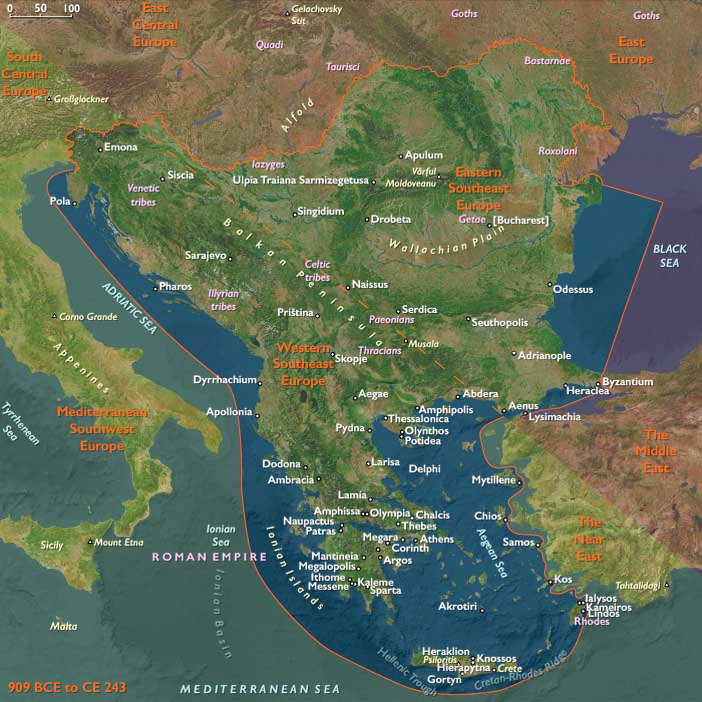
The Suppliant Women, written by Aeschylus in about 463 BCE as the first play in a trilogy, dramatizes the decision of the king of Argos to shelter fifty Egyptian women—the Danaids—who seek escape from marriage to their cousins.
He premieres in Athens another trilogy, one of enormous scope and power, the Oresteia, in 458 BCE.
The only one of the playwright’s trilogies, or any other from this age, to survive intact, the Oresteia is a dramatization of the legendary curse on the House of Atreus.
The play features the violent Agamemnon, the even more violent Choephoroe, or Libation Bearers, and the spectacular Eumenides.
The Oriesteia explores ambiguous and paradoxical relationship between humans and the cosmos, in which people must answer for actions determined by the gods.
A skene, or stage building, (originally of wood), had been added about 460 BCE at the rear of the Greek theater at Athens, consisting until now only of the large circle known as the orchestra ("dancing place").
The actors make their entrances and exits through this new structure, although the chorus continues to enter from the sides and the action is still restricted to the flat orchestra.
Additional scenery, painted on panels attached to the skene, may be in use by now.
Several special effects and machines are available to the dramatists.
These include the eccyclema, or "wheeling out" machine, a wagon (or perhaps a turntable) on which bloody tableaux are displayed after a murder takes place in the palace, represented by the skene; and a crane by which actors portraying gods can be flown above the stage.
According to the ancient, anonymous Life of Aeschylus, "boys fainted and women miscarried" at the appearance of the Furies hounding the protagonist Orestes in the Eumenides.
This is a tribute to the true showmanship of Aeschylus, whose striking visual effects combine elaborate machinery with exotic robes, painted scenery, daring costumes and masks, and high boots (kothornoi) that magnify the height of the actors.
Aeschylus after 458 BCE returns to Sicily, allegedly dissatisfied with the Athenian public.
Euripides, a thirty-year old Athenian playwright (possibly born on Salamis) enters his first competition in 455; the Attic drama festival of 454 sees the first performance of his plays.
Locations
People
Groups
Topics
Subjects
Regions
Subregions

Related Events
Showing 1 events out of 1 total
Years: 465BCE - 454BCE
Locations
People
Groups
Topics
Subjects
Regions
Subregions