Intercity conflict among such Sumerian cities as …
Years: 2493BCE - 2350BCE
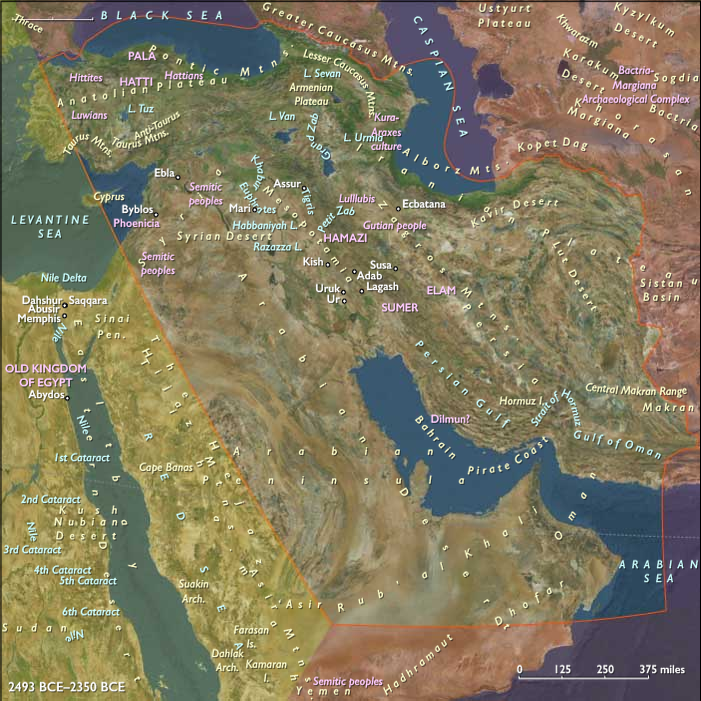
Intercity conflict among such Sumerian cities as Ur, Lagash, and Kish reaches a climax in the early twenty-fourth century BCE.
Eannatum of Lagash raids other cities.
Locations
People
Groups
Topics
Commodoties
Subjects
- Commerce
- Writing
- Watercraft
- Engineering
- Painting and Drawing
- Environment
- Labor and Service
- Style
- Conflict
- Faith
- Government
- Technology
- Archaeology
- Anthropology
Regions
Subregions
Related Events
Filter results
Showing 10 events out of 68283 total
The aboriginal populations of Southeast Asia are generally considered to have been members of the Negrito and broadly defined Austro-Melanesian groups, and may have arrived as part of the hypothesized Great Coastal Migration from Africa via coastal India.
These groups today make up only a small minority of the Southeast Asian population.
Evidence suggests that the earliest non-aboriginal Southeast Asians came from southern China and were Austronesian speakers.
Contemporary research by anthropologists, linguists (Blust, Reid, Ross, Pawley), and archaeologists (Bellwood) suggests that the inhabitants of Maritime Southeast Asia migrated from southern China to islands of the Philippines around 2500 BCE and later spread to present Malaysia and Indonesia.
Maritime East Asia (2493–2350 BCE): Late Longshan Expansion and Early Urbanization
Between 2493 BCE and 2350 BCE, Maritime East Asia—comprising lower Primorsky Krai, the Korean Peninsula, the Japanese Archipelago below northern Hokkaido, Taiwan, and southern, central, and northeastern China—continues to witness significant social and cultural developments, especially during the Late Longshan period in China. This era is characterized by increased geographic diversification, the expansion of agricultural practices, early urban settlement formation, and regional interactions that lay critical foundations for the evolution of more complex societies in subsequent periods.
Regional Expansion of Late Longshan Culture
During this era, the Longshan civilization expands notably into a wide variety of geographic regions across China, encompassing numerous distinctive sub-periods. One such prominent regional variant is the Shaanxi Longshan, flourishing notably along the middle reaches of the Jing River and Wei River valleys. This region later gains historical prominence through its strategic location near routes such as the emerging North Silk Road, underscoring the long-term significance of early settlement patterns established during this era.
These diverse regional manifestations of Longshan culture demonstrate increased cultural complexity and indicate extensive intra-regional interactions, setting an enduring pattern for subsequent Chinese historical developments.
Rise of Urbanization and Fortified Settlements
The Late Longshan period marks a decisive shift towards urbanization and increased social complexity. Permanent settlements begin exhibiting characteristics of early cities, including substantial defensive structures such as rammed-earth walls and moats. Notably, the archaeological site of Taosi (in modern-day Shanxi Province) emerges as the largest walled settlement of this period, reflecting growing population density, specialized labor, and social stratification.
Expansion and Consolidation of Rice Cultivation
Agricultural practices, particularly rice cultivation, become firmly established and expand widely across the Yangzi River basin and beyond, securing the foundation for sustainable population growth and stable economic systems. The enhanced agricultural productivity supports growing populations, facilitating further social complexity and specialization of labor, critical for urban growth and technological innovation in subsequent periods.
Legacy of the Era: Foundations for Complexity
Thus, between 2493 BCE and 2350 BCE, Maritime East Asia experiences critical developments characterized by increased regional diversification within the Longshan cultural framework, expansion of fortified urban settlements such as Taosi, and widespread agricultural consolidation. These transformative processes lay essential foundations for the subsequent emergence of more sophisticated social structures, advanced agricultural economies, and urban civilizations that define later historical trajectories in Lower East Asia.
The cultures that are to dominate this epoch lay the foundations of their success through the nexus of government, military, infrastructure, and commerce.
Notable examples include the Longshan civilization in China, the Harappan civilization of the Indus Valley, the city-states of Sumer, the commercial ports of the Canaanites, the Old Kingdom of Egypt, the Crete-based Minoan civilization of the Aegean, and the Norte Chico civilization in Peru.
A variety of geographic regions of China are involved among the various sub-periods of the Longshan civilization, particularly for the Late Longshan period.
For example, the middle reaches of the Jing River and Wei River evince settlement known as the Shaanxi Longshan.
The We'i River valley will participate in key historic events in China as the North Silk Road develops in this same area.
Life during the Longshan culture marks a transition to the establishment of cities, as rammed earth walls and moats began to appear; the site at Taosi is the largest walled Longshan settlement, by which time rice cultivation is clearly established.
It is not known what language the early Scandinavians of the Pitted Ware culture spoke, but new tribes—the Corded-Ware, or Battle-Axe culture, who many scholars think spoke Proto-Indo-European—overrun them towards the end of the third millennium BCE,
Many scholars associate Corded Ware culture with some of the Indo-European family of languages; some believe it to be related to the Catacomb culture, an early Bronze Age culture occupying what, essentially, is present-day Ukraine.
The people of the Corded Ware culture (Battle Axe culture or Single Grave culture) may have introduced into Scandinavia the Indo-European (Germanic) language (ancestral to modern Danish, Swedish, Norwegian, Icelandic, and Faeroese).
This new people, advancing up to Uppland and the Oslofjord, are cattle herders; with them, most of southern Scandinavia enters the Neolithic.
Eastern Southeast Europe (2493–2350 BCE): Cultural and Economic Exchange
Regional trade and interactions among local tribes increased.
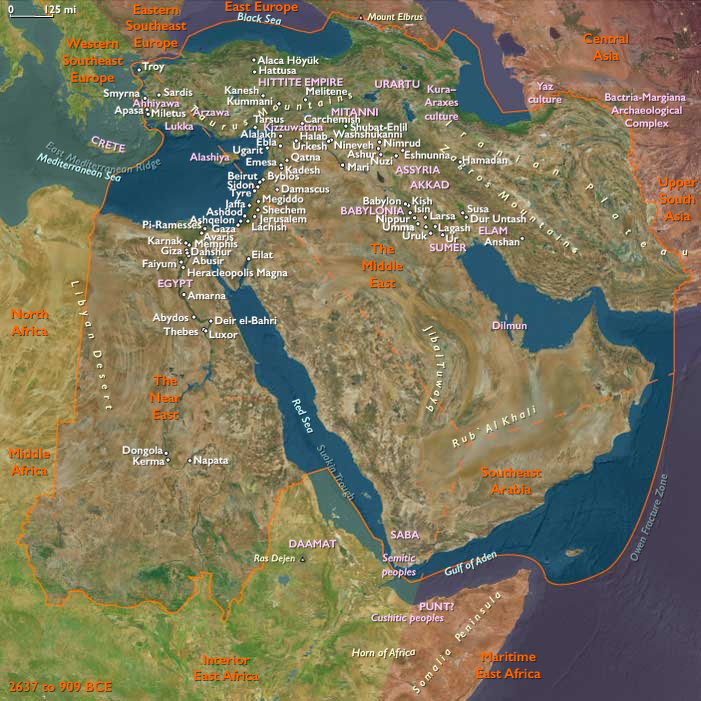
The Middle East (2493–2350 BCE): Emergence of Political Authority and Economic Networks
Transition from Priestly to Secular Kingship
From 2493 to 2350 BCE, a significant transformation occurred in Sumerian political structures, marking the shift from priestly rule toward secular authority. Unlike earlier religious rulers, new kings wielded explicit political control independent of religious functions. This period saw intense rivalry among prominent Sumerian city-states such as Umma, Kish, and Lagash, each vying for dominance over the fertile river valleys of lower Mesopotamia.
Expansion of Economic and Commercial Networks
During this era, an extensive commercial network emerged, interlinking regions as diverse as Anatolia, Mesopotamia, Egypt, the Aegean, and the Syrian coast. Central to this vast economic system was the influential kingdom of Ebla, identified at Tall Mardikh. Ebla flourished as a sophisticated and powerful indigenous empire, controlling large parts of northern Syria and exerting considerable influence on portions of lower Mesopotamia, Anatolia, and Iran.
Foundation and Early Occupation of Assur
Archaeological discoveries indicate the initial occupation of the site of Assur around 2500 BCE, possibly by groups migrating from Syria or the southern regions. The city's early foundations, including structures discovered beneath the Ishtar temple and the Old Palace, foreshadowed its eventual prominence as a significant Assyrian center.
Artistic and Technological Sophistication
The Sumerians demonstrated remarkable artistic sophistication during this period, creating intricate jewelry pieces including necklaces, earrings, rings, and bracelets. Exceptional craftsmanship is exemplified by finds from the royal tombs of Ur, where luxurious artifacts such as gold headdresses adorned with lapis lazuli pendants highlight advanced techniques like casting, cloisonné, granulation, and filigree.
Akkadian Ascendancy and Linguistic Developments
Semitic-speaking Akkadians began to dominate northern Mesopotamia around 2410 BCE, significantly altering regional power dynamics. The Akkadian language, employing the cuneiform writing system, became widespread. The proliferation of scribal schools across Sumer supported this linguistic and administrative transformation.
Intercultural Relations and Conflicts
The city-state of Mari, inhabited by Semitic peoples related to the Eblaite and Akkadian groups, developed significant cultural and political connections with southern Mesopotamia. Artifacts and votive statues from Mari's temples indicate stylistic influences from Sumerian art, reflecting extensive intercultural interactions. Conflicts, particularly between the city-states of Lagash, Kish, and others, intensified during this period, epitomized by military exploits such as those led by King Eannatum of Lagash.
Elamite Political Ascendance
Elam, with its distinct language and matrilineal succession, solidified its political presence in the region through the establishment of the Awan dynasty. This dynasty's hegemony and trade relations with Sumer, particularly under Elamite rulers who occasionally dominated Sumerian cities, underscored its significant role in regional politics and economics.
Ebla's Administrative and Cultural Legacy
The city-state of Ebla emerged prominently during this period, known for extensive administrative records on clay tablets discovered at the site. Written in the Eblaite language, these tablets provided insights into diplomatic communications, trade practices, and cultural exchanges, highlighting Ebla’s status as an economic powerhouse with far-reaching commercial ties extending across the Near East.
Phoenician Maritime Influence
Phoenician cities such as Byblos (Gubla) continued to expand maritime trade, exporting goods like cedar, olive oil, and wine, and importing luxury items from Egypt. Depictions in Egyptian reliefs from this era notably portray Phoenician maritime activities, emphasizing their significant role in Mediterranean commerce.
Military and Urban Developments
Militarily, innovations in infantry formations became apparent, illustrated by the Stele of the Vultures, which depicted organized formations akin to a phalanx. The period also saw substantial urban fortifications, notably the legendary construction of extensive defensive walls around Uruk ordered by the semi-mythological King Gilgamesh.
Ur's Dynastic Prominence
Under Mesannepada, the city of Ur rose to preeminence, marked by impressive constructions including elaborate royal tombs. These tombs, notably that of Queen Puabi, evidenced Ur’s wealth, power, and sophisticated cultural practices.
The era from 2493 to 2350 BCE was thus characterized by pronounced shifts toward political authority distinct from religious power, extensive economic networks, artistic and technological advancements, and complex intercultural relations, laying crucial foundations for future regional dynamics.

Historians generally divide Sumerian history into three stages.
The most important political development in the first stage, which extends roughly from 3360 BCE to 2400 BCE, is the emergence of kings who, unlike the first priestly rulers, exercised distinct political rather than religious authority.
Another important feature of this period is the emergence of warring Sumerian city-states, which fight for control of the river valleys in lower Mesopotamia.
An enormous commercial network linking Anatolia, Mesopotamia, Egypt, the Aegean, and the Syrian coast is perhaps under the aegis of the kingdom of Ebla ("city of the white stones"), the chief site of which will be discovered in 1975 at Tall Mardikh, sixty-four kilometers south of Aleppo.
Numerous tablets give evidence of a sophisticated and powerful indigenous Syrian empire, which dominates northern Syria and portions of lower Mesopotamia, Anatolia, and Iran.
The site of Assur, a name eventually to be applied to the city, to the country, and to the principal god of the yet-to-emerge Assyrians, is revealed by archaeology to have been originally occupied about 2500 BCE by a tribe that probably had reached the Tigris River either from Syria or from the south. (The oldest remains of the city will one day be discovered in the foundations of the Ishtar temple, as well as at the Old Palace.)
Years: 2493BCE - 2350BCE
Locations
People
Groups
Topics
Commodoties
Subjects
- Commerce
- Writing
- Watercraft
- Engineering
- Painting and Drawing
- Environment
- Labor and Service
- Style
- Conflict
- Faith
- Government
- Technology
- Archaeology
- Anthropology