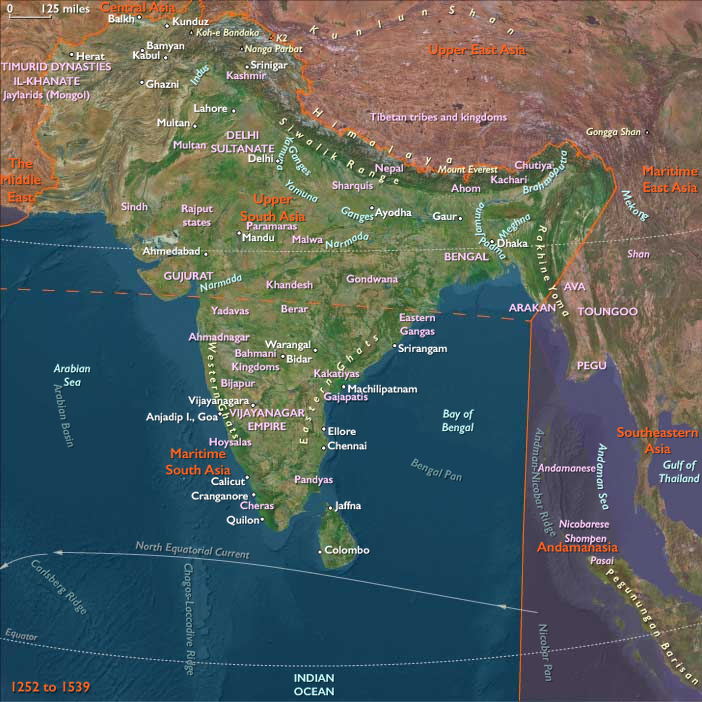
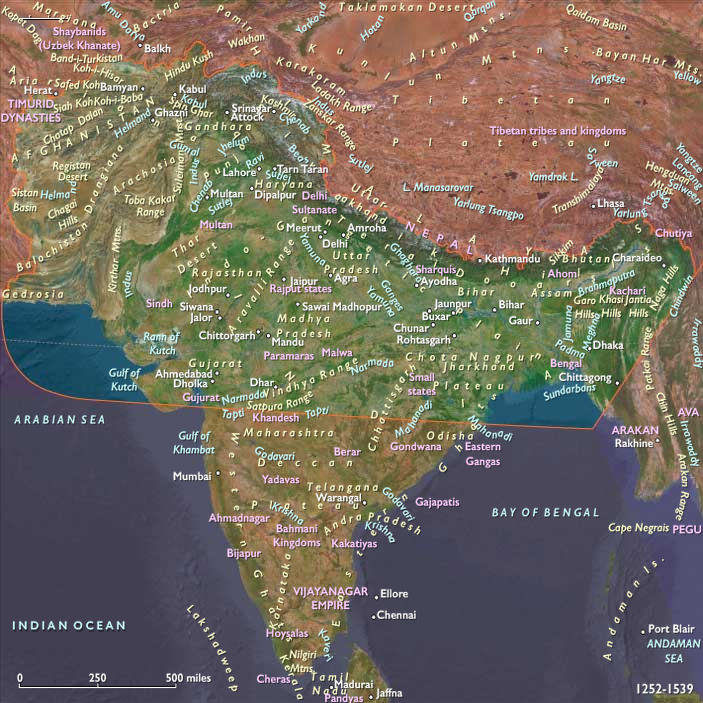
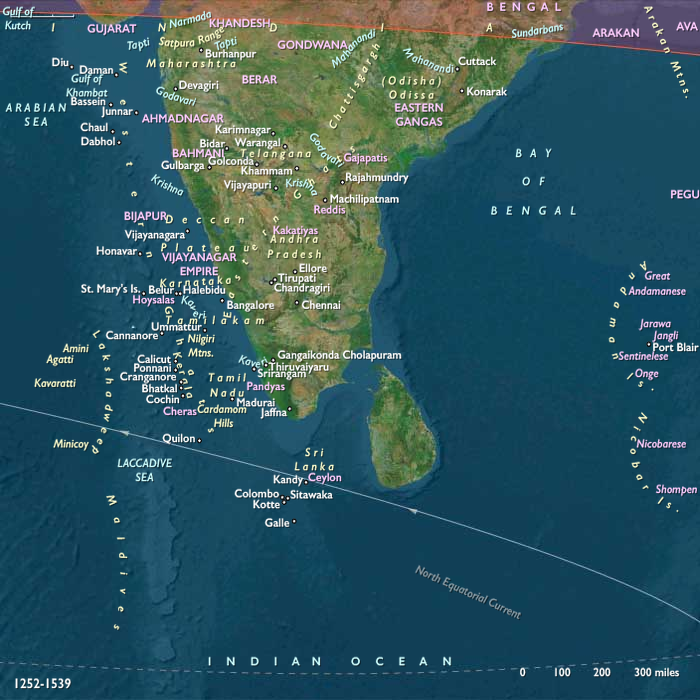
India in the sixteenth century presents a …
Years: 1396 - 1539
India in the sixteenth century presents a fragmented picture of rulers, both Muslim and Hindu, who lack concern for their subjects and who fail to create a common body of laws or institutions.
Outside developments also play a role in shaping events.
The circumnavigation of Africa by the Portuguese explorer Vasco da Gama in 1498 allows Europeans to challenge Arab control of the trading routes between Europe and Asia.
In Central Asia and Afghanistan, shifts in power push Babur of Ferghana (in present-day Uzbekistan) southward, first to Kabul and then to India.
The dynasty he founds will endure for more than three centuries.
Locations
People
Groups
- Hinduism
- Indian people
- Islam
- Portugal, Avizan (Joannine) Kingdom of
- Delhi, Sultanate of (Lodi, or Afghan, Dynasty)
- India, Portuguese State of
Topics
- India, Medieval
- Age of Discovery
- Portuguese Conquests in India and the East Indies
- Colonization of Asia, Portuguese
- Babur, Conquests of
- Mughal War against Gujarat, First
- Mughal Wars against the Sur Dynasty, Early
Subjects
Regions
Subregions
Related Events
Filter results
Showing 10 events out of 72 total
The former Knights of Rhodes have wandered without a base since their expulsion from Rhodes seven years earlier at Ottoman hands, but in 1530, the Holy Roman emperor Charles V leases them the Maltese archipelago in return, among other things, for the annual presentation of a falcon to his viceroy of Sicily.
Here they will build numerous fortifications and begin to become known as the Knights of Malta.
The naval strength of the Ottomans has become formidable in the reign of Süleyman.
Suleiman the Magnificent had in 1653 ordered Hayreddin Barbarossa, whom he had summoned from Algiers, to build a large war fleet in the arsenal of Constantinople.
Altogether, seventy galleys had been built during the winter of 1533–1534.
With this fleet, Barbarossa conducts aggressive raids along the coast of Italy, until he conquers Tunis on August 16, 1534, ousting the local ruler, heretofore subservient to the Spanish, Muley Hasan.
Barbarossa thus establishes a strong naval base in Tunis that can be used for raids in the region, and on nearby Malta.
Charles V, one of the most powerful men in Europe at this time, assembles a large army of some thirty thousand soldiers, seventy-four galleys, and three hundred ships—including the Santa Anna and Portuguese galleon São João Baptista, also known as Botafogo (Spitfire) and the most powerful ship in the world at the time, with three hundred and sixty-six bronze cannons—to drive the Ottomans from the region.
The expense involved for Charles V is considerable, and at one million ducats is on par with the cost of Charles' campaign against Suleiman on the Danube.
Unexpectedly, the funding of the conquest of Tunis comes from the galleons sailing in from the New World, in the form of a two million gold ducats treasure extracted by Francisco Pizarro in exchange for his releasing of the Inca king Atahualpa (whom he nevertheless executed on August 29, 1533).
Despite a request by Charles V, Francis I has denied French support to the expedition, explaining that he is under a three-year truce with Barbarossa following the 1533 Ottoman embassy to France.
Francis I is also under negotiations with Suleiman the Magnificent for a combined attack on Charles V, following the 1534 Ottoman embassy to France.
Francis I only agrees to Pope Paul III's request that no fight between Christians occur during the time of the expedition.
The Knights of Malta, who have organized piratical raids against Ottoman ships, capture Tunis and Goletta in 1535 with the aid of Doria and the imperial fleet.
The armies of Sultan Suleiman the Magnificent had been stopped at Vienna in 1529, but the expansion of the Ottoman Empire is the main danger to Christianity in Europe in 1538.
A Christian offensive in the Mediterranean had attempted to eliminate the danger of the great Turkish fleet in 1535, when a strong armada under Don Álvaro de Bazán and Andrea Doria captured the port of Tunis, expelling Ottoman admiral Hayreddin Barbarossa from the waters of the Western Mediterranean.
The Ottoman admiral was then required to return to Constantinople, where he had been appointed commander of a great fleet to conduct a campaign against the Republic of Venice's possessions in the Aegean and Ionian Seas.
Barbarossa has captured almost all the remaining Christian outposts in the Ionian and Aegean Seas, including the islands of Syros, Aegina, Ios, Paros, Tinos, Karpathos, Kasos, Naxos, and besieged Corfu.
The Italian cities of Otranto and Ugento and the fortress of Castro, in the province of Lecce, are also looted.
The Republic of Venice, frightened by the loss of their possessions and the ruin of their trade, conduct a vigorous campaign for the creation of a "Holy League" to recover the lost territories and expel the Ottomans from the sea.
Pope Paul III succeeds in creating a league that in February 1538, unites the Papacy itself, the Republic of Venice, the Empire of Charles V, the Archduchy of Austria and the Knights of Malta.
The Allied fleet for the campaign is supposed to consist of two hundred galleys and another one hundred auxiliary ships, and the army of about fifty thousand infantry and forty-five hundred cavalry, all that can be gathered are are only one hundred and thirty galleys and an army of around fifteen thousand infantry, mostly Spaniards.
The command of the fleet is given nominally to the Genoese Andrea Doria, but Vicenzo Capello and Marco Grimaldi, commanding officers of the Papal and Venetian fleets respectively, have almost twice as many ships as Doria.
The commander of the army is unquestionably Hernando Gonzaga, Viceroy of Sicily.
Differences among the commanders of the fleet diminish its effectiveness against an experienced opponent like Barbarossa.
Barbarossa defeats an imperial-Venetian fleet under Doria at the Battle of Preveza off the Albanian coast on September 27, 1538, thereby giving to the Ottomans the naval initiative in the Mediterranean.
It is widely speculated that Doria’s prevarication and lack of zeal were due to his unwillingness to risk his own ships (he personally owns a substantial number of the "Spanish-Genoese" fleet) and his long-standing enmity towards Venice, his home city's fierce rival and the primary target of Ottoman aggression at this time.
Venice surrenders Dalmatia and the Morea, its last possession in the Aegean, thus assuring an Ottoman naval supremacy in the eastern Mediterranean that will remain unbroken for three decades.
The Holy League fleet provides support to Spanish land forces on the Dalmatian coast that capture the small town of Castelnuovo, a strategic fortress between the Venetian possessions of Cattaro and Ragusa in the area known as Venetian Albania.
Venice therefore claims ownership of the city, but Charles V refuses to cede it.
This is the beginning of the end of the Holy League.
The town of Castelnuovo is garrisoned with approximately four thousand men.
The main force is a tercio of Spanish veteran soldiers numbering about thirty-five hundred men under the experienced Maestro de Campo Francisco Sarmiento de Mendoza y Manuel. This tercio, named Tercio of Castelnuovo, is formed by fifteen flags (companies) belonging to other tercios, among them the Old Tercio of Lombardy, dissolved the year before after a mutiny for lack of pay. The garrison also includes one hundred and fifty light cavalry soldiers, a small contingent of Greek soldiers and knights under Ándres Escrápula, and some artillery pieces managed by fifteen gunners under captain Juan de Urrés. The chaplain of Andrea Doria, named Jeremías, also remains in Castelnuovo along with forty clerics and traders and is appointed bishop of the town.
The reason for the garrison's large size is that Castelnuovo is projected to be the beachhead for a great offensive against the heart of the Ottoman Empire.
However, the fate of the troops in the fortress depends entirely on the support of the fleet, and this had been defeated by Barbarossa at Preveza.
Moreover, in a short time Venice withdraws from the Holy League after accepting a disadvantageous agreement with the Ottomans.
Without Venetian ships, the Allied fleet has no chance to defeat the Ottoman fleet commanded by Barbarossa, who is by this time supported by another experienced officer, Turgut Reis.
Suleiman orders Barbarossa to reorganize and rearm his fleet during the winter months to have it ready for the battle in the spring of 1539.
Ten thousand infantry and four thousand Janissaries are embarked aboard the warships to reinforce the troops of the galleys.
According to the orders received, Barbarossa's army, numbering about two hundred ships with twenty thousand fighting men aboard, are to blockade Castelnuevo by sea while the forces of the Ottoman governor of Bosnia, a Persian named Ulamen, is to besiege the fortress by land in command of thirty thousand soldiers.
Sarmiento, meanwhile, has used the peaceful months prior to the siege to improve the defenses of the town, repairing walls and bastions and building new fortifications.
In the event he cannot do much due to a lack of available means, as there is no plan to fortify the town since it is supposed to function as a beachhead.
Captain Alcocer is sent to Spain with instructions to call for help; Pedro de Sotomayor is sent to Sicily and Captain Zambrana to Brindisi, all in vain.
Andrea Doria, who is in Otranto with fofty-seven Imperial and four Maltese galleys, receives news of Castelnuovo's situation, but given the inferiority of his fleet he sends a message to Sarmiento recommending him to surrender.
Barbarossa's army is by 23 July ready to begin a general assault and his artillery prepared to break down the walls of Castelnuovo.
Enjoying a vast numerical superiority over the Spanish garrison, which is completely isolated and unable to receive support or supplies, Barbarossa offers an honorable surrender to the Spanish.
Sarmiento and his men will be granted a safe passage to Italy, the soldiers retaining their weapons and flags.
Barbarossa adds to his offer the incentive of giving each soldier twenty ducats.
His only demand to Sarmiento is the abandonment of his artillery and gunpowder.
Two squad corporals of Captain Vizcaino's company, Juan Alcaraz and Francisco de Tapia, manage to return to Naples and write their version of events many years later.
They record the answer given to Barbarossa that "the Maestro de Campo consulted with all the captains, and the captains with his officers, and they decided that they preferred to die in service of God and His Majesty."
The great assault on the city is launched shortly after, and last all day.
Almost all of the Janissaries and sixteen thousand from the other Ottoman units are killed in the assault.
According to rumor, Turkish losses amounted to thirty-seven thousand dead. Of the Spanish troops only two hundred survive, most of them wounded.
Half of the prisoners and all the clerics are also slaughtered to satisfy the Ottoman soldiers, who are angry at the great losses which they had suffered in capturing the city.
The few survivors are taken as slaves to Constantinople.
Twenty-five of them will manage to escape from prison six years later and sail to the port of Messina.

Tripoli, which has thirty thousand inhabitants at the end of the seventeenth century, is the only city of any size in the regency.
The bulk of its residents are Moors, as city-dwelling Arabs are known.
Several hundred Turks and renegades form a governing elite apart from the rest of the population.
A larger component is the khouloughlis (literally, "sons of servants"), offspring of Turkish soldiers and Arab women who traditionally hold high administrative posts and provide officers for the spahis, the provincial cavalry units that augment the corps of janissaries.
They identify themselves with local interests and are, in contrast to the Turks, respected by the Arabs.
Regarded as a distinct caste, the khouloughlis live in their menshia, a lush oasis located just outside the walls of the city.
Jews and Moriscos, descendants of Muslims expelled from Spain in the sixteenth century, are active as merchants and craftsmen, some of the Moriscos also achieving notoriety as pirates.
A small community of European traders clusters around the compounds of the foreign consuls, whose principal task is to sue for the release of captives brought to Tripoli by the corsairs.
European slaves and larger numbers of enslaved blacks transported from the Sudan are a ubiquitous feature of the life of the city.
Habsburg Spain and the Ottoman Turks are pitted in a struggle for supremacy in the Mediterranean throughout the sixteenth century.
Spanish forces had already occupied a number of other North African ports when in 1510 they captured Tripoli, destroyed the city, and constructed a fortified naval base from the rubble.
Tripoli was of only marginal importance to Spain, however, and in 1524 the king-emperor Charles V had entrusted its defense to the Knights of St. John of Malta.
Piracy, which for both Christians and Muslims is a dimension of the conflict between the opposing powers, lures adventurers from around the Mediterranean to the Maghebi coastal towns and islands.
Among them is Khair ad Din, called Barbarossa, who in 1510 had seized Algiers on the pretext of defending it from the Spaniards.
Barbarossa subsequently recognized the suzerainty of the Ottoman sultan over the territory that he controlled and was in turn appointed the sultan's regent in the Maghrib.
Using Algiers as their base, Barbarossa and his successors have consolidated Ottoman authority in the central Maghreb, extended it to Tunisia and Tripolitania, and threatened Morocco.
The knights are driven out of Tripoli in 1551 by the Turkish admiral, Sinan Pasha.
In the next year Dragut, a Turkish pirate captain named governor by the sultan, restored order in the coastal towns and undertakes the pacification of the Arab nomads in Tripolitania, although he admits the difficulty of subduing a people "who carry their cities with them."
Years: 1396 - 1539
Locations
People
Groups
- Hinduism
- Indian people
- Islam
- Portugal, Avizan (Joannine) Kingdom of
- Delhi, Sultanate of (Lodi, or Afghan, Dynasty)
- India, Portuguese State of
Topics
- India, Medieval
- Age of Discovery
- Portuguese Conquests in India and the East Indies
- Colonization of Asia, Portuguese
- Babur, Conquests of
- Mughal War against Gujarat, First
- Mughal Wars against the Sur Dynasty, Early