
The Sufyanids have generally retained the Roman …
Years: 678 - 678
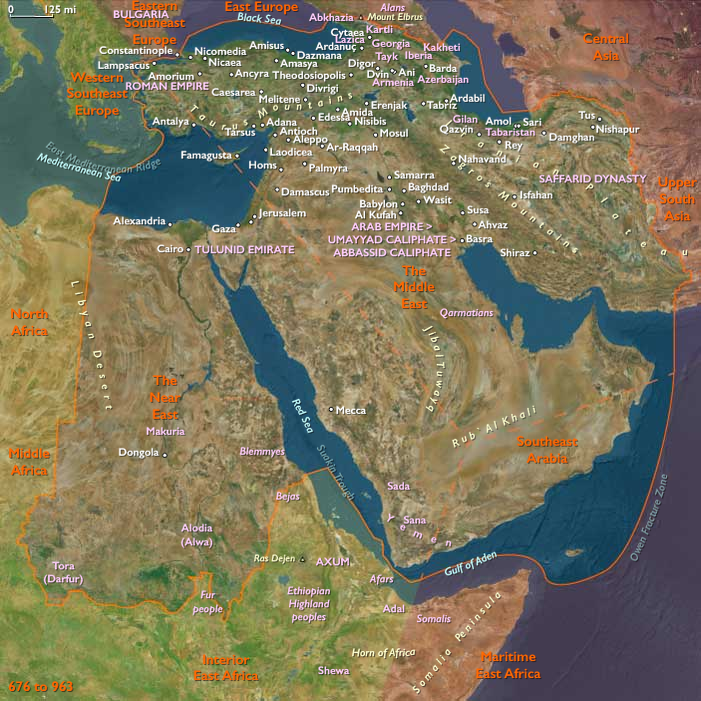
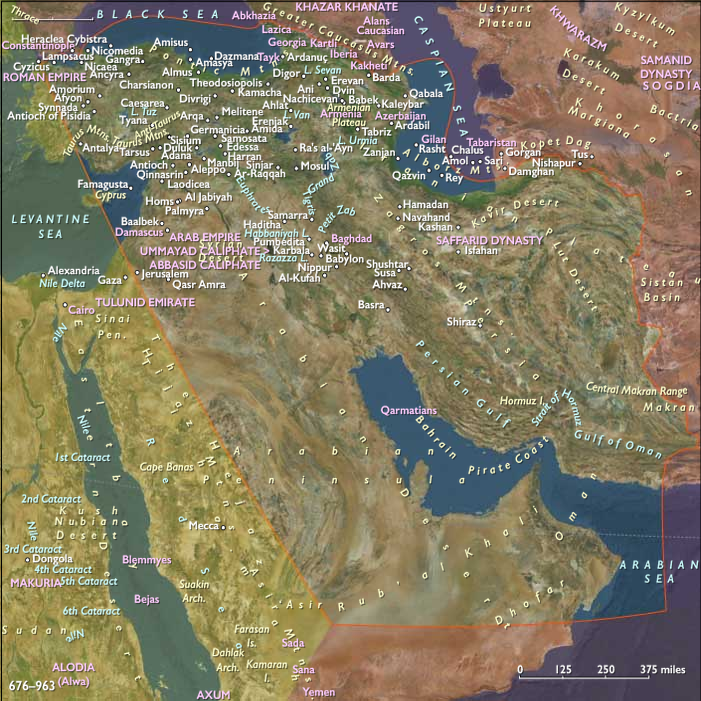
The Sufyanids have generally retained the Roman and Persian administrative bureaucracies they had inherited in the provinces; politically they are organized along Arab tribal lines, in which the caliph is chosen by his peers to become, theoretically, “first among equals,” and act on the advice of a shura, or tribal council.
Muawiyah, however, in securing during his lifetime an oath of allegiance to his son Yazid, has disregarded the traditional “election” and introduced the alien concept of hereditary succession.
For this reason, the Umayyad dynasty will sometimes be referred to as the Arab kingdom, reflecting traditional Muslim disapproval of the secular nature of the Umayyad state.
The Umayyad attacks against Constantinople from 669 to 678, while ultimately unsuccessful, have offset the secular image of the state, because they have been directed against the Christians.
Locations
People
Groups
- Arab people
- Christianity, Chalcedonian
- Roman Empire, Eastern: Heraclian dynasty
- Islam
- Umayyad Caliphate (Damascus)
Topics
Commodoties
Subjects
Regions
Subregions
Related Events
Filter results
Showing 10 events out of 56034 total
Constantine IV, sometimes incorrectly called Pogonatos, "the Bearded", by confusion with his father, had in 654 been named a co-emperor with his father Constans II, and had become senior emperor in 668 when Constans was assassinated ion Sicily.
The fact that Constantine has led the Empire in withstanding the four-year Arab siege of Constantinople greatly enhances Roman prestige and indeed marks a turning point in European history.
The spread of Christian guerillas in Syria, Lebanon and Palestine has deepened the blow.
As a result, Muawiyah sues for peace, under the humiliating terms of which the Caliphate agrees to return all the all captured Ionian islands and to pay to the Romans annual tributes of slaves, horses and thousands pounds of gold.
Adeodatus II, having reigned as pope from April 11, 672 to June 17, 676, had been succeeded by Donus, who has paved the enclosed forecourt of St. Peter's Basilica, paved the atrium or quadrangle in front of St. Peter's with great blocks of white marble, and restored other churches of Rome, notably the church of St. Euphemia on the Appian Way, and the basilica of St. Paul Outside the Walls.
During the pontificate of Donus, Reparatus, the Archbishop of Ravenna, returns to the obedience of the Holy See, thus ending the schism created by Archbishop Maurus, who had aimed at making Ravenna autocephalous.
After a colony of Nestorian monks is discovered in a Syrian monastery at Rome—the Monasterium Boetianum—Donus is reported to have dispersed them through the various religious houses of the city and to have given their monastery to Roman monks.
His successor, Agatho, a Greek born in Sicily of wealthy and devout parents, succeeds him to the papal throne in April 678.
Shortly after Agatho’s elevation, Wilfrid, Archbishop of York, arrives at Rome to invoke the authority of the Holy See in his behalf.
Wilfrid had been deposed from his see by Theodore, Archbishop of Canterbury, who had carved up Wilfrid's diocese, appointing three bishops to govern the new sees.
At a synod that Pope Agatho convoked in the Lateran to investigate the affair, it had been decided that Wilfrid's diocese should indeed be divided, but that Wilfrid himself should name the bishops.
Agatho is the first Bishop of Rome to stop paying tribute to the Emperor in Constantinople upon election.
Theodore, the Archbishop of Canterbury, had begun a substantial reorganization of the church in Mercia early in the reign of Æthelred.
He had removed Wilfred from his position as Bishop of Lichfield in 675, and over the past four years has divided the vast Mercian see into the five dioceses of Leicester, Lichfield, Worcester, Dorchester and Hereford.
Æthelred, a devout king, has made several gifts of land to the expanding church, including grants at Tetbury, Long Newton, and Somerford Keynes.
There is also a tradition that Æthelred was associated with the founding of Abingdon Abbey, in southern Oxfordshire.
The group of six Anglican kingdoms—Kent, Sussex, Wessex, East Anglia, Essex, Northumbria, and Mercia—is known to historians as the Heptarchy.
Mercia has been in conflict with Northumbria since at least 633, when Penda of Mercia defeated and killed Edwin of Northumbria at the Battle of Hatfield Chase.
However, there have been diplomatic marriages between the two kingdoms: Æthelred's sister Cyneburh had married Alhfrith, a son of Oswiu of Northumbria, and both Æthelred and his brother Peada had married daughters of Oswiu.
Cyneburh's marriage to Alhfrith had taken place in the early 650s, and Peada's marriage, to Ealhflæd, had followed shortly afterwards; Æthelred's marriage, to Osthryth, is of unknown date but must have occurred before 679, since Bede mentions it in describing the Battle of the Trent, which takes place in this year.
Bede does not mention the cause of the battle, simply saying that it occurred in the ninth year of Ecgfrith's reign.
He is more informative on the outcome.
Ælfwine, the young subking of Deira, was killed; Ælfwine was brother to Osthryth and Ecgfrith, and was well liked in both Mercia and Northumbria since Æthelred's marriage to Osthryth.
His death according to Bede threatened to cause further strife between the two kingdoms, but Theodore, the Archbishop of Canterbury, intervened.
Æthelred takes possession of Lindsey again after the battle; the change in control this time will be lasting, and Lindsey will remain part of Mercia until the Viking invasion of the ninth century remakes the map of England.
Muawiyah dies in 680, and the Islamic community is soon convulsed by civil wars.
During this time, al-Muhallab deserts the Umayyads and sides with the anti-caliph ʿAbd Allāh ibn al-Zubayr, who entrusts him with suppressing the Kharijite rebellions in Iraq by the Azariqa.
Basra will subsequently become known as Basra al-Muhallab.
Muawiyah has pacified the Arab kingdom, greatly extended its frontiers, and transformed the early Muslim patriarchy into an imperial monarchy, the Umayyad Caliphate.
Having beautified Damascus, he has developed a court to rival that of Constantinople.
At his death in 680, many of those whom Muawiyah had kept in check now rebel against his son Yazid, who is widely opposed in Syria and Mesopotamia, inaugurating what will be a series of bloody civil wars that will rend the fabric of the late Muawiyah’s Arabian Empire.
The Sarcophagus of Agilbert: A Masterpiece of Early Medieval Art
In 680, Agilbert, a prominent Merovingian bishop, passes away and is interred in the crypt of Jouarre Abbey, where his sister, Theodechildis, serves as abbess. His final resting place is marked by an exquisitely sculpted sarcophagus, a testament to the artistry of pre-Romanesque sculpture in the region east of Paris.
The long side of the sarcophagus depicts the Last Judgment, populated by hauntingly expressive figures of the resurrected dead, a rare and striking representation from this early period. The headpiece, displaying Christ flanked by the Beasts of the Apocalypse, draws influence from Coptic Egyptian art, an unparalleled motif in Western Europe, suggesting cross-cultural artistic transmission.
In contrast, the sarcophagus of his sister, Theodechildis, while also finely crafted, takes on a more austere aesthetic. Its surface is heavily inscribed in Latin characters and adorned with an intricate double-row pattern of scallop shells, an enduring Christian symbol of pilgrimage and resurrection.
Both tombs stand as remarkable relics of early medieval sculpture, bridging Merovingian craftsmanship with emerging artistic traditions that would later shape the Romanesque era.
'Ali ibn Abi Talib, the cousin and one of the Ahl al-Bayt (people of the House) of the Islamic prophet Muhammad, had migrated to Medina shortly after Muhammad.
There Muhammad told Ali that he had been ordered by God to give his daughter, Fatimah, to Ali in marriage.
'Ali had been an active servant of Muhammad's service during his decade at the helm of the community in Medina, carrying messages and orders and leading war parties of warriors on battles, participating in all the battles fought for Islam during this time eith the exception of Tabuk.
After the assassination in 656 of the third Caliph, Uthman Ibn Affan, the Companions of Muhammad in Medina had chosen 'Ali to be the new Caliph.
Because Ali is unable to apprehend and punish Uthman's murderers due to the rebel infiltration of the Muslim ranks, Muawiyah ibn Abī Sufyān, who had been a companion of Muhammad and been Governor of Syria since 640, had refused to acknowledge his caliphate.
Muawiyah had met with considerable military success in the ensuing civil war, including the seizure of Egypt.
Whereas the Shiites believe, as they do today, that the imamate, or leadership, is the sole right of the house of 'Ali, the Kharijites insist that any pious and able Muslim can be a leader of the Muslim community.
And whereas the Sunnis believe that the imam's impiousness does not, by itself, justify sedition, the Kharijites insist on the right to revolt against any ruler who deviates from the example of the Islamic prophet Muhammad and the first two Caliphs.
A Kharajite had in 661 finally assassinated 'Ali at prayer in the mosque of Kufa with a strike of a poison-coated sword, and Muawiyah—holding both Syria and Egypt and, as commander of the largest force in the Muslim Empire, having strongest claim to leadership—had assumed the caliphate.
'Ali’s sons Hasan and Hussein had acquiesced to the rule of Mu'awiyah and received pensions from him.
Hasan, initially defying Muawiyah, had soon ceased hostilities and retired to a quiet private life in Medina, where he lived until his death in 670 under mysterious circumstances.
Hussein, however, refuses in April, 680 to recognize the legitimacy of Muawiyah's son and successor, Yazid.
The townsmen of Kufah, a city with a Shi'ite majority, now invite Hussein, reputedly the favorite grandson of Muhammad, to lead then in raising the standard of revolt against the Umayyads.
Hussein, after receiving some favorable indications, sets out for Kufah from Mecca with a small band of relatives and followers.
According to traditional accounts, he meets the poet al-Farazdaq on the way and is told that the hearts of the Iraqis are for him, but their swords are for the Umayyads.
The governor of Iraq, on behalf of the caliph, sends four thousand men to arrest Hussein and his small band, trapping him on October 10 near the banks of the Euphrates River.
Hussein refuses to surrender, and he and his escort are slain, his head sent to Yazid in Damascus. (Shi'ite Muslims observe the first ten days of Muharram, the date of the battle according to the Islamic calendar, as days of lamentation in remembrance of Hussein's martyrdom.)
Revenge for Hussein’s death at the Battle of Karbala' is turned into a rallying cry that will help undermine the Umayyad caliphate and give impetus to the rise of a powerful Shi'ite movement, making permanent a division in Islam between the party of 'Ali and the Sunnite majority.
The Umayyads subdue Iraq, but rebellions in the name of this or that relative of 'Ali will continue, attracting more and more non-Arab support and introducing new dimensions to his cause.
The Göktürks, known in medieval Chinese sources as Tujue, had originated from the Ashina tribe, an Altaic people who lived in the northern corner of the area presently called Xinjiang.
Under the leadership of Bumin Khan and his sons, the Göktürks had in the late sixth century succeeded the Xiongnu as the main Turkic power in the region and taken hold of the lucrative Silk Road trade.
Rapidly expanding to rule huge territories in northwestern China, North Asia and Eastern Europe as far west as the Crimea, they are the first Turkic tribe known to use the name "Turk" as a political name.
A civil war at the beginning of the seventh century had left the empire divided into the eastern and western parts.
The eastern part, still ruled from Ötüken, had remained in the orbit of the Sui Empire and retained the name Göktürk.
The khans Shipi and Khieli of the East had attacked China at its weakest moment during the transition between the Sui and Tang dynasties, but in 657, the eastern part of the khaganate had been overrun by the Tang general Su Ding Fang, while the central part had emerged as the independent khaganate of Khazaria, led by a branch of the Ashina dynasty.
The Tang Emperor of China could by 659 claim to rule the entire Silk Road as far as Persia, as the Eastern Göktürks now carried Chinese titles and fought by their side in their wars.
The eastern steppes from 659 to 681 have been characterized by numerous independent rulers, weak, divided, and engaged in constant petty wars.
To the east, the Uyghurs had defeated their one-time allies the Syr-Tardush, a Tiele people and khanate in central and northern Asia, while to the west the Turgesh of the Ili Valley had emerged as successors to the Western Göktürks, or Onoq.
Despite these setbacks, Ilteris Sad, or Idat, and his brother Bakçor Qapagan Khan, or Mo-ch'o, after revolting against Chinese domination, succeed in 681 in reestablishing the Khanate.
The Eastern Göktürk Khagans over the following decades will steadily gain control of the steppes beyond the Great Wall.
Years: 678 - 678
Locations
People
Groups
- Arab people
- Christianity, Chalcedonian
- Roman Empire, Eastern: Heraclian dynasty
- Islam
- Umayyad Caliphate (Damascus)
