
Filters:
The final triumph of the seven hundred-year …
Years: 1396 - 1539
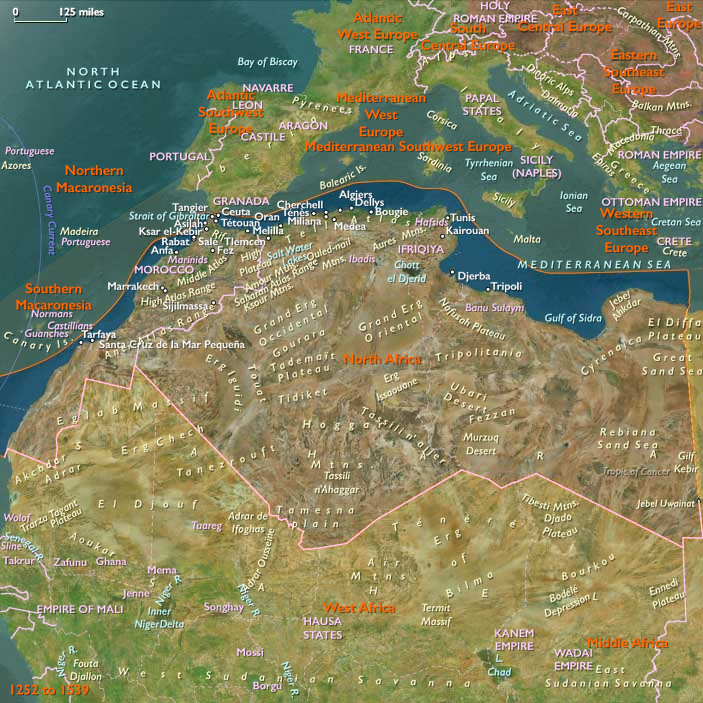
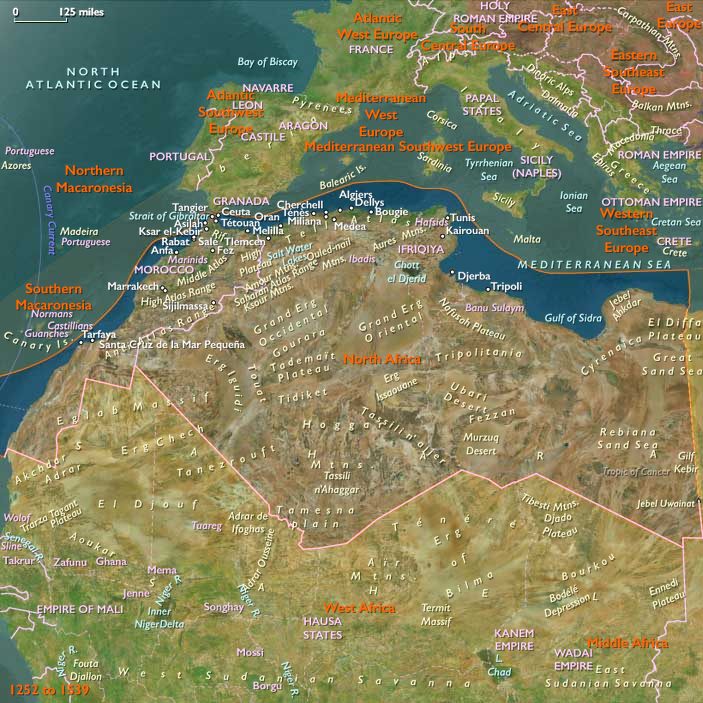
The final triumph of the seven hundred-year Christian reconquest of Spain, marked by the fall of Granada in 1492, is accompanied by the forced conversion of Spanish Muslims (Moriscos).
As a result of the Inquisition, thousands of Jews flee or are deported to the Magheb, where many gain influence in government and commerce.
Without much difficulty, Christian Spain imposes its influence on the Maghreb coast by constructing fortified outposts (presidios) and collecting tribute during the fifteenth and early sixteenth centuries.
On or near the Algerian coast, Spain taked control of Mers el Kebir in 1505, Oran in 1509, and Tlemcen, Mostaganem, and Ténès, all west of Algiers, in 1510.
In the same year, the merchants of Algiers hand over one of the rocky islets in their harbor, where the Spaniards build a fort.
The presidios in North Africa turn out to be a costly and largely ineffective military endeavor that does not guarantee access for Spain's merchant fleet.
Indeed, most trade seems to be transacted in the numerous free ports.
Moreover, from the sixteenth to the eighteenth century, sailing superior ships and hammering out shrewd concessions, merchants from England, Portugal, the Netherlands, France, and Italy, as well as Spain, will dominate Mediterranean trade.
Why Spain did not extend its North African conquests much beyond a few modest enclaves has puzzled historians.
Some suggest that Spain held back because it was preoccupied with maintaining its territory in Italy; others that Spain's energies were absorbed in obtaining the riches of the New World.
Still another possibility is that Spain was more intent on projecting its force on the high seas than on risking defeat in the forbidding interior of Africa.
As a result of the Inquisition, thousands of Jews flee or are deported to the Magheb, where many gain influence in government and commerce.
Without much difficulty, Christian Spain imposes its influence on the Maghreb coast by constructing fortified outposts (presidios) and collecting tribute during the fifteenth and early sixteenth centuries.
On or near the Algerian coast, Spain taked control of Mers el Kebir in 1505, Oran in 1509, and Tlemcen, Mostaganem, and Ténès, all west of Algiers, in 1510.
In the same year, the merchants of Algiers hand over one of the rocky islets in their harbor, where the Spaniards build a fort.
The presidios in North Africa turn out to be a costly and largely ineffective military endeavor that does not guarantee access for Spain's merchant fleet.
Indeed, most trade seems to be transacted in the numerous free ports.
Moreover, from the sixteenth to the eighteenth century, sailing superior ships and hammering out shrewd concessions, merchants from England, Portugal, the Netherlands, France, and Italy, as well as Spain, will dominate Mediterranean trade.
Why Spain did not extend its North African conquests much beyond a few modest enclaves has puzzled historians.
Some suggest that Spain held back because it was preoccupied with maintaining its territory in Italy; others that Spain's energies were absorbed in obtaining the riches of the New World.
Still another possibility is that Spain was more intent on projecting its force on the high seas than on risking defeat in the forbidding interior of Africa.
Locations
Groups
- Arab people
- Berber people (also called Amazigh people or Imazighen, "free men", singular Amazigh)
- Jews
- Bedouin
- Sanhaja (Berber tribal confederacy)
- Mauri
- Masmuda (Berber tribal confederacy)
- Islam
- Banu Sulaym
- Muslims, Sunni
- Banu Hilal
- Muslims, Kharijite
- Muslims, Shi'a
- Zenata (Berber tribal confederacy)
- Muslims, Ibadi
- Ismailism
- Christians, Roman Catholic
- Aragón, Kingdom of
- Ifriqiya, Hafsid (Banu Hafs) (first) Caliphate of
- Castile, Crown of
- Granada, Emirate of, or Nasrid Kingdom of
- Zayyanid dynasty
- Marinid Dynasty (Sultanate of Morocco)
- Tunis, Sultanate of (Hafsid Kingdom)
- Moriscos
- Christians, New
- Spain, Habsburg Kingdom of
Topics
Subjects
Regions
Subregions
Years: 1396 - 1539
Locations
Groups
- Arab people
- Berber people (also called Amazigh people or Imazighen, "free men", singular Amazigh)
- Jews
- Bedouin
- Sanhaja (Berber tribal confederacy)
- Mauri
- Masmuda (Berber tribal confederacy)
- Islam
- Banu Sulaym
- Muslims, Sunni
- Banu Hilal
- Muslims, Kharijite
- Muslims, Shi'a
- Zenata (Berber tribal confederacy)
- Muslims, Ibadi
- Ismailism
- Christians, Roman Catholic
- Aragón, Kingdom of
- Ifriqiya, Hafsid (Banu Hafs) (first) Caliphate of
- Castile, Crown of
- Granada, Emirate of, or Nasrid Kingdom of
- Zayyanid dynasty
- Marinid Dynasty (Sultanate of Morocco)
- Tunis, Sultanate of (Hafsid Kingdom)
- Moriscos
- Christians, New
- Spain, Habsburg Kingdom of
Topics
Subjects
Regions
Subregions