
China is experiencing growing internal pressures of …
Years: 1792 - 1803
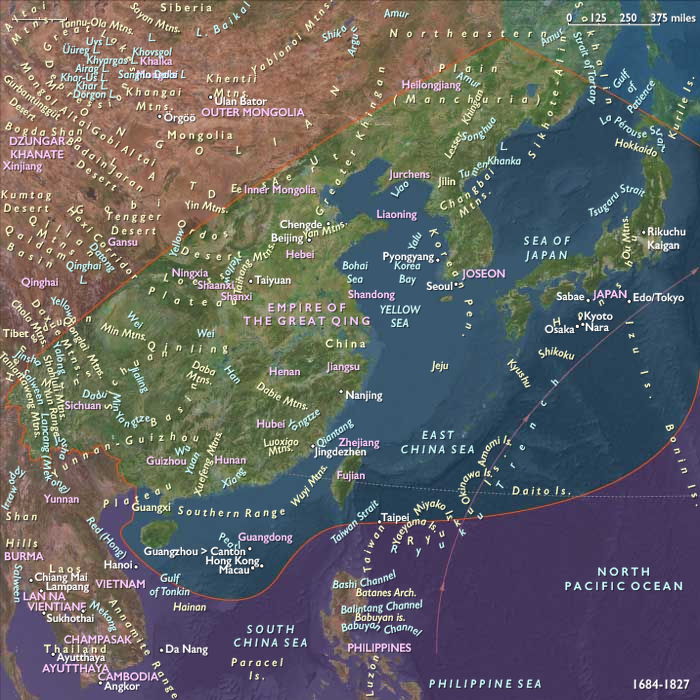
China is experiencing growing internal pressures of economic origin by the nineteenth century.
By the start of the century, there are over three hundred million Chinese, but there is no industry or trade of sufficient scope to absorb the surplus labor.
Moreover, the scarcity of land leads to widespread rural discontent and a breakdown in law and order.
The weakening through corruption of the bureaucratic and military systems and mounting urban pauperism also contribute to these disturbances.
Localized revolts erupt in various parts of the empire in the early nineteenth century.
Secret societies, such as the White Lotus sect in the north and the Triad Society in the south, gain ground, combining anti-Manchu subversion with banditry.
Locations
Groups
Topics
Subjects
Regions
Subregions
Related Events
Filter results
Showing 10 events out of 23942 total
The Treaty of Iasi in 1792 forces the Ottoman Empire to cede all of its holdings in what is now Transnistria to the Russian Empire.
An expanded Bessarabia is annexed by, and incorporated into, the Russian Empire following the Russo- Turkish War of 1806-12 according to the terms of the Treaty of Bucharest of 1812.
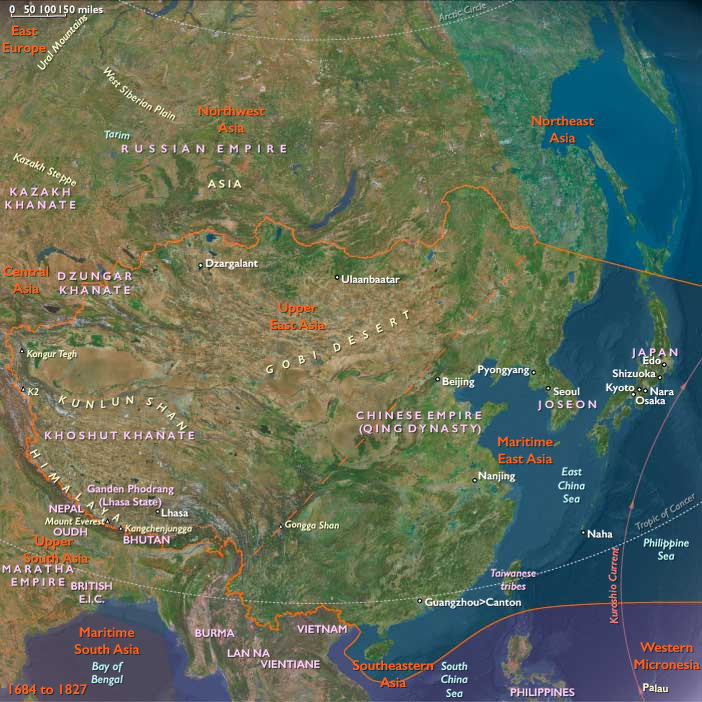
Northeast Asia (1792–1803 CE)
Consolidation of Russian Control and Intercultural Encounters
From 1792 to 1803, Russian control over Northeast Asia continued to strengthen, bolstered by strategic settlement expansion and vigorous maritime fur-trading activities. Russian traders and settlers extended their influence deeper into Kamchatka, the Aleutian Islands, and other northern territories, increasingly integrating these remote areas into a broader imperial economic network.
Kamchatka remained vital as a regional base, with the settlement at Petropavlovsk gaining prominence due to its superior harbor compared to the older and logistically challenging port of Okhotsk. Nevertheless, Okhotsk continued to function as an essential hub for maritime logistics despite the harsh climate and persistent shortages in local agricultural productivity. In 1799, the establishment of the Russian-American Company based in Okhotsk brought increased economic activity and investment to the region.
Over one hundred private fur trading and hunting voyages had already sailed from Kamchatka to North America from 1743 up to the founding of the Russian-American Company. In total, these voyages generated revenues exceeding eight million silver rubles, highlighting the economic significance of the region's fur trade.
During this period, notable intercultural exchanges further highlighted the complex dynamics of Russian and indigenous relationships. In 1792, the Japanese castaway Daikokuya Kōdayū and his surviving companions, who had previously reached Kamchatka from the Aleutian Islands, traveled to Okhotsk, where they remained for several years. Their remarkable journey attracted attention from both Russian and international observers, further opening Russian eyes to potential interactions and diplomatic relations with Japan.
Expeditions and trading activities in the region intensified ecological pressures on marine wildlife populations, notably sea otters, fur seals, and foxes, whose pelts continued to fuel the lucrative fur trade with China via the trading town of Kyakhta. Russian authorities began implementing more systematic administrative and economic controls, including the establishment of fortified outposts along key trade routes, aimed at managing the region's vast natural resources more effectively and consolidating imperial control.
Simultaneously, diplomatic and exploratory interactions continued. French explorer and diplomat Barthélemy de Lesseps, who had previously carried records of the Lapérouse expedition to France, published extensive accounts of his Siberian journey, further illuminating European understanding of the region and contributing to international interest in Northeast Asia. Russian exploration and settlement during this period set crucial groundwork for future diplomatic initiatives and territorial consolidations.
British maritime fur traders are hindered by the East India Company (EIC) and South Sea Company (SSC).
Although the SSC is moribund by the late eighteenth century, it has been granted the exclusive right to British trade on the entire western coast of the Americas from Cape Horn to Bering Strait and for three hundred leagues (approximately nine hundred miles [fourteen hundred kilometers]) out into the Pacific Ocean.
This, coupled with the EIC monopoly on British trade in China, means that sea otter skins are procurable only in the preserve of one monopoly and disposable only in that of the other.
In order to operate legally, British maritime fur traders have to obtain licenses from both companies, which is difficult and expensive.
Some traders obtain a license from the EIC only, figuring that the SSC is unable to enforce its monopoly.
Others obtain only the SSC license and take their furs to England, where they are trans-shipped to China.
Some traders try to evade the licenses by sailing their ships under foreign flags.
The EIC's primary focus in China is the tea trade; there has never been much interest within the company for the maritime fur trade.
The EIC usually allows British vessels to import furs into Canton, but requires the furs to be sold via EIC agents, and the company takes a percentage of the returns.
Worse, the EIC does not allow the British fur traders to export Chinese goods to Great Britain.
Thus the last and most profitable leg of the maritime fur trade system—carrying Chinese goods to Europe and America—is denied to British traders.
Joseph Ingraham and Simon Metcalfe are other notable American maritime fur traders.
The first British convicts to escape from assigned service in the penal colony become known as bushrangers, a term for the robbers who use the sparsely settled bush, or forest, as a refuge to hide from the authorities.
In 1801–02 Matthew Flinders in HMS Investigator leads the first circumnavigation of Australia.
Aboard ship is the Aboriginal explorer Bungaree, of the Sydney district, who becomes the first person born on the Australian continent to circumnavigate the Australian continent.
Previously, the famous Bennelong and a companion had become the first people born in the area of New South Wales to sail for Europe, when, in 1792 they accompanied Governor Phillip to England and were presented to King George III.
Dutch opium commerce on Java has fostered both a vast state enterprise and a large illicit traffic.
The Dutch East India Company, or VOC, having developed a large clientele of native Javanese opium smokers, has imported an average of fifty-six tons of opium annually from 1640 to 1799.
Nguyễn Huệ is now in control of a united Vietnam, more than twice as large than before.
He takes the title of Emperor under the reign name Quang Trung.
He distributes land to poor peasants, encourages hitherto suppressed artisans, allows religious freedom, reopens Vietnam to international trade, and replaces Classical Chinese with a Vietnamese vernacular, written with Chinese characters, as the official language.
The ambitious character of Quang Trung is legendary in Vietnamese history.
He orders the melting of Vietnamese coins to make cannons, and hopes to seize the Chinese provinces of Guangxi and Guangdong.Several stories tell of his ambitious plans and indirect challenge to the Qianlong Emperor.
In an indication of his intention to claim Chinese territory, Quang Trung even proposes to marry one of Qianlong's daughters.
Quang Trung plans the final assault on the remaining base of Nguyễn Ánh around Saigon, both by sea and land, in early 1792.
While waiting for the seasonal winds to change direction into a tailwind to propel his navy, he suddenly collapses and dies of unknown causes at the age of forty.
Many Vietnamese believe that if he had ruled for another ten years, the fate of the country would have been significantly different.
After Emperor Quang Trung's death, his son Quang Toan is enthroned as Emperor Cảnh Thịnh at the age of ten.
The real power, however, is in the hands of his uncle, Bui Dac Tuyen, who enacts a massive political purge.
Many who had served under Quang Trung are executed, while others become discouraged and leave the regime, considerably weakening the Tây Sơn.
This paves the way for Nguyen Ánh to capture the entire country within ten years, with the help of French military adventurers enlisted by French bishop Pigneau de Behaine.
Nguyen Ánh occupies Quy Nhon citadel in 1800, and in 1801 occupies Phú Xuân, forcing Quang Toan to flee to Thăng Long, which Anh besieges in 1802.
Quang Toan escapes, but then is captured and executed, ending the dynasty after twenty-four years, and the Nguyen, the last imperial dynasty of Vietnam, take over the country in 1802.
China rules more than one-third of the world's population, and had the largest economy in the world.
By area it is one of the largest empires ever.
British sea captains, to circumvent the official Chinese ban on opium, bribe Canton's mandarins and smuggle the chests into southern China where the Bengal brands command twice the price of the inferior local products.
British India is thus assured of prosperity and China of a stable opium supply.
