Some Tonkawa are involved with the Yojuanes …
Years: 1744 - 1755
Locations
Groups
Topics
Commodoties
Subjects
Regions
Subregions
Related Events
Filter results
Showing 10 events out of 27239 total
Anna dies in 1740, and her infant grandnephew is proclaimed tsar as Ivan VI.
After a series of coups, however, he is replaced by Peter the Great's daughter Elizabeth (r. 1741-62).
During Elizabeth's reign, which is much more effective than those of her immediate predecessors, a Westernized Russian culture begins to emerge.
Among notable cultural events are the founding of Moscow University (1755) and the Academy of Fine Arts (1757) and the emergence of Russia's first eminent scientist and scholar, Mikhail Lomonosov.
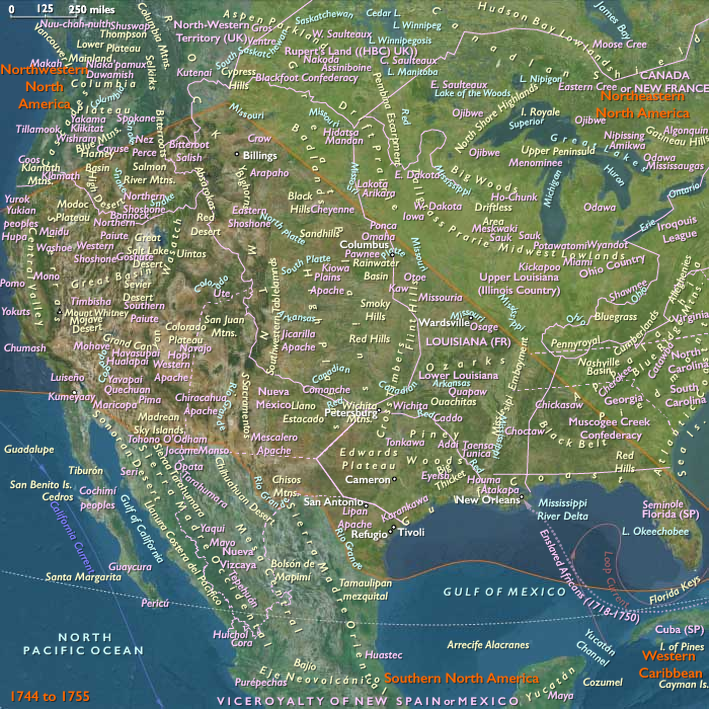
The indigenous population of the eastern seaboard, numbering around one hundred and twenty thousand in the sixteenth century, has dwindled, either through war or disease, to less than twenty thousand by 1750 .
Surviving tribes often consolidate, as had the Mohegans with their few Pequot relatives, or change identities, as for example, the Mahicans becoming known as the Stockbridge Indians after many of the tribe settled in the town of Stockbridge, Massachusetts.
Other nations simply cease to function as social units.
The Tuscaroras, having lost a war with the Carolina settlers fought from 1711 to 1713, now move north to live among the Five Nations of the Iroquois Confederacy, becoming the Sixth.
The Appalachian Mountains divide the fourteen mainland British colonies (Nova Scotia being the non-contiguous fourteenth) from New France until the early 1750s.
The expanding colony of Virginia clashes with the French over title to the Ohio Valley, which Virginia claims by treaty with the Iroquois Confederacy and by Royal Charter; France claims it as part of Louisiana.
The indigenous population of the eastern seaboard, numbering around one hundred and twenty thousand in the sixteenth century, has dwindled, either through war or disease, to less than twenty thousand by 1750 .
Surviving tribes often consolidate, as had the Mohegans with their few Pequot relatives, or change identities, as for example, the Mahicans becoming known as the Stockbridge Indians after many of the tribe settled in the town of Stockbridge, Massachusetts.
Other nations simply cease to function as social units.
The Tuscaroras, having lost a war with the Carolina settlers fought from 1711 to 1713, now move north to live among the Five Nations of the Iroquois Confederacy, becoming the Sixth.
The Appalachian Mountains divide the fourteen mainland British colonies (Nova Scotia being the non-contiguous fourteenth) from New France until the early 1750s.
The expanding colony of Virginia clashes with the French over title to the Ohio Valley, which Virginia claims by treaty with the Iroquois Confederacy and by Royal Charter; France claims it as part of Louisiana.
As Charleston has grown, so has the community's cultural and social opportunities, especially for the elite merchants and planters.
The first theater building in America had been built in 1736 in Charleston.
Several different ethnic groups have been formed benevolent societies.
The Charleston Library Society is established in 1748 by some wealthy Charlestonians who wish to keep up with the scientific and philosophical issues of the day.
Northeast Asia (1744–1755 CE)
Russian Fur Trade Expansion and Maritime Challenges
Between 1744 and 1755, Russian maritime and fur-trading activities in Northeast Asia—a region encompassing the easternmost areas of Siberia (east of 130°E), the extreme northeastern portion of China's Heilongjiang province, the northern half of Russia's Primorsky Krai, and most of the island of Hokkaido (excluding its southwestern portion)—intensified, marking a critical era of economic expansion and territorial consolidation.
Russian fur hunters, inspired by the expeditions of Vitus Bering, significantly increased their activities in the North Pacific, particularly among the Aleutian Islands, exploiting the valuable sea otter populations first identified east of Kamchatka. The harvested furs, including sea otter, fur seal, and arctic fox pelts, were transported back to Okhotsk, despite the port's inherent limitations. From Okhotsk, these pelts were carried inland, eventually reaching the Chinese market through the Mongolian trading town of Kyakhta, established for Russian trade by the 1727 Treaty of Kyakhta.
By mid-century, Okhotsk continued to grapple with considerable logistical challenges, exacerbated by its remote location and harsh climate. The town had grown minimally, housing only thirty-seven peasant families alongside a small number of Yakut cattlemen. The limited local pasture meant pack horses often had to return to Yakutsk unloaded, underscoring the logistical difficulties facing this frontier settlement.
Despite these hardships, Russian maritime expansion persisted, driven by the lucrative fur trade, which continued to reshape indigenous economies and ecological balances in Northeast Asia. This period solidified Russian presence in the region, laying a foundation for further colonial developments in subsequent decades.

Fur hunters in the mid-seventeen begin island-hopping along the Aleutian Islands, the crew of Vitus Bering having found valuable sea otters east of Kamchatka.
Furs are brought back to Okhotsk and carried inland, mostly to be sold to the Chinese at the Mongolian trading town of Kyakhta, which had been opened to Russian trade by the 1727 Treaty of Kyakhta.
By mid-century there are only thirty-seven peasant families and a number of Yakut cattlemen in Okhotsk.
There is so little pasture in the area that pack horses sometimes have to be returned to Yakutsk unloaded.
The Dutch East Indies Company or VOC is still doing business in Ayutthaya, however, despite political difficulties.