
The striking Temple of Apollo at Didyma, …
Years: 300BCE - 300BCE
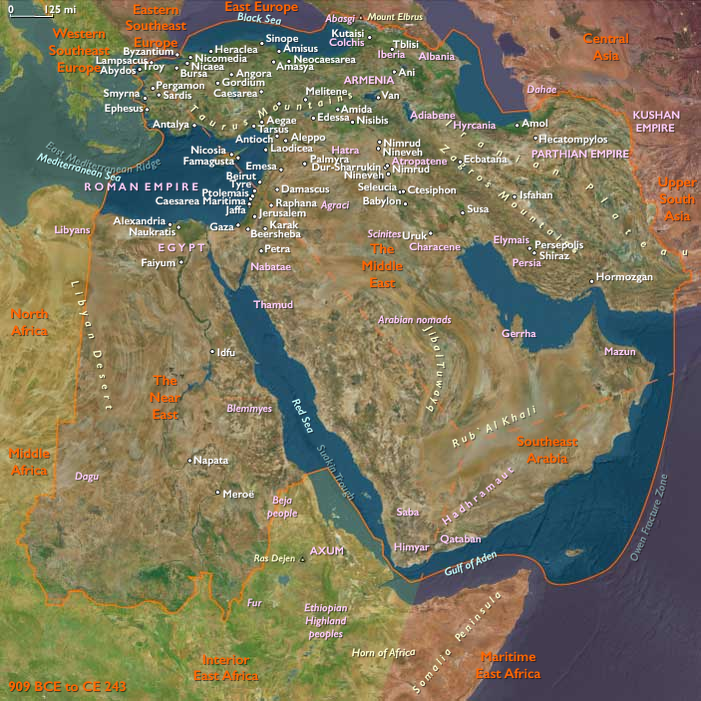
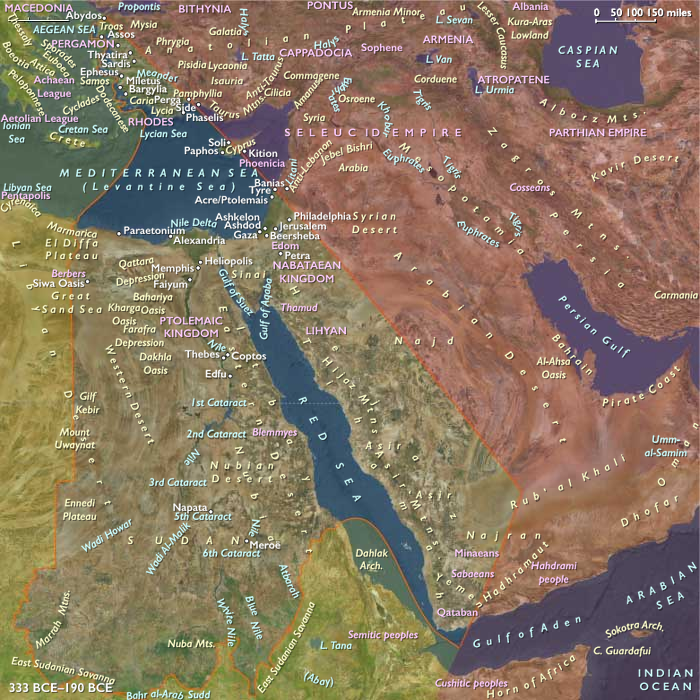
The striking Temple of Apollo at Didyma, a temple within a temple that highlights the popular Ionic order, is completed around 300 BCE.
Seleucus I Nicator had brought the bronze cult image back to Didyma, the largest and most significant sanctuary on the territory of the great classical city Miletus, and the Milesians have begun to build a new temple, which, if it had ever been completed, would have been the largest in the Hellenic world.
Vitruvius records a tradition that the architects were Paeonius of Ephesus, whom Vitruvius credits with the rebuilding of the Temple of Artemis there, and Daphnis of Miletus.
The peripteral temple is surrounded by a double file of Ionic columns.
With a pronaos of three rows of four columns, the approaching visitor passes through a regularized grove formed of columns.
The usual door leading to a cella is replaced by a blank wall with a large upper opening through which one can glimpse the upper part of the naiskos in the inner court (adyton).
The entry route lies down either of two long constricted sloping passageways built within the thickness of the walls that give access to the inner court, still open to the sky but isolated from the world by the high walls of the cella: there is the ancient spring, the naiskos—which is a small temple itself, containing in its own small cella the bronze cult image of the god—and a grove of laurels, sacred to Apollo.
The cella's inner walls are articulated by pilasters standing on a base the height of a man (one point ninety-four meters).
The visitor, turning back again, sees a monumental staircase that leads up to three openings to a room whose roof is supported by two columns on the central cross-axis.
The oracular procedure, so well documented at Delphi, is unknown at Didyma and must be reconstructed on the basis of the temple's construction, but it appears that several features of Delphi were now adopted: a priestess and answers delivered in classical hexameters.
At Delphi, nothing is written; at Didyma, inquiries and answers are written; a small structure, the Chresmographion, features in this process: it will be meticulously disassembled in the Christian period.
Locations
People
Groups
Topics
Subjects
Regions
Subregions
Related Events
Showing 10 events out of 64128 total
Years: 300BCE - 300BCE
Locations
People
Groups
Topics
Subjects
Regions
Subregions