
The spread of heretical Christian movements from …
Years: 1302 - 1302
The spread of heretical Christian movements from the twelfth century can be seen at least in part as a reaction to the increasing moral corruption of to the clergy, which included illegal marriages and the possession of wealth.
The Inquisition's main focus in the Middle Ages has been to eradicate these new sects.
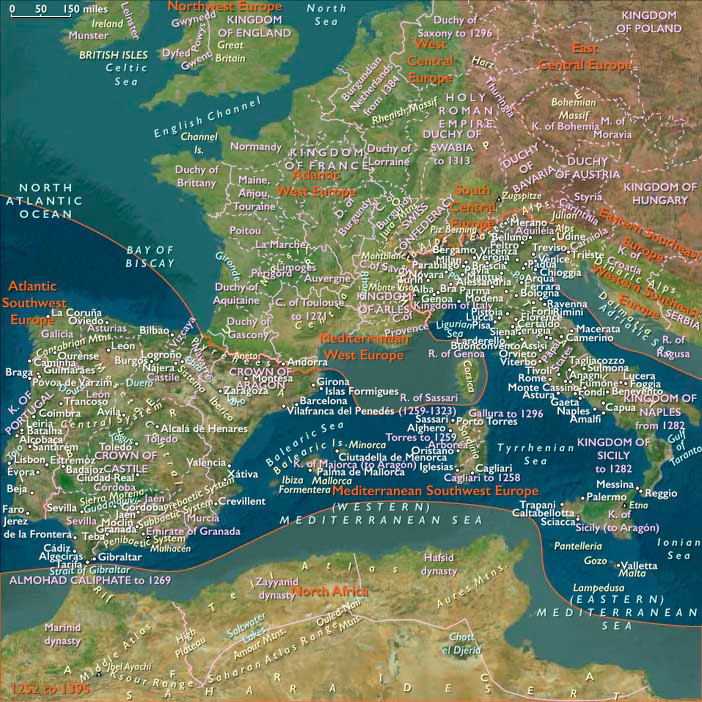
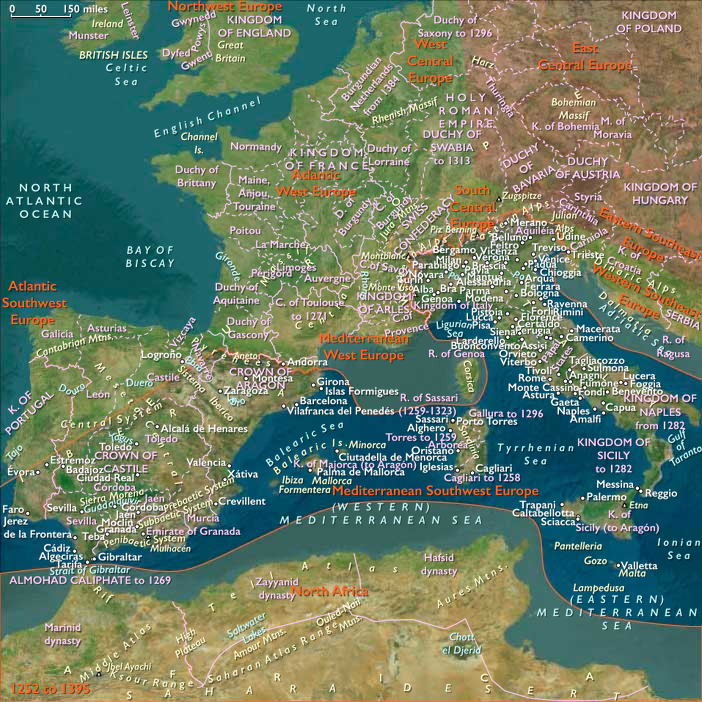
Thus its range of action is predominantly set in Italy and France, where such sects had settled.
The two main heretic movements of the period are the Cathars and the Waldensians.
The former are mostly in south of France, in cities like Toulouse.
They appear to have been originally founded by some soldiers from Second Crusade, who, on their way back, had been converted by a Bulgarian sect, the Bogomils.
The Cathars' main heresy is their belief in dualism: the evil God has created the materialistic world and the good God has created the spiritual world.
Therefore, Cathars preach poverty, chastity, modesty and all those values which in their view help people to detach themselves from materialism.
The Waldensians are mostly in Germany and North Italy.
In contrast with the Cathars and in line with the Church, they believe in only one God, but they do not recognize priesthood nor the veneration (not synonymous with worship) of saints and martyrs, which are part of the Church's orthodoxy.
The other two main sects of the period, which preach against the moral corruption of the Church, are the Dominicans and the Franciscans.
However, instead of persecuting them, Pope Innocent III had decided early in the thirteenth century to employ them in the fight against heresy.
As a result, many Franciscans and Dominicans had become inquisitors.
For example, Robert le Bougre, the "Hammer of Heretics" (Malleus Haereticorum), was a Dominican friar who became an inquisitor known for his cruelty and violence.
Another example is the case of the province of Venice, which had been handed to the Franciscan inquisitors, who quickly became notorious for their frauds against the Church, by enriching with confiscated property from the heretics and the selling of absolutions.
Because of their corruption, they are eventually forced by the Pope to suspend their activities in 1302.
Locations
People
Groups
- Papal States (Republic of St. Peter)
- Catharism (Albigenses)
- Venice, (Most Serene) Republic of
- Waldenses
- Franciscans, or Order of St. Francis
- Dominicans, or Order of St. Dominic
Subjects
Regions
Subregions
Related Events
Showing 10 events out of 45053 total
Years: 1302 - 1302
Locations
People
Groups
- Papal States (Republic of St. Peter)
- Catharism (Albigenses)
- Venice, (Most Serene) Republic of
- Waldenses
- Franciscans, or Order of St. Francis
- Dominicans, or Order of St. Dominic
Subjects
Regions
Subregions