
The spice trade linking India to Egypt, …
Years: 1504 - 1504
The spice trade linking India to Egypt, and thence Venice, had been seriously diminished and prices had shot up following the bombardment of Calicut in 1500–01 by the second Portuguese India Armada under Pedro Cabral.
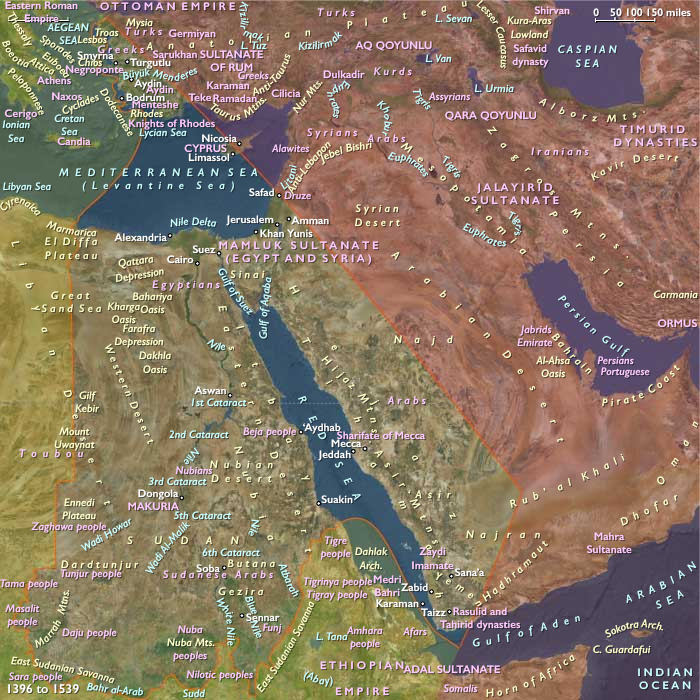
Arab shipping is also being attacked directly: an Egyptian ship had been robbed and sunk by the Portuguese in 1503 as it was returning from India.
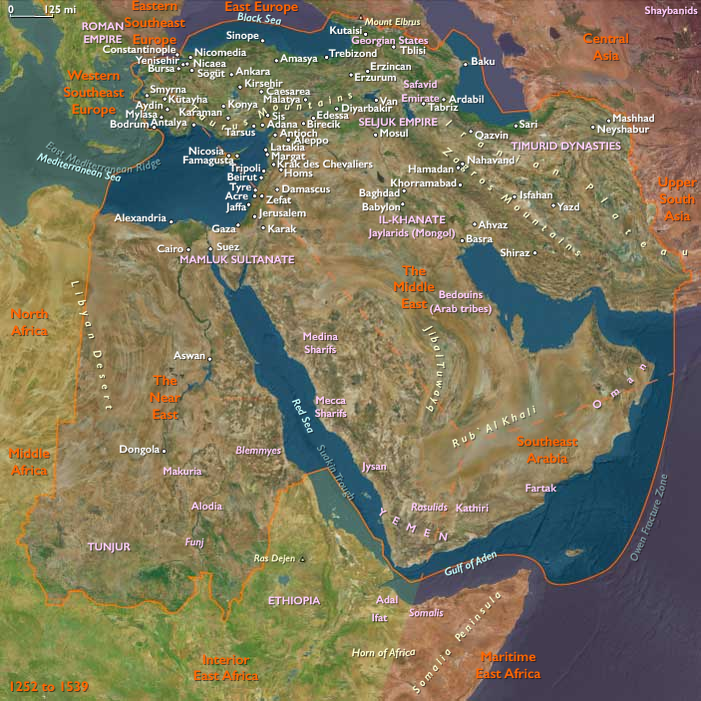
The Mamluk Sultan Qansuh al-Ghurii in 1504 first sends an envoy to the Pope, in the person of the Grand Prior of the Saint Catherine's Monastery, warning that if the Pope does not stop the exactions of the Portuguese against Muslims, he will bring ruin to the Christian Holy Place in the Levant and to the Christians living in his realm.
The Venetians, who share common interests with the Mamluks in the spice trade and desire to eliminate the Portuguese challenge if possible, send envoy Francesco Teldi, posing as a jewel buyer, as envoy to Cairo.
Teldi tries to find a level of cooperation between the two realms, encouraging the Mamluks to block Portuguese maritime movements.
The Venetians claim they cannot intervene directly, and encourage the Mamluk Sultan to take action by getting into contact with Indian princes at Cochin and Cananor to entice them not to trade with the Portuguese, and the Sultans of Calicut and Cambay to fight against them.
Some sort of alliance is thus concluded between the Venetians and the Mamluks against the Portuguese.
There will be claims, voiced during the War of the League of Cambrai, that the Venetians had supplied the Mamluks with weapons and skilled shipwrights.
The cavalry-oriented Mamluks have little inclination for naval operations, but the Portuguese keep blockading the Red Sea, and arresting Muslim merchant ships.
Locations
People
- Afonso de Albuquerque
- Al-Ashraf Qansuh al-Ghawri
- António de Saldanha
- Diogo Fernandes Pereira
- Duarte Pacheco Pereira
- Francesco Teldi
- Francisco de Almeida
- João da Nova
- Lopo Soares de Albergaria
- Lourenço de Almeida
- Manuel I of Portugal
- Pedro Álvares Cabral
- Pope Julius II
- Pêro de Ataíde
- Tristão da Cunha
Groups
- Hinduism
- Arab people
- Jews
- Christians, Eastern (Diophysite, or “Nestorian”) (Church of the East)
- Nair
- Islam
- Papal States (Republic of St. Peter)
- Kolattunādu (Kingdom of Cannanore)
- Kilwa Sultanate
- Christians, Roman Catholic
- Cochin, Kingdom of
- Venice, (Most Serene) Republic of
- Palestine, Mamluk
- Ormus, Kingdom of
- Ethiopia, Solomonid Dynasty of
- Kozhikode, or Calicut, Kingdom of
- Egypt and Syria, Mamluk Burji Sultanate of
- Portugal, Avizan (Joannine) Kingdom of
- Gujarat Sultanate
- Portuguese Empire
- Portuguese Mozambique
Topics
- India, Medieval
- Yemen, Medieval
- Age of Discovery
- Renaissance Papacy
- Portuguese Conquests in India and the East Indies
- Colonization of Asia, Portuguese
- Cochin, Battle of
- Portuguese–Mamluk naval war
- Portuguese Ceylon
Commodoties
Subjects
- Commerce
- Watercraft
- Engineering
- Labor and Service
- Conflict
- Exploration
- Faith
- Government
- Custom and Law
- Technology
- Finance
Regions
Subregions
Years: 1504 - 1504
Locations
People
- Afonso de Albuquerque
- Al-Ashraf Qansuh al-Ghawri
- António de Saldanha
- Diogo Fernandes Pereira
- Duarte Pacheco Pereira
- Francesco Teldi
- Francisco de Almeida
- João da Nova
- Lopo Soares de Albergaria
- Lourenço de Almeida
- Manuel I of Portugal
- Pedro Álvares Cabral
- Pope Julius II
- Pêro de Ataíde
- Tristão da Cunha
Groups
- Hinduism
- Arab people
- Jews
- Christians, Eastern (Diophysite, or “Nestorian”) (Church of the East)
- Nair
- Islam
- Papal States (Republic of St. Peter)
- Kolattunādu (Kingdom of Cannanore)
- Kilwa Sultanate
- Christians, Roman Catholic
- Cochin, Kingdom of
- Venice, (Most Serene) Republic of
- Palestine, Mamluk
- Ormus, Kingdom of
- Ethiopia, Solomonid Dynasty of
- Kozhikode, or Calicut, Kingdom of
- Egypt and Syria, Mamluk Burji Sultanate of
- Portugal, Avizan (Joannine) Kingdom of
- Gujarat Sultanate
- Portuguese Empire
- Portuguese Mozambique
Topics
- India, Medieval
- Yemen, Medieval
- Age of Discovery
- Renaissance Papacy
- Portuguese Conquests in India and the East Indies
- Colonization of Asia, Portuguese
- Cochin, Battle of
- Portuguese–Mamluk naval war
- Portuguese Ceylon
Commodoties
Subjects
- Commerce
- Watercraft
- Engineering
- Labor and Service
- Conflict
- Exploration
- Faith
- Government
- Custom and Law
- Technology
- Finance
Regions
Subregions