A sequence of five earthquakes strikes Calabria, …
Years: 1783 - 1783
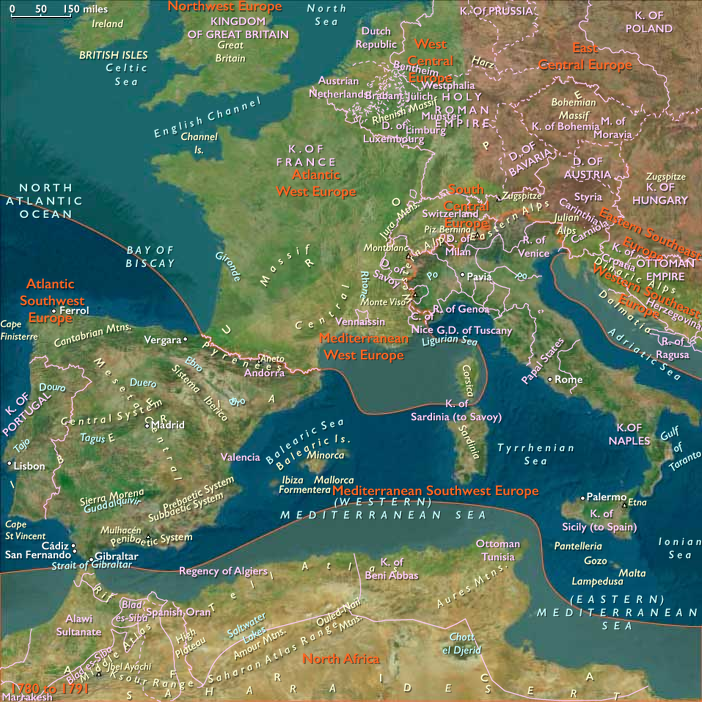
A sequence of five earthquakes strikes Calabria, Italy (February 5–7, March 1 and 28), leaving fifty thousand dead.
Groups
Topics
Subjects
Regions
Subregions
Related Events
Filter results
Showing 10 events out of 47 total
Because it is first performed in Prague, it is popularly known as the Prague Symphony.
An opera in two acts, based on the legends of Don Juan, a fictional libertine and seducer (K. 527; complete title: Il dissoluto punito, ossia il Don Giovanni, literally The Rake Punished, namely Don Giovanni or The Libertine Punished), Da Ponte's libretto is billed as a dramma giocoso, a common designation of the time that denotes a mixing of serious and comic action.
Mozart enters the work into his catalogue as an opera buffa.
Although sometimes classified as comic, it blends comedy, melodrama and supernatural elements.
The opera had been commissioned as a result of the overwhelming success of Mozart's trip to Prague in January and February 1787.
The subject matter may have been chosen in consideration of the long history of Don Juan operas in Prague; the genre of eighteenth-century Don Juan opera originated in Prague.
A staple of the standard operatic repertoire, Don Giovanni for the five seasons 2011/12 through 2015/16 will be ninth on the Operabase list of the most-performed operas worldwide.
It will also prove a fruitful subject for writers and philosophers.
The war against revolutionary France and the subsequent Napoleonic wars causes a temporary interruption of the reactionary movement.
In 1804 Francis II transfers his imperial title to the Austrian domains (Austria, Bohemian Kingdom, Hungary, Galicia, and parts of Italy), and two years later the Holy Roman Empire is formally dissolved.
The Austrian Empire comes into existence and is to play a leading role in the newly established German Confederation.
From 1815, after the conclusive defeat of Napoleon, the policy of reaction devised by Austria's foreign minister, Prince Metternich, will dominate European affairs.
...Prague, and ...
The Paris revolution of February 1848 precipitates a succession of liberal and national revolts against autocratic governments.
Revolutionary disturbances pervade the territories of the Austrian Empire, and Emperor Ferdinand I (1835-48) promises to reorganize the empire on a constitutional, parliamentary basis.
In the Bohemian Kingdom, a national committee is formed that includes Germans and Czechs, but Bohemian Germans favor creating a Greater Germany out of various German-speaking territories.
The Bohemian Germans soon withdraw from the committee, signaling the Czech-German conflict that will characterize subsequent history.
František Palacký proposes Austro-Slavism as the creed of the Czech national movement.
He advocates the preservation of the Austrian Empire as a buffer against both German and Russian expansionism.
He also proposes the federalization of the empire on an ethnographic basis to unite the Bohemian
Germans with Austria in one province and Czechs and Slovaks in another.
Palacký further suggests that the various Slavic peoples of the empire, together constituting a majority, should form a political unit to defend their common interests.
In June 1848 the Czechs convene the first Slavic Congress to discuss the possibility of political consolidation of Austrian Slavs, including Czechs, Slovaks, Poles, Ruthenians (Ukrainians), Slovenes, Croats, and Serbs.
At first, the national movements were confined to discussion of language, literature, and culture, but during the revolutions of 1848, the Czechs and Slovaks make bold political demands.
The revolutions of 1848 also reveal that the German and Hungarian liberals, who are opposed to Habsburg absolutism, are equally hostile to Czech and Slovak aspirations.
It has become clear that the Czech and Slovak national movements have to contend not only with Habsburg absolutism but also with increasingly virulent German and Hungarian nationalism.
Czech leader Frantisek Palacky organizes a Pan-Slavic Congress in Prague in June to demand equality with the Empire’s Germans.
The Austrian Empire uses its troops to crush the pan-Slavic rebellion on June 17.
The Habsburg armies crush the uprising in Bohemia and check the insurrection in Italy in the course of the summer of 1848.
Alfred, Fürst du Windischgrätz, who was military governor of Bohemia when the revolutions of 1848 broke out in the Hapsburg empire, had quelled the insurrection in Vienna, but because of the pressure of public opinion he is sent back to Bohemia.
Meanwhile Prague had fallen to the revolutionists, and Windischgrätz's wife and eldest son had been killed in the insurrection.
Windischgrätz recaptures Prague in June after bombarding it and establishes a military dictatorship over Bohemia.
The Prague Slavic Congress brings together members of the Pan-Slavism movement from June 2 to June 12, 1848.
The initiative comes from Pavel Jozef Šafárik and Josip Jelačić, but is organized by Czech activists František Palacký, Karl Zapp, Karel Havlíček Borovský, and František Ladislav Rieger.
In addition to lacking a goal, the conference planners also quarrel over the format and the agenda of the gathering.
Once underway, the conference meets in three sections: Poles and Ukrainians (at this time Ruthenians); South Slavs; and Czecho-Slovaks.
The Pole-Ukrainian section contains a combination of Ruthenes, Mazurians, Greater Poles, and Lithuanians.
Of the total 3three hundred and forty delegates at the Congress, the greatest number comes from the Czecho-Slovak section.
Two hundred and thirty-seven Czecho-Slovaks participate along with forty-two South Slavs and sixty-one Poles-Ukrainians.
German is the primary language used during discussions.
During the Congress, there is debate about the role of Austria in the lives of the Slavs.
The Congress is cut short on June 12 because of the Prague Uprising of 1848 that erupts due to the Austrian garrison in Prague opening fire on a peaceful demonstration.

Only a few days after the Emperor had reconquered northern Italy, Alfred I, Prince of Windisch-Grätz, takes provocative measures in Prague to prompt street fighting.
Once the barricades go up, he leads Habsburg troops to crush the insurgents.
After having taken back the city, he imposes martial law, orders the Prague National Committee dissolved, and sends delegates to the "Pan-Slavic" Congress home.
These events are applauded by German nationalists, who fail to understand that the Habsburg military will crush their own national movement as well.
Prague is the first victory of counter-revolution in the Austrian Empire.