
Filters:
It is no easy task to find …
Years: 1396 - 1539
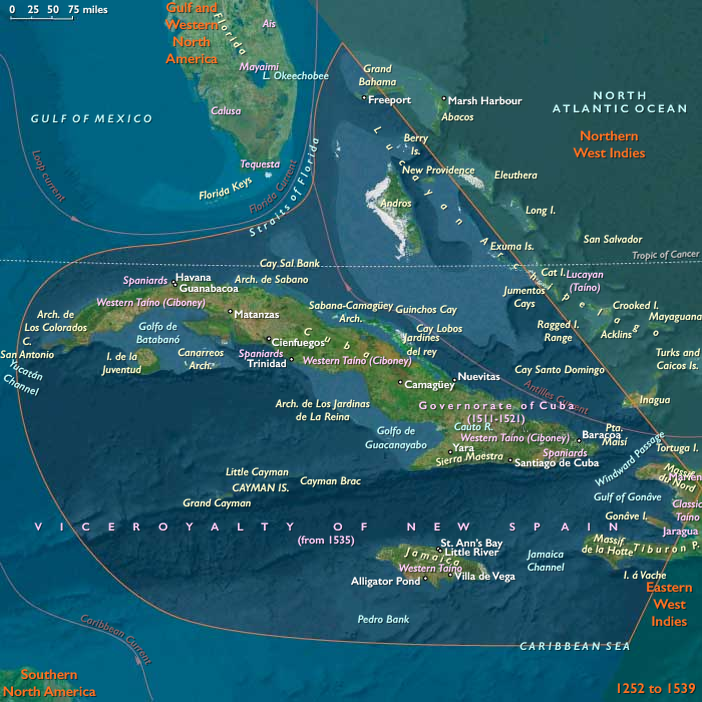
It is no easy task to find a conquistador who combines military skill, administrative talent, and loyalty to the crown as well as to Diego Columbus himself.
The choice finally falls on Diego Velazquez de Cuellar (governor of Hispaniola, 1511—21), Ovando's lieutenant and one of the wealthiest Spaniards in Hispaniola.
Although not as heroic or daring as later conquistadors such as Francisco Pizarro, conqueror of Peru, or as cunning as Hernán Cortés, conqueror of Mexico, Velazquez has achieved a reputation for courage and sagacity because of his role in subduing native caciques in Hispaniola.
From the start, Velazquez faces an outraged and hostile native population.
Led by Hatuey, a fugitive chieftain from Hispaniola, the natives of eastern Cuba resolve to resist the Spanish onslaught.
It is a futile gesture, for the peaceful Tainos lack the military skills and weapons to face the better armed and trained Spaniards.
Spanish horses and hounds, both unknown in Cuba, play a decisive role in terrorizing the indigenous peoples, who soon surrender or flee into the mountains to escape the wrath of the conquistadors.
Hatuey himself is captured, tried as a heretic and a rebel, and burned at the stake.
The choice finally falls on Diego Velazquez de Cuellar (governor of Hispaniola, 1511—21), Ovando's lieutenant and one of the wealthiest Spaniards in Hispaniola.
Although not as heroic or daring as later conquistadors such as Francisco Pizarro, conqueror of Peru, or as cunning as Hernán Cortés, conqueror of Mexico, Velazquez has achieved a reputation for courage and sagacity because of his role in subduing native caciques in Hispaniola.
From the start, Velazquez faces an outraged and hostile native population.
Led by Hatuey, a fugitive chieftain from Hispaniola, the natives of eastern Cuba resolve to resist the Spanish onslaught.
It is a futile gesture, for the peaceful Tainos lack the military skills and weapons to face the better armed and trained Spaniards.
Spanish horses and hounds, both unknown in Cuba, play a decisive role in terrorizing the indigenous peoples, who soon surrender or flee into the mountains to escape the wrath of the conquistadors.
Hatuey himself is captured, tried as a heretic and a rebel, and burned at the stake.
People
- Bartolomé de las Casas
- Diego Columbus
- Diego Velázquez de Cuéllar
- Francisco Pizarro
- Hatuey
- Hernán Cortés
- Nicolás de Ovando
Groups
- Guanahatabey
- Arawak peoples (Amerind tribe)
- Cuba, Governorate of
- Spain, Habsburg Kingdom of
- Spaniards (Latins)
Commodoties
Subjects
Regions
Subregions
Years: 1396 - 1539
People
- Bartolomé de las Casas
- Diego Columbus
- Diego Velázquez de Cuéllar
- Francisco Pizarro
- Hatuey
- Hernán Cortés
- Nicolás de Ovando
Groups
- Guanahatabey
- Arawak peoples (Amerind tribe)
- Cuba, Governorate of
- Spain, Habsburg Kingdom of
- Spaniards (Latins)
Commodoties
Subjects
Regions
Subregions