The Spanish Christians continue to invest Granada …
Years: 1483 - 1483
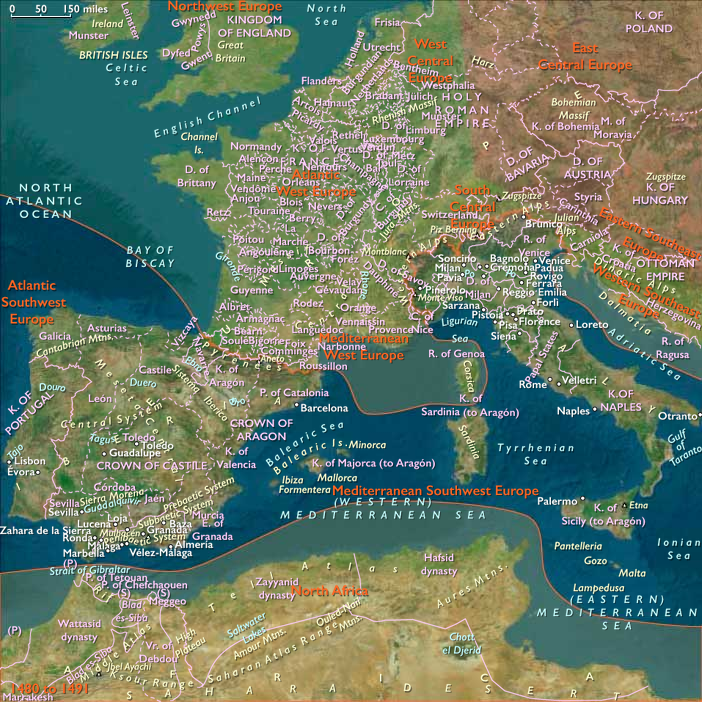
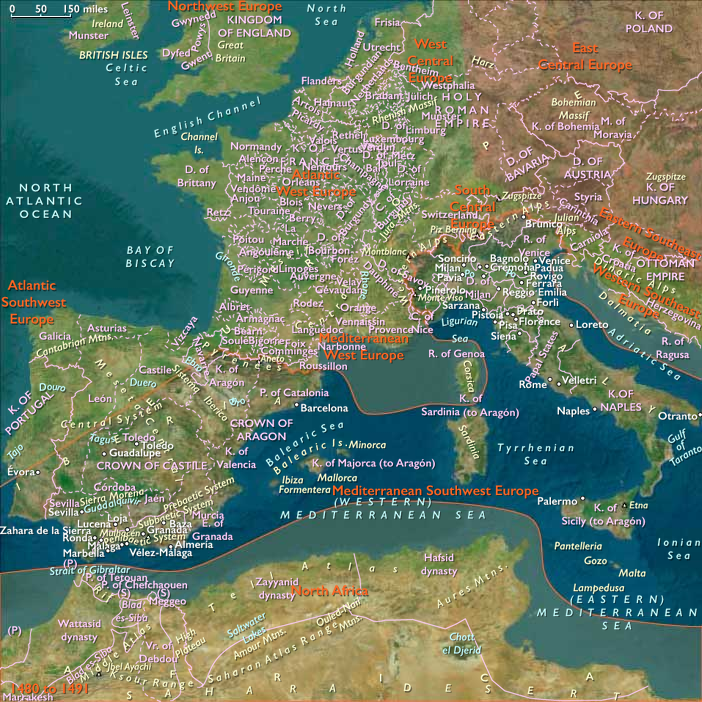
The Spanish Christians continue to invest Granada on land from mid-1483 while a Spanish fleet blockades Granada’s North African supply lines.
Locations
People
Groups
- Islam
- Christians, Roman Catholic
- Aragón, Kingdom of
- Aragon, Crown of
- Castile, Crown of
- Granada, Emirate of, or Nasrid Kingdom of
- Morocco, Wattasid Sultanate of
Topics
Commodoties
Subjects
Regions
Subregions
Related Events
Filter results
Showing 10 events out of 17 total
The pope’s entreaties with Venice to cease hostilities are vigorously rebuffed, with threats of excommunication countered by the withdrawal of the Venetian ambassador, followed by Sixtus' interdict of Venice in May 1483.
Now Sixtus grants free passage to Alfonso and his troops to go to defend Ferrara against the pope's recent allies, aided by papal troops under Virginio Orsini.
A contingent of Florentine troops arrives also, and the fortunes of Este begin to look much better.
Venice, in a diversionary maneuver, sends Roberto Sanseverino to attack the Duchy of Milan under the pretext of supporting the rights of the Visconti heir, but the diversion is further diverted when Robert has to counter Alfonso, who is sacking Milanese territories.
The war begins to lose momentum.
Sixtus had been rendered more eager to sue for peace by the series of victories by Venetian forces, who seized the opportunity to forward their territorial ambitions and had been hasty to declare war on Ferrara on a minor pretext.
Florence, Naples, Mantua, Milan, and Bologna have stood by Ferrara.
While the papal forces were holding in check the Neapolitans who sought to move north to aid Ferrara, and with the Roman Campagna being harassed by the Colonna, and Milan engaged in combat with Genoa, the Venetians had besieged Ferrara into starvation.
With the Venetians ready to take over Ferrara, the Pope, fearing his erstwhile allies, had suddenly changed sides: he made a treaty with Naples, and permitted the Neapolitan army to pass through his territories, giving them the chance to convey supplies to Ferrara and neutralize the siege.
At the same time the Pope had excommunicated the Venetians, and now urges all Italy to make war upon them.
Venice, taking advantage of dissension among the allies arrayed against them, secretly concludes with Milan the Peace of Bagnolo on August 7 1484.
Their battle defeats notwithstanding, the Venetians retain convention rights over Ferrara and Ercole cedes the territory of Rovigo in the Polesine, lost at an early stage of the fighting.
The war comes to a conclusion with the Treaty of Bagnolo and the Venetian forces that are occupying Ferrara-owned territory withdraw.
Ercole has successfully avoided the absorption of Ferrara, seat of the Este, into the Papal States.
The Peace of Bagnolo checks Venetian expansion in the terra firma, ceding to it the town of Rovigo and a broad swath of the fertile delta of the Po.
This acquisition agreed upon at Bagnolo marks the high-point of Venetian territory; never again will Venice control so large a territory nor have so much influence as it does in the last half of the fifteenth century.
Nevertheless, Sixtus is not pleased with the terms reached without consulting him.
When the ambassadors declared to him the terms of the treaty he is thrown into a violent rage, and declares the peace to be at once shameful and humiliating.
Suffering from gout, he dies on the following day, August 12, 1484.
Artois and the Treaty of Senlis: Resolving Franco-Habsburg Rivalries (1477–1493)
The strategic and economically vibrant County of Artois had long been a contested region within Atlantic West Europe, shaping regional rivalries between the French crown and the House of Habsburg. The extinction of the male line of the Valois-Burgundy dukes following Charles the Bold's death at the Battle of Nancy (January 5, 1477) intensified dynastic claims over the Burgundian inheritance, including Artois, precipitating a period of fierce competition and diplomatic tension.
The Contested Burgundian Legacy (1477–1482)
After Charles the Bold’s demise, King Louis XI of France swiftly occupied the Burgundian territories, including Artois, incorporating the county into France’s administrative structure as a seneschalate. This rapid annexation triggered vehement opposition from Archduke Maximilian of Austria, who, as husband of Charles’s heiress, Mary of Burgundy, aggressively asserted Habsburg claims. In 1479, the ensuing conflict culminated at the Battle of Guinegate, where Maximilian’s forces secured a pivotal victory, temporarily safeguarding the Habsburg interests.
Nevertheless, following Mary’s untimely death in 1482, Maximilian was compelled, under the Treaty of Arras (1482), to cede both Artois and Franche-Comté to France as a dowry for the marriage of his daughter, Margaret of Austria, to the French dauphin, Charles VIII.
The Breton Marriage Crisis and Diplomatic Reversal (1491–1493)
The diplomatic landscape dramatically shifted when Charles VIII repudiated his engagement to Margaret in favor of Anne of Brittany, Maximilian’s intended bride. This breach inflamed Maximilian, prompting him to demand the restitution of Artois, Franche-Comté, and other territories ceded in 1482. By 1493, facing the challenge of his ambitious campaigns in Italy, Charles VIII sought reconciliation with Maximilian, recognizing that a secure northern frontier was crucial for his Italian ambitions.
The Treaty of Senlis (May 23, 1493)
The resulting Treaty of Senlis formally ended hostilities between France and the Burgundian Netherlands, decisively redefining their territorial relationship:
- Artois and Franche-Comté were restored to the Habsburgs, becoming officially integrated into the Holy Roman Empire.
- Flanders and the broader region of the Seventeen Provinces were consolidated under Habsburg authority.
- France, while relinquishing control of Artois and Franche-Comté, retained the strategically significant Duchy of Burgundy (with Dijon as its capital), ensuring continued French influence in the region.
Persistent French Claims and Strategic Outposts
Despite Habsburg territorial gains, France retained several crucial legal claims, feudal rights, and military outposts within Artois and Flanders. These strategic footholds preserved France’s influence, perpetuating a delicate balance of power along the contested northern frontier and setting the stage for ongoing Habsburg-Valois conflicts throughout the sixteenth century.
Long-Term Significance and Geopolitical Impact
The Treaty of Senlis had far-reaching implications:
- It secured the Low Countries firmly within the Habsburg patrimony, laying foundations for future Habsburg dominance in European geopolitics.
- The treaty underscored the ongoing rivalry between the French crown and the Habsburgs, intensifying a dynastic competition that would shape European political dynamics for generations.
- Artois became a focal point in later Franco-Habsburg struggles, notably during the protracted wars of the sixteenth and seventeenth centuries, influencing regional identities, alliances, and hostilities into the modern era.
Thus, the resolution achieved by the Treaty of Senlis (1493) significantly reshaped the territorial and diplomatic landscape of late medieval Atlantic West Europe, embedding tensions and rivalries that resonated throughout subsequent European history.
Pope Innocent VIII, in conflict with King Ferdinand I of Naples over Ferdinand's refusal to pay feudal dues to the papacy, had excommunicated and deposed Ferdinand by a bull of September 11, 1489.
Innocent had then offered the Kingdom of Naples to Charles VIII of France, who has a remote claim to its throne because his grandfather, Charles VII, King of France, had married Marie of Anjou of the Angevin dynasty, the ruling family of Naples until 1442.
Innocent had later settled his quarrel with Ferdinand and revoked the bans before dying in 1492, but the offer to Charles remains an apple of discord in Italian politics.
Ferdinand dies on January 25, 1494, and is succeeded by his son Alfonso II.
Charles VIII, in order to have a free hand in Italy, has made ruinous pacts with all his neighbors, so they will not interfere.
Henry VII has been given cash, Ferdinand II of Aragon has been given Roussillon and Maximillian has been given Artois and Franche-Comté.
This handing out of territory is symptomatic of Charles' lack of foresight.
Charles is willing to do this, however, in his attempt to establish his Neapolitan base for his crusade.
The fighting between the many independent towns of Italy has been done by establishing a contract, condotta in Italian, between the town leaders and the leaders of mercenary bands, who had come to be called condottieri.
This had led to the developing of fighting tactics destined to establish field supremacy, gaining wealthy prisoners to be ransomed, and minimizing casualties, as it is basically a business.
These tactics will be put to shame when the motivated armies of France and Spain descend upon the Italian peninsula.
Rapallo is occupied by four thousand Neapolitan troops on September 3, 1494, with Giulio Orsini, Obietto Fieschi and Fregosino Campofregoso in command, their plan being to force a rebellion in Genoa; however, the Neapolitan fleet is soon forced away by bad weather.
Louis d'Orleans lands on September 5 with one thousand Swiss mercenary infantry, later reinforced overland by two thousand more Swiss mercenaries and a contingent of Genoese-Milanese infantry.
A skirmish breaks out between the Swiss mercenaries and Neapolitan forces, though the terrain does not allow for the Swiss to form up their pike squares.
The battle is mainly fought, however, between the Genoese-Milanese and Neapolitan infantry.
Following concentrated artillery fire from the French fleet, the Neapolitans are routed.
The Swiss massacre Neapolitans trying to surrender, although Orsini and Campofregoso are captured in the retreat.
After the battle the Swiss mercenaries kill the enemy wounded and sack the town of Rapallo.
Though this had been a small battle, it is seen as a significant victory that halts Neapolitan-Aragonese attempts to incite a rebellion in Genoa against the French.

Ludovico Sforza, who has long controlled the Duchy of Milan, finally procures the ducal title in October 1494, after providing a hitherto unheard-of dowry to his niece, who is marrying the Holy Roman Emperor, Maximilian.
He is immediately challenged by Alfonso II, who also has a claim on Milan.
Ludovico decides to remove this threat by inciting Charles to take up Innocent's offer.
Charles is also being encouraged by his favorite, Étienne de Vesc, as well as by Cardinal Giuliano della Rovere, the future Pope Julius II, who hopes to settle a score with the incumbent Pope, Alexander VI.
A contingent of Charles' VIII's army besieges the fortress of Mordano on October 19.
After refusing to surrender, the fortress is bombarded, taken by French-Milanese forces, and the surviving inhabitants massacred.
This shocks the Italians, who are accustomed to the relatively bloodless wars of the condottieri.
Charles VIII had been on good terms with the two powers in northern Italy, Milan and Venice, and both have encouraged him to make good his claims over the Kingdom of Naples.
Thus he assumed he would have their support when he moved against Alfonso II of Naples, especially as the rival claimant is Ferdinand II of Aragon, King of Spain.
Charles had led a powerful twenty-five thousand-man French army, including an eight thousand-strong contingent of Swiss mercenaries and the first train of artillery seen in history, into Italy at the end of August 1494 Charles VIII had l
He had been granted free passage through Milan, but is vigorously opposed by Florence, Pope Alexander VI, and Naples.
Louis d'Orleans' victory at Rapallo had allowed Charles to march his army through the Republic of Genoa.
Years: 1483 - 1483
Locations
People
Groups
- Islam
- Christians, Roman Catholic
- Aragón, Kingdom of
- Aragon, Crown of
- Castile, Crown of
- Granada, Emirate of, or Nasrid Kingdom of
- Morocco, Wattasid Sultanate of