
The Spanish army’s displeasure at regent Maria …
Years: 1840 - 1840
October
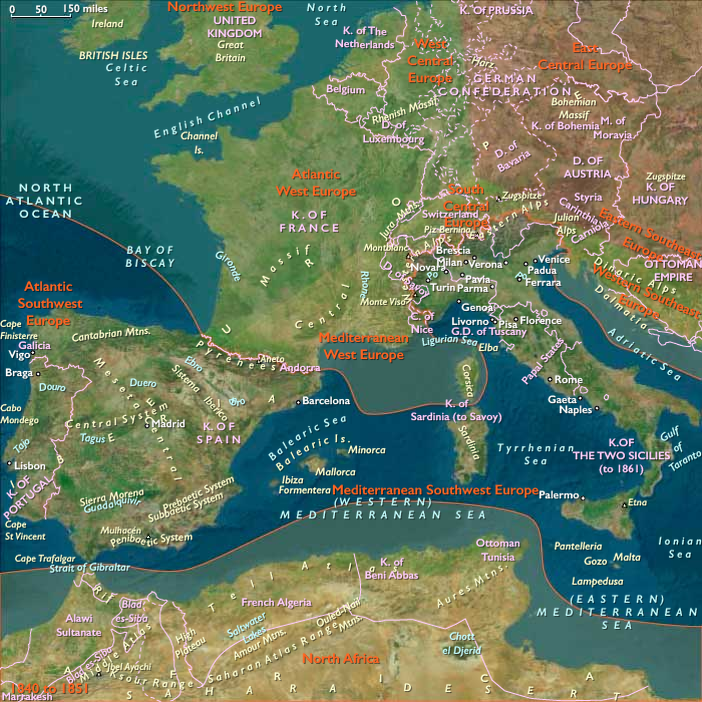
The Spanish army’s displeasure at regent Maria Cristina’s attempts to overturn the constitution of 1837 results in her exile in 1840.
The Spanish civil war that ended in 1839 had lasted over seven years, the fighting spanning most of the country at one time or another, although the main conflict had centered on the Carlist homelands of the Basque Country and Aragon.
This first of the so-called Carlist Wars has left civilian politicians discredited, and generals have become the arbiters of politics not as intruders, as in 1814-20, but as part of the political machinery.
They have become the “swords” of the two main political groups.
The moderados, who are upper-middle-class oligarchic liberals fearful of democratic violence and upholders of the prerogatives of the crown, represent the conservative stream in liberalism.
Their rivals, the progresistas, are the heirs of the exaltados and represent a lower stratum of the middle class; the progresistas are prepared to use the discontent of the urban masses in order to bring pressure on the crown to give them office.
Their instrument is the Urban Militia.
General Baldomero Espartero, Prince of Vergara, had begun to dabble in politics in 1836; on his return to Madrid in 1840, he becomes head of the government and selects a cabinet of ministers who agree with his progressive ideas.
Espartero uses his military faction and his supporters among the younger progresista politicians and their artisan followers in the great cities to oust Maria Cristina, who in October resigns the regency rather than accept his program of reforms.
She departs for Paris.
Locations
People
Groups
Topics
Commodoties
Subjects
Regions
Subregions
Related Events
Showing 10 events out of 18028 total
Years: 1840 - 1840
October
Locations
People
Groups
Topics
Commodoties
Subjects
Regions
Subregions