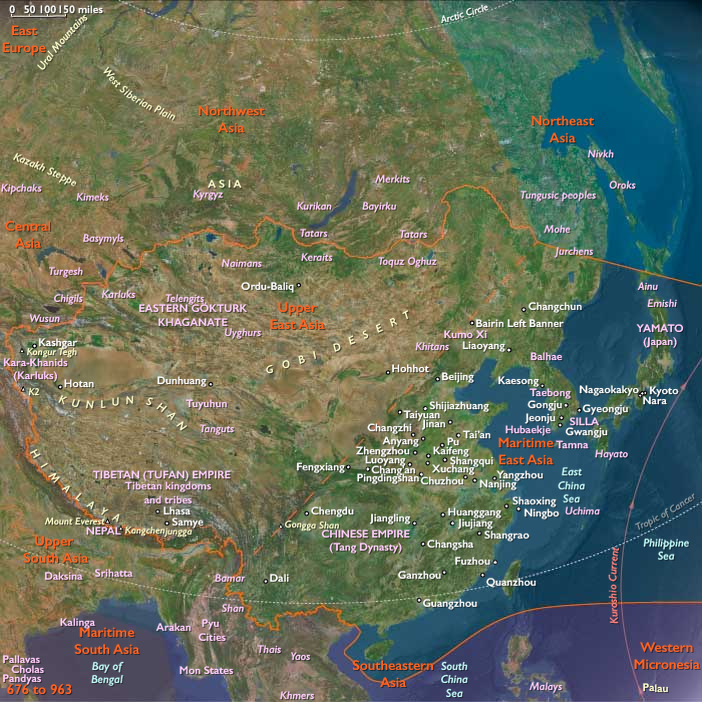
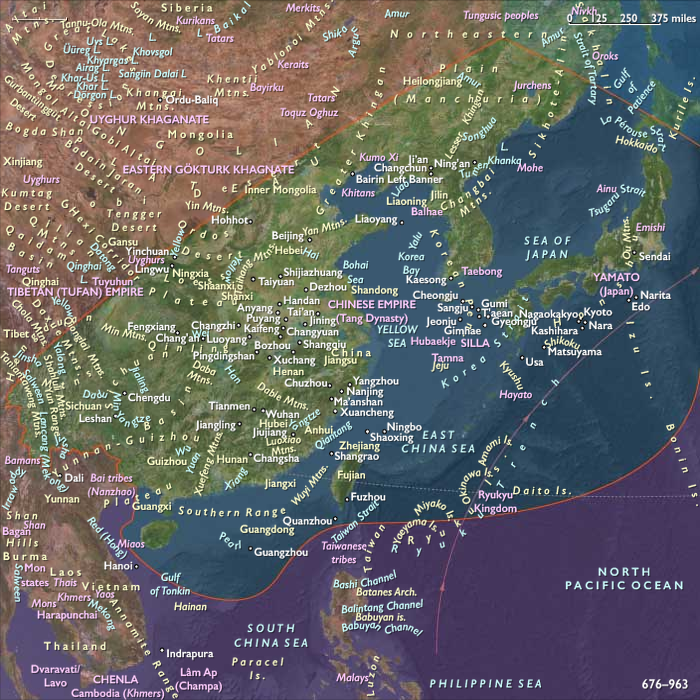
The Southern Tang kingdom is established at …
Years: 937 - 937
The Southern Tang kingdom is established at Nanjing in 937.
Locations
Groups
Topics
Commodoties
Subjects
Regions
Subregions
Related Events
Filter results
Showing 10 events out of 53092 total
The Wu State is taken from within by Li Bian, who then founds the Southern Tang Kingdom.
Yelu Bei, elder brother of the Liao Dynasty emperor, is murdered by the Later Tang Dynasty.
Abu Abdollah Jafar Rudaki, born in 858 in Rudak (Panjrud), a village located in Panjakent, located in the Samanid Empire in modern day Tajikistan.
Even though most of his biographers assert that he was completely blind, some early biographers are silent about this or do not mention him as being born blind.
His accurate knowledge and description of colors, as evident in his poetry, renders this assertion very doubtful.
He has become court poet to Nasr II in Bukhara, ruler of Khorasan and Transoxiana, the fame of his accomplishments early in his life, having reached the ear of the Samanid amir.
Rudaki had become his daily companion, amassed great wealth, and garnered high honors.
Generally regarded as the first major poet of the Islamic period, the prodigious Rudaki produces lyrics, panegyrics, and narrative poems (of which about a thousand lines survive).
It is claimed that he well deserved the title of the father of Persian literature, or the Adam or the Sultan of poets even though he had various predecessors, because he was the first who impressed upon every form of epic, lyric and didactic poetry its peculiar stamp and its individual character.
He is also said to have been the founder of the diwan, or the typical form of the complete collection of a poet's lyrical compositions in a more or less alphabetical order, which all Persian writers use even today.
He was also a very adept singer and instrumentalist (chang).
Rudaki eventually falls out of favor in 937; his life will end in poverty.

The town of Magdeburg, founded by Charlemagne in 805 as Magadoburg (probably from Old High German magado for big, mighty and burga for fortress'), has been fortified in 919 by King Henry I the Fowler against the Magyars and Slavs.
The city had gone to Edward the Elder's daughter Edith in 929 through her marriage to Henry's son Otto I, as a Morgengabe—a Germanic customary gift received by the new bride from the groom and his family after the wedding night.
Edith loves the town and often lives there; at her death she will be buried in the crypt of the Benedictine abbey of Saint Maurice, later rebuilt as the cathedral.
In 937, Magdeburg is the seat of a royal assembly.
Arnulf dies in Regensburg in 937 and is buried at St. Emmeram's Abbey.
Many believe Arnulf was married to Judith of Friuli, daughter of Count Eberhard of Friuli and Gisela of Verona.
The dates, however, do not match up.
Judith of Friuli died around 881.
This would have made a marriage between a boy (or at least young) Arnulf and an elder Judith, who was supposed to have produced several children twenty-three years or so after her death.
More likely, therefore, is that he was married to Judith of Sulichgau (born in about 888), daughter of Eberhard of Sulichgau.
Arnulf's eldest daughter, Judith, will in 948 marry Henry, the second son of the German King Henry the Fowler and his wife Matilda, and through this marriage the Duchy of Bavaria will enter the growing Kingdom of Germany.
Otto further offends the nobility in 937 through his appointment of Gero to succeed his older brother, Siegfried, as Count and Margrave of a border region abutting the Wends on the lower Saale.
His decision frustrates Thankmar, Otto's half-brother and Siegfried's cousin, who feels that he holds a greater right to the appointment.
The Ikhshidids are an Egyptian-based dynasty of Sogdian origins, whose founder, a Turkic slave soldier named Muhammad bin Tughj Al-Ikhshid, had been installed in 935 by the Abbasid Caliph, giving him and his descendants the Wilayah for thirty years.
Two years later, he obtains from the 'Abbasid caliph ar-Radi the title ikhshid (Persian: princely title in the area of Osrūshana, which he considers his land of origin), the name he gives to his dynasty, hence the last term in his name.
This title allows him to rule somewhat independently of the Caliphate.
Abd ar-Rahman conquers some thirty castles in León in 937.
He next turns to Muhammad ibn Hashim at-Tugib, governor of Zaragoza, who had allied with Ramiro but is pardoned after the capture of his city.
Alan Barbetorte Reclaims Brittany: The Retaking of Nantes (937)
Alan II Barbetorte ("Twisted-Beard"), the exiled Breton leader, successfully reclaims Nantes in 937, marking a turning point in the reconquest of Brittany from Viking rule. Having spent years in exile in England, Alan returns with military support from King Æthelstan, leading a Breton invasion to restore his ancestral homeland.
Alan Barbetorte’s Exile and Return to Brittany
- After Viking forces, led by Rognvald, conquered Brittany in 919, Alan fled to England, where he was given refuge at the court of King Æthelstan.
- He remained in exile for nearly two decades, waiting for the opportunity to reclaim his duchy.
- In 936, with Æthelstan’s backing, Alan returns to Brittany with a fleet and a well-trained army, beginning the Breton Reconquest.
The Battle for Nantes (937)
- Nantes had been a Viking stronghold for nearly two decades, serving as their capital in Brittany.
- Alan’s Breton forces engage the Norse occupiers in a fierce battle, using guerrilla tactics, cavalry raids, and knowledge of the terrain to their advantage.
- After intense fighting, Alan emerges victorious, and the Vikings lose control of the city.
- The victory at Nantes symbolizes the resurgence of Breton rule and inspires further resistance against Viking occupiers in Brittany.
Impact of Alan Barbetorte’s Victory
-
End of Viking Rule in Brittany Begins
- The fall of Nantes weakens Norse control over the region, marking the beginning of the end of Viking occupation in Brittany.
-
Brittany is Reclaimed as an Independent Duchy
- Alan’s victory allows him to establish himself as Duke of Brittany, restoring Breton sovereignty.
- His rule solidifies Breton independence from both Normandy and West Francia.
-
Continued Breton Resistance
- The war against the Vikings is not over, but Alan’s leadership ensures that Breton forces continue pushing them out of the region.
- Over the next few years, Alan systematically expels Norse forces, securing complete control over Brittany.
Conclusion: The Restoration of Breton Rule
Alan Barbetorte’s victory at Nantes in 937 marks the beginning of the full Breton Reconquest, leading to the reestablishment of Brittany as a powerful independent duchy. Having successfully defeated the Vikings, Alan’s rule ensures that Brittany remains free from Norse domination, paving the way for its continued cultural and political autonomy in medieval Europe.
William III of Aquitaine: A Struggle for Recognition and Power (935–962)
William III of Aquitaine, son of Ebalus Manzer and Emilienne, was born in Poitiers and inherited his father’s claim to the Duchy of Aquitaine in 935. However, despite his effective rule over the region, his ducal title was not formally recognized by the royal chancery until 962, just a year before his death.
William’s Claim to Aquitaine (935)
- Upon the death of Ebalus Manzer in 935, William asserts control over Aquitaine, though West Frankish royal authority remains weak in the south.
- However, his rule is not immediately recognized by the royal chancery, likely due to ongoing power struggles between the monarchy and feudal lords.
Conflict with Hugh the Great (936)
- Following the death of King Rudolph in 936, the new king, Louis IV (d'Outremer), begins asserting royal authority over feudal lords.
- Under pressure from Hugh the Great, one of the most powerful nobles in West Francia, Louis compels William to forfeit some lands to Hugh.
- Though William yields without open conflict, this act sours relations between him and Hugh, leading to continued tension.
William’s Long Struggle for Ducal Recognition
- Despite ruling as Duke of Aquitaine in practice, William’s ducal title is not officially recognized by the monarchy until 962, almost three decades later.
- This reflects the fragmentation of West Francia, where regional rulers exercised real power but lacked immediate royal validation.
Consequences of William’s Rule
-
Aquitaine Remains Semi-Independent
- Even without immediate royal recognition, William’s rule ensures that Aquitaine remains autonomous from the central monarchy.
-
Tensions with the Robertians
- His deteriorating relations with Hugh the Great and his successors underscore the struggle between regional lords and the West Frankish monarchy.
-
Feudal Decentralization Continues
- William’s delayed ducal recognition shows the declining influence of the Carolingian kings, as nobles increasingly govern independently of royal authority.
Conclusion: A Duke in All But Name
William III of Aquitaine’s claim to power in 935 and his belated recognition in 962 illustrate the political reality of feudal France, where noble power outweighed royal legitimacy. His struggles against Hugh the Great and the monarchy exemplify the shift toward regional autonomy, setting the stage for Aquitaine’s continued prominence in medieval France.