The Song dynasty’s capital city of Kaifeng …
Years: 1021 - 1021
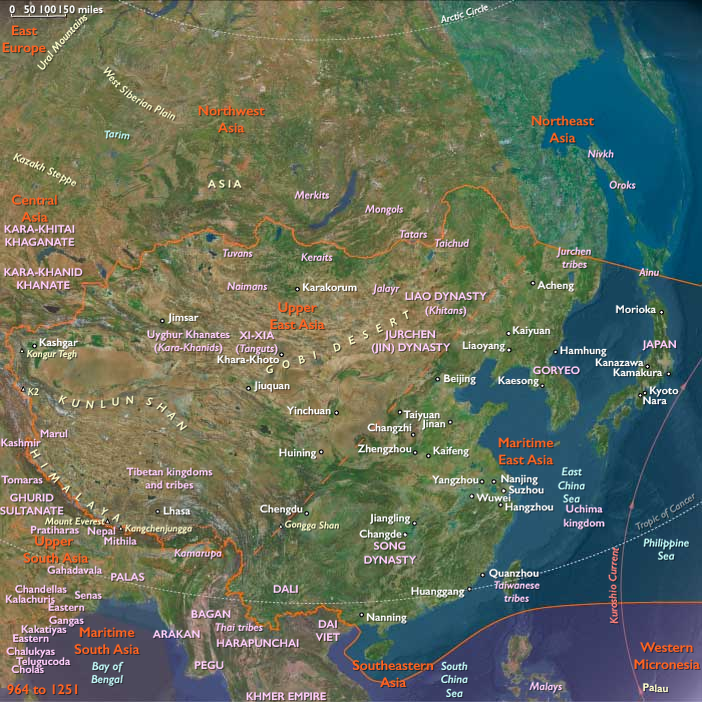
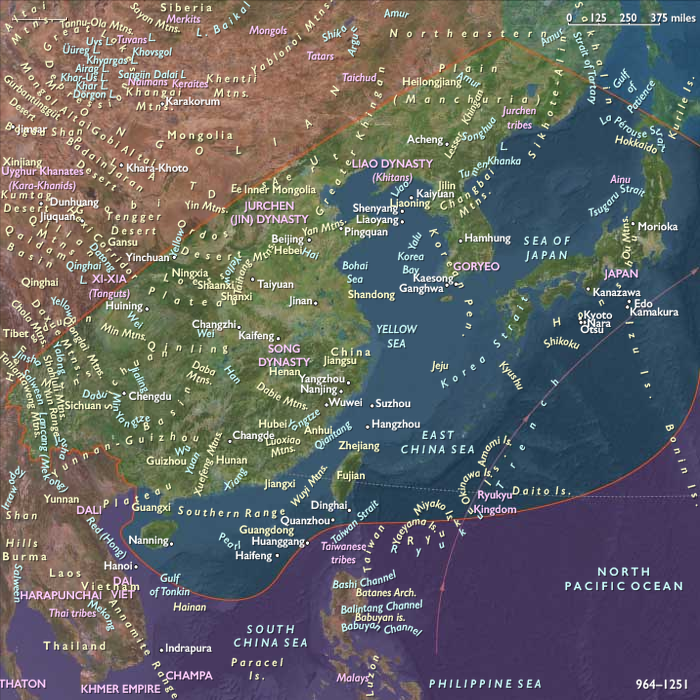
The Song dynasty’s capital city of Kaifeng has some half a million residents by this year; including all those present in the nine designated suburbs, the population is over a million people.
The Song dynasty military has one million registered soldiers, an increase since the turn of the eleventh century, when the Song military only had nine hundred thousand soldiers.
Locations
Groups
Subjects
Regions
Subregions
Related Events
Filter results
Showing 10 events out of 51668 total
The kingdom of Vaspurakan had been divided in 968 on the death of Abusahl-Hamazasp among his three sons, and Ashot-Sahak, as the eldest, had retained the royal title and the suzerainty over his younger brothers.
On his death, royal power had been usurped by the second son, Gurgen-Khachik, who had reigned as King of Vaspurakan until his own death in 1003.
At that point, Hovhannes-Seneqerim, the third son, also withheld power from his nephews and crowned himself king.
His authority is weak, as the result of the successive usurpations, and his realm has been increasingly threatened by Turkmen attacks.
He therefore appeals to the protection of the emperor Basil II, and in 1021 he hands over his entire kingdom in exchange for vast domains in Sebasteia, where he and fourteen thousand of his retainers settle.
The Kingdom of Vaspurakan becomes the imperial theme of Vasprakania or Media.
Abu Shuja had lived in Baghdad during his youth with his father, Baha' al-Dawla.
Shortly before Baha' al-Dawla's death in 1012, he had named Abu Shuja as his successor.
Upon succeeding his father, he had taken the title Sultan al-Dawla wa 'Izz al-Milla ("Power of the Dynasty and Glory of the Community").
Traveling to his father's capital in Shiraz, he did seek for the traditional investiture by the Abbasid caliph, but instead had the required materials sent to him.
He had entrusted his oldest brothers Jalal al-Dawla and Qawam al-Dawla with the governorships of Iraq and Kerman, respectively.
He stayed in Persia for a long time; when he returned to Iraq three years later, he only went to Ahvaz to meet with his governor.
Sultan al-Dawla had again come to Iraq in 1018, in an attempt to maintain friendly terms with the neighboring Amirate of Mosul.
Qawam al-Dawla, taking advantage of his brother's presence in the west, had invaded Fars with the support of the Ghaznavids.
The attack had failed, but Qawam al-Dawla's marks the division of the Buyid state.
After repulsing Qawam al-Dawla's attack, Sultan al-Dawla had returned to Iraq in order to solidify his rule there.
The marchlands of the region, which had long resisted Buyid authority, were finally subjugated.
The Turkish mercenaries, however, have become discontented over the presence Sultan al-Dawla's Daylamite troops.
They therefore raise a brother of the amir, Musharrif al-Dawla, as their ruler in 1021.
After a long series of negotiations, Sultan al-Dawla recognizes his brother as "King of Iraq", in exchange for the latter's submission as a vassal.
Sultan al-Dawla, however, wantsto retain direct rule over the region, and he invades with his army.
His defeat by Musharrif al-Dawla's forces puts an end to this plan, and Iraq becomes fully independent.
The concept of the senior amir temporarily dies; each region of the Buyid state is now ruled independently of one another.
Musharrif al-Dawla hereafter will consider himself as Sultan al-Dawla's equal and assumes the title of "Shahanshah".
For the rest of his reign, he will be forced to placate the troops that had brought him to power.

Mahmud founds the Great Mosque at Ghazni, capital of the Ghaznavid Empire, in 1021.
Sultan Mahmud appoints Malik Ayaz to the throne of Lahore in 1021 and makes the city the capital of the Ghaznavid Empire.
As the first Muslim governor of Lahore, Ayaz begins rebuilding and repopulating the city.
Institutionalized prostitution has been extant in India since classical Hindu times—lay prostitutes are a recognized caste.
As the Koran forbids prostitution, the Muslim invasions of India result in official pronouncements against both secular and sacred prostitution.
Actual practices under Muslim rule, however, do little to discourage it; temple prostitution, in which girls are dedicated to a deity, continues.
Mahipala extends Palan influence west to Benares (Varanasi) and south along India’s east coast, prompting the Cholas to initiate a military campaign against the Palas in 1021.
The Cholas, who have intermittently invaded Chalukyan territories in the southern and western Deccan since 990, cease these ultimately fruitless incursions in 1021.
Al-Hakim's administration is tolerant at times.
During famines, he distributes food and tries to stabilize prices.
He also founds mosques and patronizes scholars and poets.
Al-Hakim, who is already accorded the position of imam, a divinely appointed and authoritative spokesman for Islam, had begun in 1017 to encourage the teachings of some Isma'ili missionaries.
His house arrest ended, he will write scores of other treatises on physics, astronomy and mathematics.
He will later travel to Islamic Spain.
During this period, he will have ample time for his scientific pursuits, which include optics, mathematics, physics, medicine, and practical experiments
Born around 965 in Basra, which was at that time part of the Buyid emirate, to an Arab family, Ibn al-Haytham had been educated there and in Baghdad, the capital of the Abbasid Caliphate.
During his time in Basra he had trained for government work and became Minister for the area.
One account of his career has him called to Egypt by Al-Hakim bi-Amr Allah, ruler of the Fatimid Caliphate, to regulate the flooding of the Nile, a task requiring an early attempt at building a dam at the present site of the Aswan Dam.
After deciding the scheme was impractical and fearing the caliph's anger, he had feigned madness, hence his decade-long confinement.
Al-Hakim claims to be the embodiment of the Godhead—a state beyond name and beyond good and evil, the final maqam (Arabic, “location”) or incarnation of God.
This act establishes the Druse (or Druze) religion, named for al-Hakim's first missionary, Muhammad ibn Isma'il ad-Darazi, who wins many converts in Syria and Lebanon.
Al-Darazi's rival Hamzah ibn 'Ali Ibn Ahmad, however, becomes the Druses' first imam.
Considerable resistance to the new doctrines appears, and when ad-Darazi publicly proclaims the doctrine in the principal mosque of Cairo, rioting ensues that quite probably leads to his own death in 1019.