
The son of the Kohen Gadol (high …
Years: 66 - 66
The son of the Kohen Gadol (high priest) Eliezar ben Hanania, in reaction, ceases prayers and sacrifices for the Roman Emperor at the Temple.
Protests over taxation join the list of grievances and random attacks on Roman citizens and perceived 'traitors' occur in Jerusalem.
Joseph returns to Jerusalem on the eve of a general revolt against Roman rule.
Florus further angers the Jewish population of his province by having seventeen talents removed from the treasury of the Temple in Jerusalem, claiming the money is for the Emperor.
In response to this action, the city falls into unrest and some of the Jewish population begins to openly mock Florus by passing a basket around to collect money as if Florus were poor.
Florus reacts to the unrest by sending soldiers into Jerusalem the next day to raid the city and arrest a number of the city leaders.
The arrested individuals are whipped and crucified despite many of them being Roman citizens.
The pro-Roman king Agrippa II has expended large sums in beautifying Jerusalem and other cities, especially Berytus.
His partiality for the latter has rendered him unpopular among his own subjects, and the capricious manner in which he has appointed and deposed the high priests make him disliked by the Jews.
Agrippa fails to prevent his subjects from rebelling, and urges instead that they tolerate the behavior of the Florus.
But in 66 the Jews expels him and his sister Berenice, who, fearing the worst, flee to Galilee.
Urged on by the fanatical Zealots, the Jews oust Florus and set up a revolutionary government in Jerusalem that extends its influence throughout the whole country.
Along with many others of the priestly class, Joseph counsels compromise but is drawn reluctantly into the rebellion.
Cestius Gallus, the legate of Syria, brings a legion, the XII Fulminata, and auxiliary troops as reinforcements to restore order.
All available troops in autumn 66 are mustered, formed into a column and sent to confront the rebellion’s perceived center.
Ideally, such a show of force would have allowed the Romans to regain the initiative and prevent the rebellion from developing and growing stronger.
Gallus conquers Bezetha, in the Jezreel Valley, soon to be the seat of the Great Sanhedrin (Jewish supreme religious court), but is unable to take The Temple Mount.
The Roman forces invest Jerusalem, then for uncertain reasons, withdraw back towards the coast, closely pursued by rebel scouts.
Locations
People
- Agrippa II
- Berenice of Cilicia (daughter of Herod Agrippa I)
- Cestius Gallus
- Gessius Florus
- Josephus
- Nero
Groups
- Polytheism (“paganism”)
- Jews
- Greeks, Hellenistic
- Galilee, Roman province of
- Judea (Roman province)
- Zealots
- Roman Empire (Rome): Julio-Claudian dynasty
Topics
Commodoties
Subjects
Regions
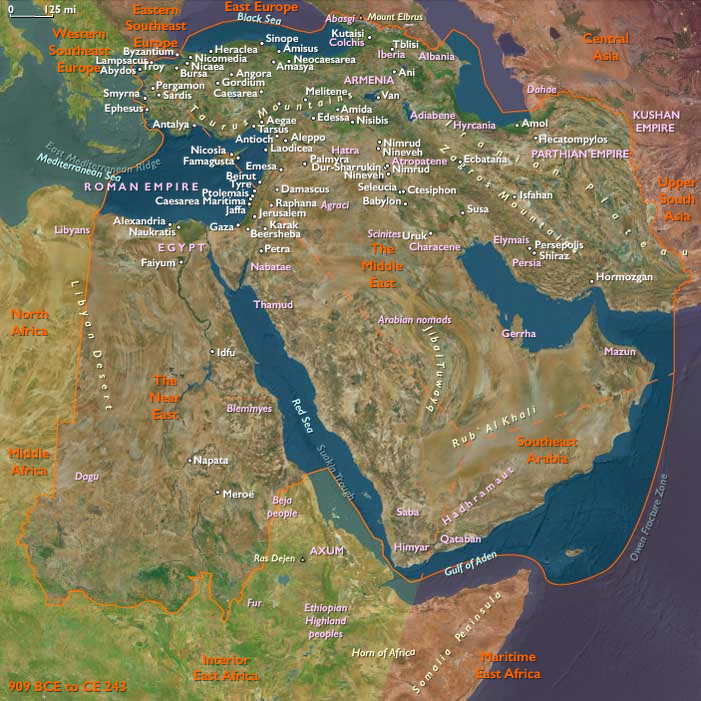
Subregions
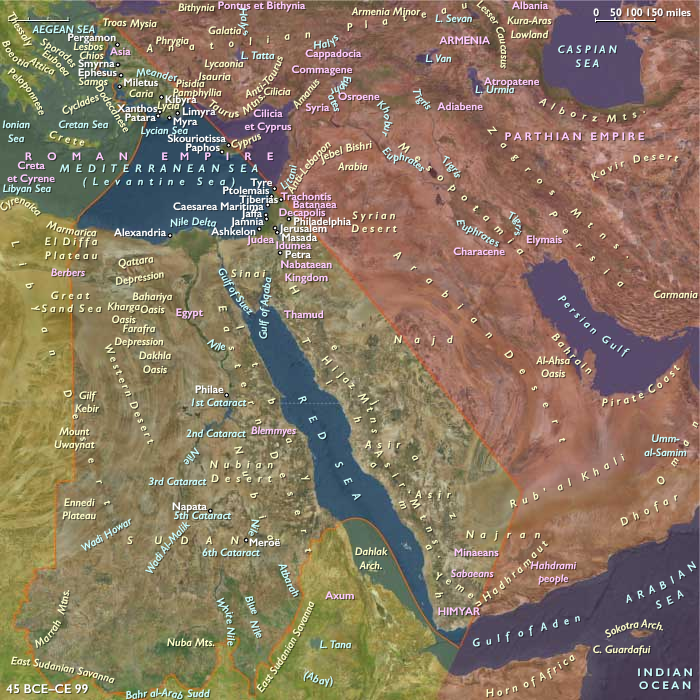
Related Events
Showing 1 events out of 1 total
Years: 66 - 66
Locations
People
- Agrippa II
- Berenice of Cilicia (daughter of Herod Agrippa I)
- Cestius Gallus
- Gessius Florus
- Josephus
- Nero
Groups
- Polytheism (“paganism”)
- Jews
- Greeks, Hellenistic
- Galilee, Roman province of
- Judea (Roman province)
- Zealots
- Roman Empire (Rome): Julio-Claudian dynasty
Topics
Commodoties
Subjects
Regions
Subregions